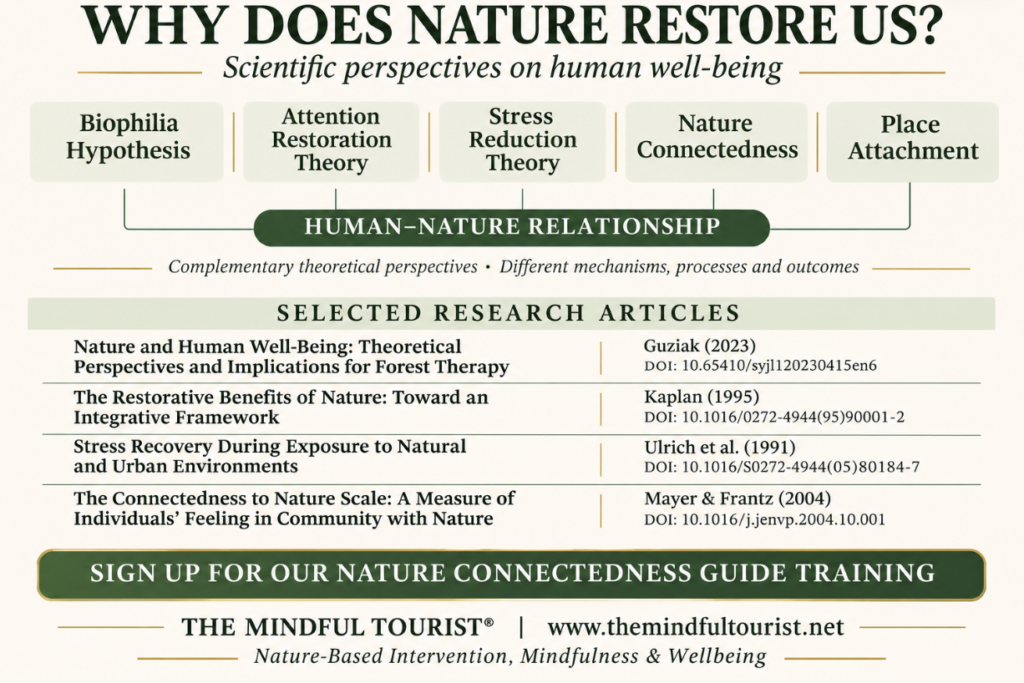
Why Does Nature Restore Us?
Exploring the scientific theories behind human well-being, environmental restoration, and our relationship with the natural world.
Nature and the human organism
Why might natural environments influence attention, emotion, physiological regulation, and psychological well-being?
Research increasingly suggests that contact with natural environments can support aspects of human well-being. Yet explaining why these effects occur remains a complex scientific question.
Environmental psychology, cognitive science, evolutionary biology, and psychophysiology have each contributed theoretical explanations for human responses to natural environments.
Some frameworks focus on evolutionary relationships with living organisms. Others investigate cognitive restoration, emotional and physiological responses, or the psychological significance of particular places.
These perspectives are related, but they do not necessarily describe identical processes or outcomes.
Is the presence of nature sufficient to explain restoration, or does the way we experience an environment also matter?
Understanding the human–nature relationship requires attention to both environmental characteristics and individual experiences.
Five perspectives on nature and well-being
Scientific theories offer distinct approaches to understanding why natural environments may influence human functioning. The complete article examines these frameworks, their evidence, and their relationships in greater depth.
The Biophilia Hypothesis
Could the human relationship with living organisms reflect evolutionary predispositions shaped over time?
Attention Restoration Theory
Why might natural environments support recovery from mentally demanding activities?
Stress Reduction Theory
How might exposure to certain natural settings influence emotional and physiological stress responses?
Nature Connectedness & Relatedness
Does the perceived relationship between a person and the natural world influence well-being?
Favorite Places & Place Attachment
Why do particular environments become personally meaningful and potentially restorative?
Restoration is not a single outcome
The phrase "nature is good for us" is frequently used to describe a broad range of psychological and physiological observations.
However, changes in cognitive performance, subjective emotion, physiological stress indicators, and perceived nature connectedness concern different constructs.
Distinguishing between them is essential when interpreting empirical studies and evaluating claims about nature-based interventions.
It is equally important to recognise that findings may vary according to the population studied, environmental conditions, exposure duration, and methods of measurement.
Different scientific questions
How does exposure influence cognitive attention?
What changes occur in emotional and physiological stress responses?
How does perceived nature connectedness relate to well-being?
What significance do familiarity and attachment to place hold?
How can these perspectives inform the interpretation of forest therapy research?
What does this mean for Shinrin-Yoku and Forest Therapy?
Shinrin-Yoku, Forest Bathing, and Forest Therapy offer a practical context in which questions about environmental restoration and human–nature relationships become particularly relevant.
Guided encounters involve interactions between the characteristics of an environment, individual perceptions, sensory experience, and the circumstances of participation.
Understanding these interactions requires more than identifying positive outcomes. It also requires critical consideration of how different theoretical explanations relate to practice.
My full article examines these relationships and considers their implications for scientifically informed and responsible guided forest therapy.
Nature and Human Well-Being: Theoretical Perspectives and Implications for Forest Therapy
This research article examines influential theoretical frameworks concerning human responses to natural environments and explores their relationships and relevance to Shinrin-Yoku and forest therapy.
The complete publication provides the detailed scientific discussion, evidence, critical considerations, and implications for practice.