Living with Nature | Luján de Cuyo, Mendoza, Argentina
For the past year, the stones scattered across the arid landscape of Luján de Cuyo, at the foothills of the Andes, have repeatedly invited me to reflect on my journey as a human being, a mindful tourist, and a small part of this vast universe.
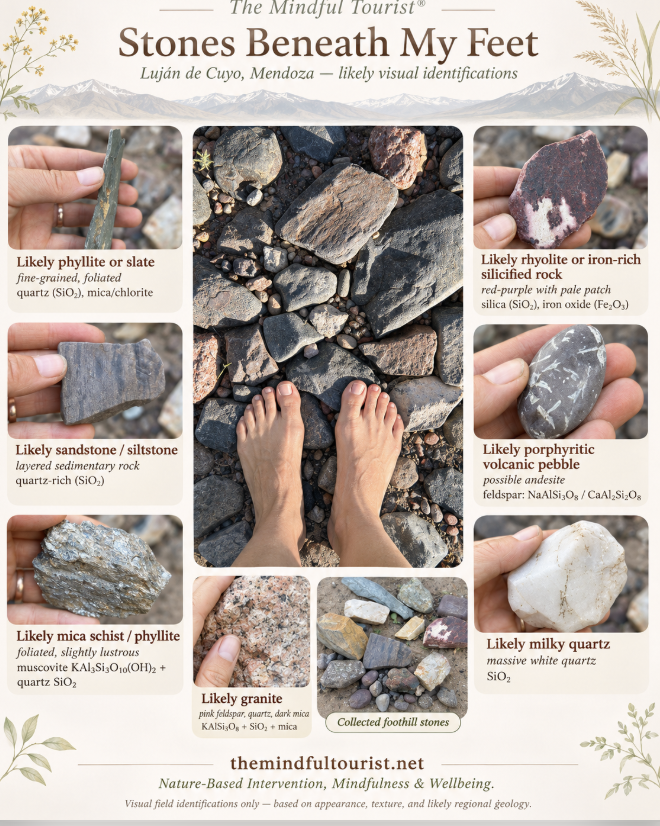
The terrain remains unfamiliar to me, although I have been learning about its vegetation, wildlife, climate, and soil. Almost every day, as I work in the garden, I encounter stones of different sizes, shapes, textures, colours, and mineral compositions. Some are small enough to disappear between my fingers. Others require considerable effort to lift. Some are rounded and smooth, while others possess sharp edges and irregular surfaces. There are pale grey stones, reddish and brown rocks, almost white fragments, and darker pieces that seem to absorb the intense summer sunlight.
At first, they were mostly obstacles.
I wanted to cultivate the ground, establish plants, create a nature-connected path, and make the land more welcoming to walk through. This required moving an enormous number of stones, some of which had to be dug out from beneath the surface. But something happened during this repetitive physical work. As I lifted them, turned them over, and felt their different surfaces with my bare hands, I began to pause.
Where had these stones come from? How old were they? What geological processes had brought them to this particular place? And how did their existence relate to my own brief existence on Earth?
The Andes: a mountain range born from movement
The Andes extend for approximately 7,000 kilometres along the western edge of South America, from the northern part of the continent towards its southernmost regions. Their formation is inseparable from the continuous movement of Earth’s tectonic plates. Far beneath the Pacific Ocean, the oceanic Nazca Plate moves towards the South American Plate. Because the oceanic plate is denser, it descends beneath the continental plate through a process known as subduction. The boundary of this movement is marked by the Peru–Chile Trench, also known as the Atacama Trench, an enormous depression in the floor of the Pacific Ocean.
Over millions of years, these tectonic interactions have compressed, folded, fractured, and uplifted the continental crust, contributing to the formation and evolution of the Andes. This process has also been associated with earthquakes, volcanic activity, and the creation of numerous geological formations. The mountains are therefore not static monuments. They are the visible expressions of a planet that continues to move.
The landscape that appears so solid and permanent from where I stand is itself the result of immense changes, and those changes have not entirely ceased. When I contemplate this, my own experience of time suddenly feels very different. I have been working with this land for approximately one year. The processes responsible for forming the mountains have unfolded over tens of millions of years. And the Earth itself is approximately 4.54 billion years old. What is one year within such an extraordinary history?
Before the world looked as it does today: continents in motion
As I hold a stone in my hand and look towards the Andes, I sometimes try to imagine how different the Earth must have looked millions of years ago. The continents we recognise on today’s maps have not always occupied their present positions. The familiar outlines of South America, Africa, Europe, Antarctica, Australia, and the other continental landmasses are not permanent features of our planet. They have moved, separated, collided, and changed their shapes over immense periods of geological time. Between approximately 300 and 200 million years ago, the continents formed a vast supercontinent known as Pangaea. What we now recognise as separate lands, divided by enormous oceans, once formed a connected landmass.
South America and Africa, for instance, were once joined as part of the southern supercontinent Gondwana. Their coastlines still suggest something of that former connection, although the stronger scientific evidence comes from matching rock formations, fossils, and ancient geological structures found on opposite sides of the Atlantic. As tectonic forces gradually pulled the continental plates apart, the Earth’s crust fractured and new oceanic crust formed along spreading centres. The Atlantic Ocean began to open and widen. South America and Africa moved away from one another, and the distance between them continued to increase over millions of years.
At the same time, other continents changed their positions. India travelled northwards and eventually collided with Eurasia, contributing to the formation of the Himalayas. Antarctica became increasingly isolated, while Australia separated from it and moved northwards. The world map that seems so familiar to us today is therefore only a representation of one particular moment in Earth’s geological history. It is not a final arrangement. The continents continue to move, generally at rates of a few centimetres per year. Oceans may widen or narrow, new mountain ranges may form, and existing landscapes will continue to evolve.
I find this extraordinary.
When I look at a modern map, I see clearly defined continents, oceans, borders, and countries. Everything appears fixed, as though the world has always been organised in this way. Yet geological history reveals something entirely different. The land beneath our feet is moving, even when we cannot perceive that movement. The mountains are changing, even when they appear motionless. And the oceans that separate us today have not always existed in their present forms.
It makes me wonder how easily we confuse the temporary appearance of something with its permanence. Yet another limitation of human perception… We observe the world within the timescale of our own lives and assume that what remains relatively unchanged during those years must somehow be permanent. Yet even the continents are only temporary arrangements within the continuing evolution of Earth.
Tupungato: the mountain that appears and disappears
From where I live, I can see Tupungato on many days. This imposing volcanic mountain rises to approximately 6,570 metres above sea level and belongs to the high Andes along the border between Argentina and Chile. It is a volcano of the Pleistocene, a reminder of the region’s geological past. Nearby lies the younger Tupungatito volcanic complex, which has experienced eruptions within recorded history. Sometimes Tupungato appears exceptionally clear. Its slopes and ridges become visible against the blue sky, while the snow and ice covering parts of its upper elevations seem almost luminous.
At other times, clouds gather around the mountain. They slowly conceal its summit, then its slopes, until the entire mountain disappears into their soft, shifting forms. There are moments when it looks as though Tupungato no longer exists. And yet, nothing has happened to the mountain itself. It remains where it was. Only the conditions of my perception have changed.
I have also noticed something remarkably familiar about the texture of the surrounding Andes. From a distance, some of the ridges appear folded and creased, almost like sheets of paper that have been crumpled and then unfolded. They remind me of the paper my mother used to wrap the breakfast I took to school when I was a child. It is a small and rather unexpected memory. An immense mountain range, created through geological processes extending over millions of years, brings back the image of my mother’s hands preparing something for me to take to school. The scale of these two experiences could hardly be more different. And yet, through observation, they become connected.
One of the extraordinary capacities of human consciousness is to find relationships between experiences separated by enormous distances in space, time, and meaning.
The stones as fragments of geological history
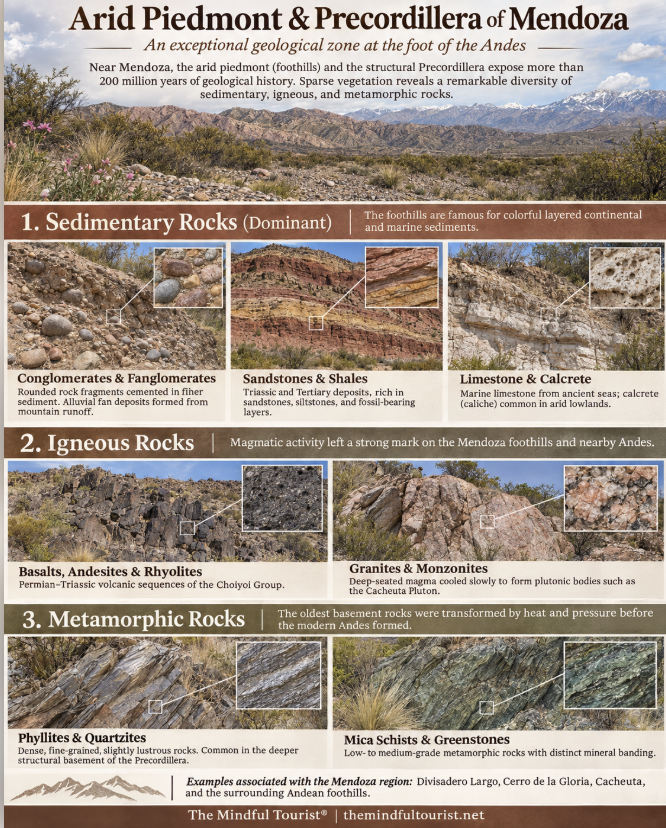
The stones scattered across this terrain are not necessarily pieces that have fallen directly from the mountains I see today. Many have been transported over long periods by rivers, temporary watercourses, floods, erosion, and gravity. The foothills of Mendoza contain extensive alluvial deposits, where materials originating from different geological formations accumulate. The Mendoza River and numerous smaller drainage systems have played important roles in transporting rock fragments towards lower elevations. Large blocks gradually break into smaller fragments. Their edges may become rounded through collisions and abrasion during transportation. Over time, some fragments become gravel, sand, silt, and eventually even finer mineral particles. The stones I hold may therefore belong to different geological histories. Some may originate from volcanic rocks formed when magma cooled and solidified. Others may come from ancient sedimentary formations created through the accumulation and consolidation of particles. Still others may have undergone metamorphism, their mineral structures altered by heat and pressure deep within Earth’s crust. The surrounding region contains granitic and granodioritic rocks, volcanic formations, sandstone, conglomerate, limestone, and various metamorphic rocks. Different minerals contribute to their colours and textures. Quartz, composed of silicon dioxide, can produce pale or translucent areas. Feldspars, a large group of aluminium-containing silicate minerals, may contribute white, pink, or grey tones. Iron-bearing minerals can produce reddish, brown, or darker colours, particularly as they undergo oxidation. Other rocks contain minerals rich in calcium, magnesium, potassium, or additional elements. Of course, their appearance alone is not sufficient to identify them precisely. But knowing that such diversity exists changes the way I look at every stone. Each one is more than an object occupying space. It is a material expression of Earth’s history.
A closer look at the rocks and their chemical composition
My background in chemistry makes me particularly curious about another aspect of these stones: their chemical composition. The rocks around Luján de Cuyo and the nearby Andes may contain numerous minerals, each possessing a particular chemical structure and composition. Most rocks are mixtures of several minerals rather than single chemical substances. Consequently, a rock such as granite or basalt does not have one fixed empirical formula. However, many of the minerals that compose these rocks can be described using chemical formulas expressing their elemental proportions.
The following table presents rock types documented in the wider Mendoza Andean region, their characteristic mineral constituents, and representative chemical formulas.
| Rock type | Principal minerals or components | Representative mineral formulas |
|---|
| Granite and granodiorite | Quartz, potassium feldspar, plagioclase and mica | Quartz: SiO₂; orthoclase: KAlSi₃O₈; albite: NaAlSi₃O₈ |
| Andesite | Plagioclase feldspar, amphibole and pyroxene | Albite: NaAlSi₃O₈; anorthite: CaAl₂Si₂O₈; diopside: CaMgSi₂O₆ |
| Basalt | Calcium-rich plagioclase, pyroxene and sometimes olivine | Anorthite: CaAl₂Si₂O₈; diopside: CaMgSi₂O₆; forsterite: Mg₂SiO₄ |
| Sandstone | Sand-sized grains, often quartz and feldspar, joined by natural mineral cement | Quartz: SiO₂; orthoclase: KAlSi₃O₈; calcite cement: CaCO₃ |
| Conglomerate | Rounded fragments of several rock types, held together by a finer matrix or cement | Variable; may contain SiO₂, CaCO₃ and numerous silicate minerals |
| Limestone | Predominantly calcite, sometimes with dolomite and other minerals | Calcite: CaCO₃; dolomite: CaMg(CO₃)₂ |
| Metamorphic rocks | Depending on the rock: quartz, feldspar, mica and other recrystallised minerals | Quartz: SiO₂; muscovite: KAl₃Si₃O₁₀(OH)₂ |
| Iron-rich mineral fragments | Iron oxides that may contribute reddish, brown or dark colours | Hematite: Fe₂O₃; magnetite: Fe₃O₄ |
Scientific note: These are representative mineral formulas, not chemical formulas for entire rock types. Minerals such as quartz and calcite have relatively well-defined compositions. Others, including feldspars, pyroxenes and amphiboles, form solid-solution series in which certain elements can substitute for one another. The listed formulas therefore represent particular minerals or idealised end-member compositions. The presence of a rock type in the wider region does not establish that it occurs on my land.
What fascinates me is that elements such as silicon, oxygen, aluminium, iron, calcium, magnesium, sodium, and potassium, arranged in different proportions and crystalline structures, produce such an extraordinary variety of materials. Two stones of similar colour may possess entirely different chemical compositions. Others may contain similar minerals but have formed under very different conditions.
The properties I experience through touch—hardness, texture, weight, and the way a stone fractures—are connected to its mineral composition, structure, and geological history. What appears to my eyes as an ordinary stone is, at another level, an arrangement of atoms connected through chemical bonds. And those same chemical elements participate in the formation of the soil, the growth of plants, and the functioning of living organisms. The distinction between the mineral world and the living world begins to feel less absolute. Life depends upon chemical elements that circulate through the Earth’s geological and biological systems.
There is something remarkable about holding a stone and recognising that the same physical universe has produced both its crystalline structure and my capacity to examine it.
Working with my bare hands and feet
There is something deeply personal about touching these stones. During the past year, I have moved hundreds, perhaps thousands, of them while creating the paths and cultivating the garden. Sometimes the work has been physically demanding. The ground can be compacted, the stones unexpectedly large, and the summer heat exhausting. But I have also discovered moments of remarkable stillness within this work.
I pick up a stone. I feel its weight. I examine its irregular surface, its colour, its temperature, and the places where it has fractured or worn smooth. Sometimes I place it in my palm and simply look at it. At other times, I walk barefoot across the ground when conditions permit, feeling the differences between sand, fine gravel, compacted soil, and larger stones.
The experience brings my attention directly into the present moment. There is no need to imagine a connection with nature. The contact is already occurring. My skin meets the surface of the Earth. My body responds to its temperature, pressure, and texture. I begin to experience the land not only through sight, but through touch, movement, and physical effort. And somewhere within these encounters, I feel that I am becoming part of this landscape, just as the landscape is becoming part of my experience. We coexist, although on very different timescales.
I may live here for a few years or several decades. Many of these stones may remain long after I am gone. They will continue to be exposed to sunlight, wind, rain, temperature fluctuations, and the gradual processes of physical and chemical weathering. Some will fracture into smaller pieces. Others will become incorporated into new layers of sediment. Minerals may dissolve, transform, or contribute to the developing soil. And eventually, some of the rock fragments will become the sand that the summer winds carry across the garden, sometimes striking my face and bare skin with surprising force.
The stone that feels so permanent in my hand is also changing. Only its pace of change differs from mine.
For a long time, I considered the abundance of rocks in the garden a difficulty to overcome. I wanted to prepare the ground for native grasses, flowering plants, shrubs, and fruit trees. Removing stones seemed necessary to make room for roots and to create workable planting spaces. But as I learned more about desert ecosystems, I began to understand that stones also perform important functions. They influence how water moves across and through the soil. A natural covering of stones can protect the surface from the direct impact of rainfall, reduce the displacement of soil particles, and, under suitable conditions, slow surface runoff and encourage water infiltration. This is especially relevant in arid regions, where rainfall may be infrequent but occasionally intense.
Stones can also affect evaporation and soil temperature. Depending on their size, colour, arrangement, and exposure, they may help shade parts of the soil and reduce moisture loss. But they may also absorb considerable heat under the summer sun, creating warmer conditions around neighbouring plants. Their effects are therefore not universally beneficial or harmful. They depend on the particular conditions.
The same is true of their contribution to plant nutrition. As minerals slowly undergo chemical weathering, elements such as calcium, potassium, magnesium, and iron may enter the surrounding soil. Some eventually become available to plants, although the rate of release varies greatly and can be extremely slow in dry environments. A stone is not an immediate substitute for fertile soil. But rocks and minerals participate in the long-term development of soil, helping determine its physical and chemical properties.
I have also begun to notice how stones create small differences in the landscape. A larger rock may cast a little shade during part of the day. A small depression beside it may collect windblown organic material or retain moisture after rain. A crevice may provide temporary shelter for an insect or another small animal. A seed may become trapped between stones and eventually germinate when conditions are favourable.
The spaces between rocks are not necessarily empty. They can become small habitats within the larger ecosystem.
From obstacles to building materials
The stones have also become an important part of creating the nature-connectedness path and other path on the land. Rather than removing them entirely from the property, I have been using them to define walking routes, create borders, and organise different sections of the garden. Larger stones provide structure. Smaller fragments can be used along paths and around particular planting areas. Their variety of colours and textures contributes to an appearance that feels consistent with the surrounding desert.
There is something satisfying about using the material that already exists on the land. It reduces the need to bring in additional materials and allows the garden to retain some of its natural character.
I have also experimented with arranging stones around planting areas and along routes used by the black leaf-cutting ants that seem particularly interested in my fruit trees. Although stones may help organise and protect the physical structure of the garden, I have learned that they do not provide a dependable barrier against ants. The ants can often find their way around or across them. And even this observation has become part of my learning.
The stones that I arrange according to my intentions are experienced differently by the other organisms sharing this land. What is a border to me may simply be another surface to cross. What I consider an obstacle may provide shelter or become part of an animal’s route.
The landscape does not necessarily function according to the categories I impose upon it.
When familiarity makes us stop seeing
Perhaps one of the most important aspects of this experience is that my relationship with the stones has not remained constant. There are days when I feel strongly connected to them. I notice their colours, study their surfaces, and think about the geological processes responsible for their existence. At other times, I become absorbed in the practical work. I move them without paying much attention. I become tired. I want to finish preparing a particular area. And I almost forget that the objects I am handling have histories extending far beyond my own life.
This makes me reflect on something familiar in many human relationships. We may initially encounter something with curiosity, admiration, or wonder. But as it becomes familiar, our attention gradually diminishes. We begin to take its presence for granted.
The stones have not become less extraordinary. Only my attentiveness has changed.
The human journey within geological time
As I continue working with the soil and stones, I often return to the question of what it means to be human within this immense universe. We experience our lives through years, decades, memories, responsibilities, relationships, and expectations. We are deeply concerned with what happened yesterday and what may happen tomorrow. We build, cultivate, organise, and attempt to create some degree of permanence in a world that continuously changes. Yet the stones remind me that the human sense of time represents only one way of experiencing existence. The Earth existed long before the emergence of our species. The rocks beneath my feet contain minerals and structures formed through processes that began long before any human could observe them.
The Andes have continued to evolve through immense spans of geological time. And the materials of which my body is composed ultimately belong to the same physical universe as the mountains, stones, rivers, and soil.
I am not separate from these processes in any absolute material sense. My existence is another temporary expression of matter organised into a living form. But unlike the stone I hold, I possess the ability to reflect consciously on that relationship. I can ask where it came from. I can wonder what it will become. I can feel gratitude for its presence.
The gift of the stones
One year ago, I looked at this rocky terrain and wondered how I could transform it into a garden. Today, I am beginning to appreciate that the stones themselves are part of what makes this place what it is. They are fragments of geological histories, components of the soil, influences on water and vegetation, shelters for small organisms, and materials through which I can create paths without entirely replacing the character of the land.
But they have also become something more personal. They have made me pause. They have invited me to think about the formation of the Andes, the movement of tectonic plates, the evolution of Earth, and the extraordinary brevity of human life within geological time. They have reminded me of my childhood, of my mother’s hands, and of the fragile ways in which memories become connected with our present experiences. They have taught me that even the most ordinary physical work can become an opportunity for observation. And that what appears lifeless, insignificant, or merely inconvenient may participate in relationships we have not yet learned to recognise.
I still move the stones.
I still prepare the ground, cultivate plants, and continue developing the nature-connected path.
But sometimes I stop, holding one of them in my hand.
I look towards the Andes.
Perhaps Tupungato is visible that day.
Perhaps it has disappeared behind the clouds.
And I find myself wondering about the countless processes that have brought both the stone and me into this particular moment.
The mountain may remain hidden behind the clouds, but it continues to exist.
The stone may appear motionless in my hand, but it belongs to a world that never stops changing.
And here I am, for this brief moment in Earth’s history, able to experience both.