Living with Nature | Luján de Cuyo, Mendoza, Argentina
As I walk through this arid landscape, I cannot help but notice a particularly beautiful floral fragrance. It is delicate, yet surprisingly powerful, and quite distinctive against the dry, earthy scent of the surrounding vegetation. I first encountered this plant last year. As I normally do when discovering an unfamiliar plant, I tried to identify it and learn more about it. It turned out to be Glandularia platensis, a South American native belonging to the Verbenaceae family, commonly known as verbena blanca or margarita blanca.
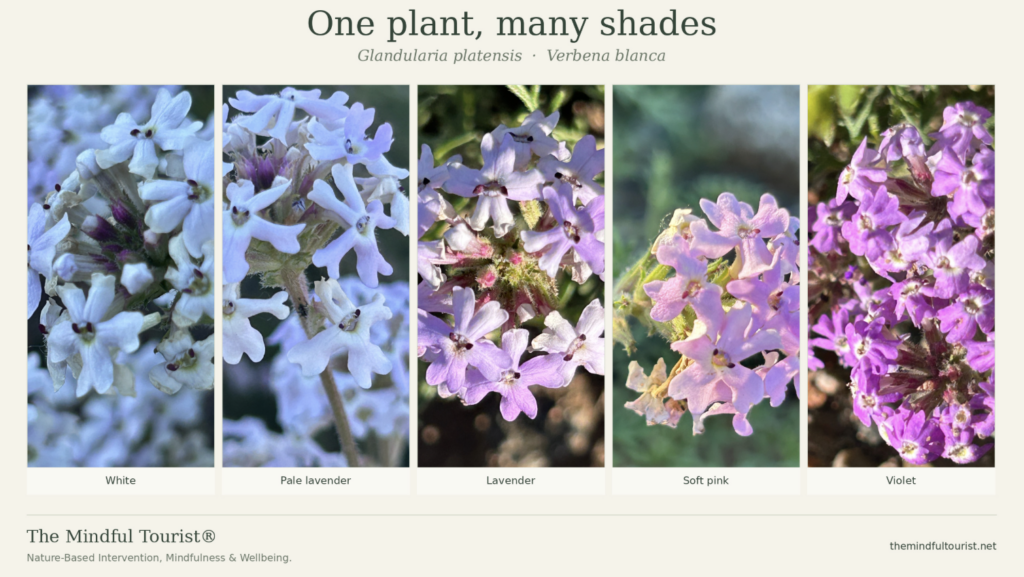
At first, it was the fragrance that captured my attention. But then I began noticing something else. Some flowers were white, others pale pink, and others had beautiful lavender or violet shades. Initially, I assumed that I was looking at different varieties of the same species. However, when I looked more closely, I realised that flowers of different colours were growing on the same plant. And so another little investigation began.
My first thought was that the colour differences might be related to soil chemistry. I remembered how certain plants, particularly hydrangeas, can produce flowers of different colours depending on the chemical conditions of the soil. But why does this happen? The fascinating chemistry of hydrangeas: soil pH, aluminium and flower colour In certain hydrangeas, particularly cultivars of Hydrangea macrophylla and Hydrangea serrata, flower colour can change from pink to purple or blue depending on the soil environment. At first, this appears to be a simple relationship between soil pH and flower colour.
Acidic soil (approximately pH 5.0–5.5): Flowers are more likely to develop blue shades.
Moderately acidic soil (approximately pH 5.5–6.0): Flowers may display purple, violet or intermediate shades.
Less acidic to near-neutral soil (approximately pH 6.0–6.5 and above): Flowers are more likely to develop pink shades.
These are approximate ranges. The actual colours depend on the cultivar, aluminium availability and other soil conditions. Interestingly, soil acidity does not directly turn the flowers blue. The key is aluminium availability. Aluminium is naturally present in many soils, but its chemical form and solubility depend strongly on pH. In acidic soils, aluminium is generally more soluble and can become available for uptake by plant roots. As soil pH increases, aluminium tends to form less soluble compounds, reducing its availability to the plant. This matters because certain hydrangeas contain an anthocyanin pigment called delphinidin-3-glucoside, which participates in the formation of the flower’s colour. When aluminium interacts with this pigment and other molecules known as copigments within the coloured floral tissues, the resulting molecular complexes can produce blue shades. When insufficient aluminium is available, the same pigment system is more likely to produce pink or reddish colours. In other words, the process involves several connected chemical relationships:
Soil pH → aluminium solubility → aluminium uptake → pigment interactions → flower colour.
What makes this especially fascinating is that the visible colour depends not simply on the presence of a pigment, but also on its molecular environment. Metal-ion coordination, copigmentation and conditions inside plant cells all influence how pigment molecules absorb and reflect light. And there is another important detail: not all hydrangeas change colour in response to soil pH. Some cultivars have limited colour-changing ability, while white hydrangeas generally lack the necessary coloured pigment system for this particular blue–pink transformation. The relationship is therefore not universal, even within hydrangeas.
Could something similar happen in Glandularia platensis?
This was my initial hypothesis. Perhaps differences in soil chemistry were influencing pigment formation in the flowers I observed. However, there was an important difference. I was not comparing plants growing in different soils. I was observing different flower colours on the same plant, sometimes even within the same flower cluster. This made me question whether soil pH was really the most likely explanation. Furthermore, I could not find scientific evidence demonstrating that soil pH or aluminium availability causes the colour differences in Glandularia platensis. The hydrangea example illustrates how complex flower colour chemistry can be, but it does not establish that the same mechanism occurs in this species. I therefore began exploring another possibility: could the colours represent different stages of flower development?
Interestingly, botanical descriptions provide some support for this explanation.
Fundación Cassará describes the flowers as initially white, becoming violet as they wither. Meanwhile, Argentina’s Sistema de Información de Biodiversidad describes white flowers acquiring yellowish tones as they age. These descriptions differ, but both suggest that flower colour can change during the flower’s life. One possible biochemical explanation involves anthocyanins, a group of plant pigments responsible for many red, pink, purple and blue colours. Their appearance can depend on pigment concentration, molecular structure, cellular pH and interactions with other compounds. However, I have not found research confirming the particular pigments or biochemical processes responsible for the colour changes in Glandularia platensis.
I also wondered whether pollination might play a role. In some flowering species, pollination is associated with changes in flower colour, potentially signalling to pollinators that a flower has already been visited or is no longer offering the same reward.
Could something similar happen here?
Perhaps. But I have not found species-specific evidence demonstrating that pollination triggers the colour changes in Glandularia platensis. For now, flower ageing appears to be a plausible explanation, while the precise mechanism remains an open question.
And what about that extraordinary fragrance?
This was actually what interested me most. How could such a small flower produce a fragrance noticeable while walking through an open, dry landscape? From a chemical perspective, floral fragrances are generally composed of mixtures of volatile organic compounds (VOCs). These are carbon-containing molecules that can evaporate from plant tissues and disperse through the surrounding air. Different combinations, concentrations and emission patterns create the distinctive fragrances we associate with different plants. A systematic review published in Frontiers in Plant Science in 2020 examined floral volatile emissions across 305 plant species from 66 families. The researchers identified hundreds of compounds, with terpenoids, benzenoids and fatty-acid derivatives among the major chemical groups contributing to floral fragrances. This offers an interesting chemical framework for understanding the fragrance I experience, even though the specific composition of Glandularia platensis has not yet been established.
The chemistry behind floral fragrances
Two particularly interesting groups of molecules are benzenoids and terpenoids. Benzenoids and related aromatic compounds contribute to many sweet, floral, fruity and sometimes spicy fragrances.
Examples found in the wider world of floral chemistry include:
2-Phenylethanol, associated with a rose-like fragrance.
Benzaldehyde, which can contribute an almond-like aroma.
Methyl benzoate, found in the scent mixtures of various flowering plants.
Another important group is the monoterpenes, which frequently contribute fresh, floral, herbal or citrus-like characteristics.
Examples include:
Linalool, associated with floral and sometimes citrus-like notes.
trans-β-Ocimene, a widespread floral volatile involved in chemical interactions between plants and other organisms.
Limonene, often associated with citrus-like aromas.
These examples help me understand the remarkable diversity of molecules that might contribute to a floral fragrance. But I want to emphasise an important distinction: these are examples of compounds identified in floral scents generally, not compounds confirmed in Glandularia platensis. To establish the actual chemical composition of this plant’s fragrance, we would need an appropriate analytical study, such as headspace sampling followed by gas chromatography–mass spectrometry (GC-MS). Such an investigation could identify which volatile molecules are released, their relative abundance and whether their emission changes throughout the day or as the flowers age. I find this especially fascinating because the fragrance that I experience as one unified sensation may actually be the result of numerous molecules interacting with my olfactory system.
A fragrance is also a form of ecological communication
Flowers do not produce fragrances simply for humans to enjoy. Floral VOCs can play important ecological roles, particularly in interactions between plants and pollinators. Different pollinators respond to different combinations of visual and chemical signals. Some nocturnally visited flowers release strong fragrances that can help moths locate them in low light. This made me wonder whether the white tubular flowers of Glandularia platensis might have a particular relationship with nocturnal pollinators. It is an interesting possibility, but the flower’s appearance and fragrance alone are not enough to establish that it is specifically pollinated by hawkmoths. That would require observations of flower visitors, their behaviour and their effectiveness in transferring pollen. The broader research nevertheless reminds me that what I experience as a pleasant fragrance may have a completely different significance to another organism. What is beauty to me may also be information to an insect.
Could microorganisms contribute to the fragrance?
Another particularly interesting discovery emerged while exploring the chemistry of floral scents. I had previously thought of flower fragrance primarily as something produced by the plant itself. However, research suggests that the microorganisms living on flowers may also influence the volatile compounds released into the surrounding air. A study reported by Universitat Autònoma de Barcelona and CREAF investigated how bacteria and fungi associated with elderflowers affect their fragrance. When researchers altered the microbial communities living on the flowers, the composition and quantity of emitted volatile compounds also changed. This suggests that, at least in some species, the fragrance we perceive may emerge partly from interactions between the plant and its microscopic inhabitants.
What an extraordinary possibility!
A flower’s fragrance may not always be the product of the flower alone, but of a small ecological community that we cannot see. Of course, this has not been demonstrated specifically for Glandularia platensis. Nevertheless, it introduces another question worth exploring. Could microorganisms contribute to the fragrance I notice in this plant?
While investigating the fragrance in my journey as a mentor and instructor for Shinrin-Yoku/Forest Bathing/ Forest Therapy and Nature Connectedness guide training courses, I also came across many years the term phytoncides (VOCs). However, it is important to distinguish between plant-derived volatile organic compounds and claims about their biological effects.
Some plant VOCs have demonstrated antimicrobial or other biological activities under particular experimental conditions. But not every floral VOC has been shown to possess such properties, and detecting a volatile compound does not automatically establish a health benefit for humans. For this reason, when discussing the fragrance of Glandularia platensis, I prefer the more chemically precise term floral volatile organic compounds. The scent is a real sensory experience. Its precise composition and any biological effects remain separate scientific questions.
I find it remarkable how a simple encounter with a small flowering plant can open so many questions. First, I noticed its fragrance. Then I became curious about its identity. Later, I observed that the flowers appeared in different colours, even on the same plant. That observation led me towards questions about flower development, soil chemistry, aluminium–pigment interactions, pollination, plant volatile compounds and eventually the invisible microorganisms that may influence floral fragrances.
And yet, after all this reading, I still cannot say exactly which molecules create the beautiful scent I experience when walking past this particular plant. Nor can I explain with certainty why its flowers develop such different shades. But perhaps that is what makes observing nature so interesting.
Observation does not always lead immediately to an answer. Sometimes it leads to better questions.
Living with nature is not simply about recognising the names of plants or identifying their characteristics. It is also about developing the willingness to notice what we previously overlooked, to question our assumptions and to recognise the limits of what we know. A small flower in the dry landscape of Mendoza has reminded me that there is still so much to discover, even in the most familiar surroundings. And tomorrow, when I walk past it again, I will probably stop to smell it. Perhaps I will also look more closely at which flowers are white, which are turning violet, and whether any insects are visiting them.
Because this little investigation is far from finished.