The Mindful Tourist Nature-Based Intervention, Mindfulness & Wellbeing
The Mindful Tourist

We Are Updating Our Website

We are currently updating The Mindful Tourist website, including pages, articles and resources dating back to 2021.

Bringing everything up to date will take some time. During this process, certain pages and links may not yet work as expected.

We sincerely apologise for any inconvenience. You are warmly invited to continue exploring the website and the content already available.

Thank you for your patience and understanding.

Q&A with Milena: Who Holds the Authority in Shinrin-Yoku, Forest Bathing and Forest Therapy? Follow-up Part 2

The Mindful Tourist® | Follow-up Q&A

If Nature Is Free,
Why Do We Need Forest Therapy Guides?

Three questions on professional guidance, commercialisation and our relationship with nature.

Shinrin-Yoku · Forest Bathing · Forest Therapy

Following our November 2, 2026 Q&A session, we continued collecting thoughtful questions about Shinrin-Yoku, Forest Bathing and Forest Therapy Guide Training.

I would like to begin our follow-up reflections with three closely related questions. At first, they may appear to concern money, professional services and the growing forest therapy industry.

However, I believe they invite us to explore something much deeper: our relationship with nature, the responsibilities of professional guides, and the possibility of helping people develop a relationship with nature that continues beyond our presence.

I am writing from within this profession. These questions apply to my own work as much as to that of anyone else.

Choose a question, then open the themes you would like to explore. You can open several themes at once.

Question 1 · Who Benefits from Forest Therapy?

If Nature Is Freely Accessible, Why Should People Pay Someone to Experience It?

What additional value does a trained guide provide? Are we facilitating a relationship with nature, or turning something naturally available into a commercial product?

1.1 · The Long History of Nature Disconnectedness

I must confess that I have long felt a certain discomfort with the expression spending time in nature.

Why do we speak about spending time in nature as though nature were somewhere outside us, a destination that we temporarily visit before returning to our ordinary lives?

Human beings emerged through a long evolutionary history within the natural world. We did not originate separately from ecological processes.

Yet through agricultural expansion, industrialisation and urbanisation, the environments in which many people live have changed considerably.

Urban development has brought enormous benefits, including healthcare, education, infrastructure and opportunities. We should not romanticise the past.

Nevertheless, these transformations have also changed how frequently many people encounter natural environments in everyday life.

For some, nature has gradually become something they intentionally seek during their free time, rather than an ordinary part of their daily surroundings.

How did we arrive at a point in human history where some people need professional assistance simply to feel comfortable, attentive or connected in a natural environment?

I explore this historical transformation, its relationship with modern living conditions, and the possible role of guides in my research article Why We Need Forest Therapy Guides .

1.2 · Nature May Be Free, but Access Is Unequal

The sunlight, sounds of birds, movement of leaves and many other qualities of nature do not depend upon professional certification.

No guide creates these processes. No association owns them.

But access to suitable natural environments is not equally available to everyone.

Some people live far from accessible green spaces. Others face transport difficulties, mobility limitations, safety concerns or responsibilities that restrict their opportunities to visit natural environments.

For some, the challenge may be unfamiliarity. They may feel uncomfortable walking alone through a forest or uncertain about insects, sounds, terrain or weather.

From my experience, sometimes participants do not need an elaborate programme. They first need time to familiarise themselves with an environment.

We occasionally receive requests of this kind. A person may simply wish to feel safe and sufficiently comfortable in a natural place before beginning to explore independently.

A guide may provide reassurance, site familiarity, appropriate preparation and supportive companionship.

The value of a guide does not always lie in how much they teach, but sometimes in how gently they help someone begin.
1.3 · What Are Participants Actually Paying For?

People are not paying a guide for nature itself. They are paying for a professional service that may support a particular way of encountering nature.

Depending on the session, this may involve environmental and participant risk assessments, site preparation, accessibility considerations, sensory invitations, group facilitation, and an understanding of professional boundaries.

Responsible guiding also includes preparing for unexpected circumstances, respecting participant autonomy and recognising physical and emotional risks.

These contributions deserve recognition. Yet we should not automatically assume that a guided experience is more meaningful or beneficial than an independent one.

Someone who has spent decades observing and developing a relationship with a particular forest may have a profound connection with that place without ever having attended a guided session.

In my research on Modalities of Spending Time in the Forest , I consider different forms of engagement with forests, from independent experiences to guided activities and more structured nature-based interventions.

These do not need to be competing approaches. Different people may choose different forms of engagement at different moments in their lives.

1.4 · Professional Education and the Story of My Book

These questions have accompanied the development of my book, Your Guide to Becoming a Forest Therapy Guide.

The book did not begin as a commercial publication. From 2023, it developed as a practical manual provided to students during our immersive guide training programmes in Japan.

Over time, students' experiences, practical questions, scientific research and my own reflections contributed to its development.

The manual evolved through eight editions before becoming a book available to the wider public.

The first published edition is now out of stock, and I am preparing a revised second edition, planned for release toward the end of November 2026.

I mention this because I do not see professional education as simply teaching a sequence of invitations or giving someone a certificate.

It requires scientific inquiry, practical preparation, risk assessment, ethics, reflection and the recognition of professional limitations.

And perhaps most importantly, it begins with developing one's own relationship with nature before attempting to facilitate that relationship for others.

Read about the development of the book and the forthcoming edition →

1.5 · Ultimately, the Participant Decides

The longer I work in this field, the less interested I become in suggesting that everyone needs a guide.

I am more interested in understanding who may benefit from guidance, in which circumstances, and for what purpose.

Some people genuinely appreciate and benefit from professional guidance. That is perfectly fine.

Others may need a guide only at the beginning, until they become familiar with the environment and feel comfortable exploring independently.

Some people may prefer guided experiences because they enjoy group connection, structured reflection or the opportunity to encounter something unfamiliar.

Others may never feel the need for professional guidance at all.

I see no contradiction among these possibilities.

The responsibility of a guide is not to convince everyone that guidance is necessary, but to offer a meaningful service to those who choose it.
Question 2 · Commercialisation and Ethics

Can Forest Bathing Become Another Form of Consumerism Disguised as Wellbeing?

Are we nurturing a relationship with nature, or turning another human experience into a commercial product?

2.1 · Yes, Commercialisation Is a Real Concern

Yes. I believe we need to acknowledge that possibility openly.

Today, we can find courses, retreats, workshops and certification programmes offering many different approaches to wellbeing.

Some are carefully developed and professionally delivered. Others may provide limited preparation while making substantial promises about professional competence or therapeutic results.

I have encountered inexpensive online programmes advertising forest bathing guide certification for around USD 99.

However, I do not believe that price alone tells us whether a course is educationally valuable.

An inexpensive programme may introduce useful knowledge, while an expensive programme may fail to provide appropriate professional preparation.

What matters is what the qualification claims to represent and whether the education and assessment justify those claims.

Learning about Shinrin-Yoku is one thing. Becoming professionally responsible for guiding other people is another.
2.2 · What Can a Certificate Really Demonstrate?

A guide may need to assess environmental hazards, recognise possible emotional risks, understand consent, adapt invitations and respect professional boundaries.

These responsibilities cannot automatically be demonstrated through a short online course or a knowledge-based quiz.

A certificate may show that an individual completed particular educational requirements.

It does not automatically guarantee professional competence.

This is why our training emphasises practical sessions, documented preparation, self-assessment, reflective learning, ethical responsibilities and physical and emotional risk assessment.

Guide education should provide opportunities to develop judgment, recognise limitations and understand the responsibilities that accompany professional facilitation.

Certification should not be treated simply as a product that can be purchased.

2.3 · What Can We Learn from Yoga and Mindfulness?

I sometimes think about how yoga and mindfulness have changed as they have become increasingly popular and commercialised.

There is nothing inherently wrong with offering classes or receiving payment for professional work.

However, broader philosophical, ethical and contemplative traditions can sometimes become reduced to simplified, marketable outcomes.

Mindfulness may be promoted primarily as a stress-reduction or productivity tool.

Yoga may become associated mainly with physical performance or lifestyle branding.

I wonder whether something similar is happening in parts of the forest bathing and forest therapy industry.

What are we promising participants? Relaxation? Happiness? Transformation? Healing?

What happens when someone leaves a session feeling sad, uncomfortable or restless?

Should we automatically interpret emotional experiences as therapeutic?

These questions remind us that the participant's experience should not be reduced to a promised commercial outcome.

2.4 · Professional Ethics and Therapeutic Claims

For me, professional ethics extends far beyond possessing a written code of conduct.

It concerns the decisions we make when no one is watching.

It concerns how we communicate scientific findings, the claims we make, and whether we are prepared to acknowledge limitations in our knowledge.

If someone becomes emotional during a session, do we immediately describe that response as healing?

If someone reports feeling peaceful, do we claim that our methodology alone produced the result?

And if a participant does not enjoy an invitation, do we respect that experience without judgment?

Professional guiding introduces a relationship of trust. That trust creates responsibility.

We should not promise clinical treatment outside our qualifications or impose interpretations on participants.

Ethical practice requires transparency, humility and a continuing willingness to examine our assumptions.

These considerations are explored further in my articles on professional identity and ethical responsibility and therapeutic experience and commercialisation .

2.5 · Can We Earn a Living and Still Be Ethical?

I believe we must be careful not to suggest that all professional guides should offer their services free of charge.

A guide invests time in education, preparation, equipment, travel, insurance, administration and continuing professional development.

Professional guiding may also provide someone's primary source of income.

There is nothing inherently unethical about earning a living through work that is meaningful to us.

Problems may arise when commercial interests begin to outweigh participant autonomy, professional responsibility or ecological considerations.

We should also consider how our activities affect natural environments and the communities connected to them.

Could we offer community-based activities? Can we support independent nature engagement? Can we improve access for people who cannot afford commercial programmes?

We do not all need to adopt the same business model, but we can examine whether our economic choices align with our values.

Receiving payment for professional work and respecting nature as something beyond commercial ownership are not mutually exclusive.
Question 3 · Autonomy and the Future of Guiding

Are We Teaching People to Connect with Nature, or Making Them Dependent on Professional Guides?

Should successful guiding eventually make the guide unnecessary? And how can guides reconcile participant independence with the need to sustain their professional lives?

3.1 · Should the Guide Eventually Become Unnecessary?

I believe helping people develop confidence and independence should certainly be one of our aspirations.

If someone attends a forest bathing session and gradually discovers that they can engage meaningfully with nature without professional assistance, I would consider that a positive development.

The forest was never dependent upon my presence.

The participant's ability to notice, feel, reflect and develop relationships with natural environments does not belong to me.

However, independence does not mean that a person will never wish to return to a guided experience.

We return to teachers, books, music performances and group activities throughout our lives, even when we can engage independently.

Sometimes people seek guidance to learn. Sometimes they appreciate companionship. Sometimes they enjoy another person's perspective or the structure of a shared experience.

The distinction I would make is between choosing to return to a guide and believing one cannot meaningfully experience nature without one.

The first may express autonomy. The second may indicate dependency that deserves careful reflection.
3.2 · The Professional Dilemma: Livelihood and Values

Now comes the uncomfortable part.

Many guides wish to develop a professional practice that allows them to earn a living through work they love.

We live within an economic system in which most of us need money for housing, food, healthcare, education and other necessities.

On the one hand, we want participants to feel confident enough to continue exploring nature independently.

On the other hand, our professional livelihood may depend on people returning to our services.

How do we reconcile these realities?

Perhaps the starting point is self-honesty.

Can we acknowledge that we wish to earn a living without allowing that wish to determine how we speak about nature or our participants' needs?

Can we celebrate someone's growing independence, even when they no longer need our services?

Can we develop a sustainable professional practice without encouraging fear, uncertainty or unnecessary dependence?

I believe these questions require ongoing reflection and a willingness to examine our values.

3.3 · From Personal Wellbeing to Emotional Connection

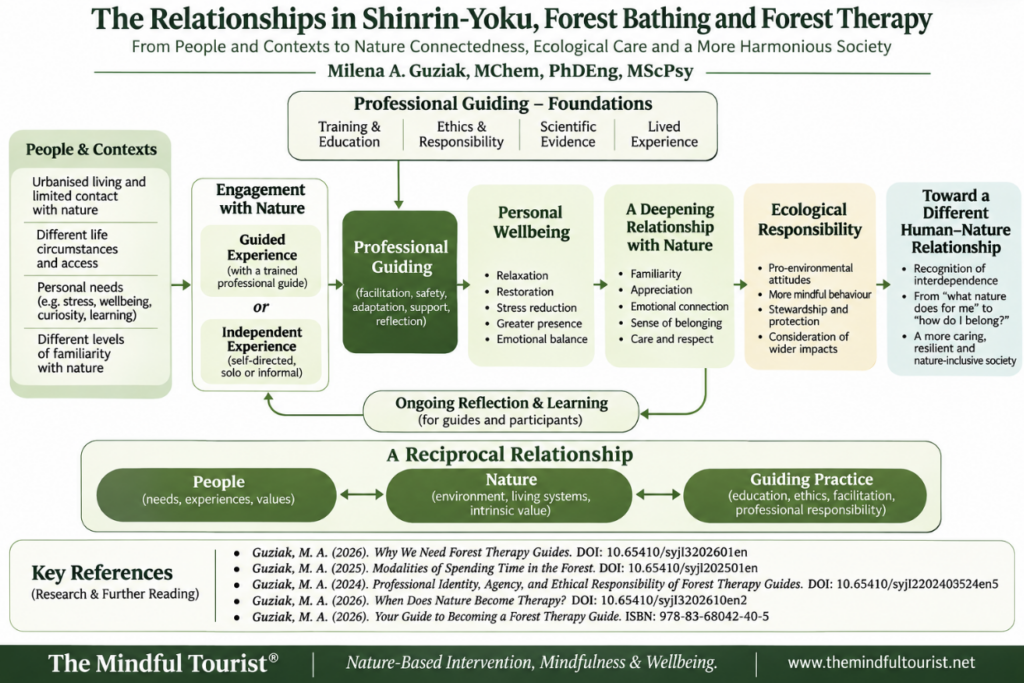
When I think about the longer purpose of Shinrin-Yoku and nature connectedness, I do not see the journey ending with stress reduction.

Someone may initially approach Shinrin-Yoku because they are tired, stressed or simply curious.

They want to feel better. And that is perfectly understandable.

But something else may gradually develop.

The person starts noticing changing light, the fragrance of plants, seasonal patterns or the movement of grasses in the wind.

A familiar place begins to acquire personal meaning.

What was once simply a pleasant environment may gradually become somewhere they feel a sense of belonging.

Through repeated encounters, appreciation may develop into emotional connection.

And emotional connection may, in some circumstances, encourage greater care and responsibility.

The question may slowly change from "What can nature do for me?" to "What is my relationship with this place, and how do my actions affect it?"
3.4 · From Emotional Bond to Ecological Responsibility

I believe nature connectedness may develop beyond the search for personal wellbeing.

We often approach nature through its usefulness: forests provide resources, landscapes provide space, and natural environments may support human wellbeing.

Yet our relationship can also deepen toward recognising that nature has value beyond what it provides to us.

When a forest, garden, desert or particular tree acquires personal meaning, it may cease to be merely a background for human activity.

A growing emotional bond may encourage people to care for the place and recognise their responsibility toward other living beings.

This does not mean everyone will develop the same relationship or become involved in environmental conservation.

Nor should we assume that one guided experience automatically produces lasting ecological behaviour.

Human experiences and circumstances are far more complex than that.

Nevertheless, I see an important possibility here.

Nature connectedness may begin with personal wellbeing, but it does not have to end there.
3.5 · The Wider Vision: SYA and Nature Connectedness

This broader perspective has influenced my decision to develop work beyond The Mindful Tourist® training programmes.

Through the Shinrin-Yoku Association, I have wanted to contribute to ethical standards, professional responsibility, education, scientific dialogue and a more unified approach to the field.

The purpose is not to claim ownership over Shinrin-Yoku or establish one organisation as the ultimate authority.

Rather, we need spaces where perspectives can meet, assumptions can be questioned and professional responsibilities can be examined.

My vision for the Global Institute of Nature Connectedness extends into a broader direction.

I would like nature connectedness to be understood as more than a professional methodology requiring certification.

People may develop their relationships with the natural world through gardening, walking, research, meditation, education, wildlife observation or guided experiences.

The starting points differ.

Someone may first be motivated by a desire to reduce stress. Another by scientific curiosity. Another by childhood memories or emotional experiences.

We do not all develop at the same pace.

Professional guides can contribute to this process, but they are not its only facilitators.

Nature itself remains part of the learning process.

3.6 · Are We Moving Toward a Different Understanding of Humanity?

Perhaps this is where my reflection becomes more philosophical.

I sometimes wonder whether we are gradually moving toward a different understanding of our place in the world.

For a long time, many human activities have been organised around distinctions between ourselves and our surroundings.

Human and nature. Mind and environment. Individual wellbeing and ecological wellbeing.

Yet these distinctions may not fully describe the relationships through which life actually unfolds.

We are not visitors to a world that exists independently of us.

We are participants in it.

Our bodies depend upon air, water, food, microorganisms and countless ecological processes.

Our minds and experiences are shaped partly by the environments in which we live. Our decisions also influence those environments.

For some people, recognising these relationships begins with scientific knowledge or philosophical reflection.

For others, it begins with the beauty of a forest, the fragrance of a flower or the silence of a landscape.

Curiosity may encourage repeated contact. Repeated contact may support familiarity. Familiarity may develop into emotional attachment, and attachment may create opportunities for care.

This is one possible pathway, not a guaranteed progression.

Perhaps we are all approaching a similar recognition of interdependence from different starting points.

We cannot prescribe what everyone should feel or believe.

But I find meaning in contributing to opportunities for these relationships to develop.

Perhaps the Best Guide Is One Who Is Willing to Become Unnecessary

Returning to our three questions, I find that they are not really separate.

If nature is freely accessible, we must be careful not to imply that everyone needs professional guidance.

If forest bathing can become another form of consumerism, we must examine our ethical responsibilities and commercial motivations.

And if guiding can create dependency, perhaps we should consider whether one measure of successful practice is the growing autonomy of the people we accompany.

Yet professional guidance can still be valuable for those who choose it.

Some people need reassurance. Some appreciate structured learning. Some benefit from accessibility support or professional preparation. And some simply enjoy a shared experience.

There is room for all these possibilities.

For me, one of the most meaningful professional achievements would be hearing that, after our time together, someone began visiting natural places independently.

That they started noticing what they had previously overlooked.

That they developed a relationship with a particular place.

And that they no longer felt they needed permission or professional validation to experience nature meaningfully.

Our role may simply be to accompany people for part of the journey, until they feel ready to continue in their own way.

And if they choose to walk with us again, they are always welcome.

With gratitude,

Milena A. Guziak, MChem, PhDEng, MScPsy
Founder, The Mindful Tourist®
Founder, Shinrin-Yoku Association

The Mindful Tourist®
Nature-Based Intervention, Mindfulness & Wellbeing.
www.themindfultourist.net

Author: Milena A. Guziak, PhD Founder, The Mindful Tourist & Shinrin-Yoku Association

error: Content is protected !!
Text size
100%
New Research Publication ✦ When Does Nature Become Therapy? ✦ Shinrin-Yoku · Forest Bathing · Forest Therapy ✦ Read the Scientific Article → ✦
Member Login Login