Three Pathways to Becoming a Certified Shinrin-Yoku, Forest Bathing & Forest Therapy Guide — Upcoming Training Dates 2026–2027
A Personal Message from the Founder
When the Path Begins to Make Sense
Perhaps there comes a moment when the forest is no longer simply a place you visit, but a place to which you keep returning.
Once, ten times, perhaps a hundred. You return to observe, to wonder, to process, to express, or simply to be. And somewhere along the way, something begins to change within you.
You may not understand what is happening at first. You simply recognise that this relationship has become meaningful. And perhaps you begin to wonder why.
My own journey has taken me through chemistry, applied physics, psychology, years of living in Japan, scientific research, mindfulness, and meditation. For a long time, these appeared to be separate chapters of my life.
Only gradually did I begin to recognise connections that I could not see before. These experiences have shaped the work I do today through The Mindful Tourist®.
When I began developing our guide training, I wanted to create something beyond learning techniques or following a sequence of activities.
I wanted to encourage people to understand their own experiences, explore the scientific questions, develop their relationship with nature, and learn how to share that relationship responsibly with others.
And perhaps the moment to begin sharing comes when we recognise the beauty of allowing others to discover something for themselves.
Not to reproduce our experiences in them, but to accompany them as they develop their own.
I continue to learn, question and reconsider my understanding. And I hope that whatever pathway you choose, your own curiosity never comes to an end.
Founder, Shinrin-Yoku Association
The Connections I Could Not See Before
A personal reflection on science, nature, consciousness, mindfulness and the gradual unfolding of a life. Discover the experiences and questions that helped shape the philosophy behind The Mindful Tourist®.
Read Milena's Personal Story ↗News · November 2026 · Professional Education
Three Pathways to Becoming a Certified Shinrin-Yoku, Forest Bathing & Forest Therapy Guide
Upcoming Training Dates 2026–2027
Five years of professional education, approximately 170 certified guides, and a continuing commitment to science, mindfulness, nature connectedness, and responsible guiding.
At The Mindful Tourist® (TMT), we are pleased to announce the upcoming learning opportunities for our Shinrin-Yoku, Forest Bathing and Forest Therapy Guide Training programmes.
These include two new mentored online cohorts beginning in November 2026 and our next immersive training in Japan in July 2027.
As we approach the next chapter of our educational journey, we would also like to reflect on how this training began, why it was developed, and the people who have contributed to its growth.
Over the past five years, approximately 170 guides have successfully completed our certification requirements. Our international community continues to grow, bringing together individuals from different countries, cultures, professional backgrounds, and circumstances.
We are currently updating our Certified Guide Directory to reflect our growing community and to provide more accurate and accessible information about certified guides.
What does it truly mean to become a guide, and what responsibilities accompany the decision to guide others into a relationship with nature?
01 / The Story Behind Our Training
Why We Created the Shinrin-Yoku Guide Training
The development of The Mindful Tourist® guide training began in 2021, bringing together different areas of scientific inquiry, education, personal experience, and an enduring interest in the relationship between human beings and the natural world.
Its founder, Dr. Milena A. Guziak (MChem, PhDEng, MScPsy), spent approximately a decade living in Japan, where her academic, professional, and personal experiences contributed to a growing interest in Shinrin-Yoku and broader questions surrounding nature, consciousness, human well-being, and mindfulness.
The intention was never simply to create another programme teaching people how to lead activities in a forest.
Instead, the aim was to develop an educational approach that encouraged people to understand the scientific and historical foundations of Shinrin-Yoku while cultivating their own capacity for observation, reflection, ethical judgement, and meaningful engagement with nature.
We wanted students to begin by experiencing and understanding nature themselves, before learning how to facilitate experiences for others.
This distinction remains fundamental. A guide may learn how to introduce a sensory invitation, facilitate a reflective activity, or organise a forest walk.
However, learning a sequence of activities is not necessarily the same as developing the awareness, sensitivity, and judgement required to respond appropriately to different people and environments.
Our training therefore brings together scientific knowledge, Japanese cultural perspectives, mindfulness, nature connectedness, personal reflection, practical guiding, and professional ethics.
Over time, it has developed into three learning pathways designed to accommodate different needs, geographical locations, and ways of learning, while preserving the same core certification requirements.
02 / History, Science & Terminology
From Shinrin-Yoku to Forest Bathing and Forest Therapy
An important part of our training involves understanding the historical development of Shinrin-Yoku and the terminology used internationally.
The Japanese expression Shinrin-Yoku (森林浴), commonly translated as forest bathing, was introduced in Japan in 1982 as part of an initiative encouraging people to spend time in forests and experience their atmosphere.
Its purpose was not initially to establish a new clinical treatment or a profession based on a universally prescribed sequence of activities.
It encouraged people to rediscover something that had long existed: the possibility of engaging directly with natural environments.
As scientific interest expanded, researchers began investigating psychological and physiological responses associated with exposure to forests.
Over time, additional concepts and expressions emerged in Japan, including shinrin ryōhō (森林療法), translated as forest therapy, and shinrin serapī (森林セラピー), which became associated with different health-oriented and institutional developments.
These changes contributed to the growth of research, professional education, certification systems, and organised forest-based experiences.
When does spending time in nature become therapy?
Is it when an individual experiences relaxation? When physiological changes are measured? When a professional guide facilitates the experience? Or when an activity is formally organised within a therapeutic framework?
Within The Mindful Tourist® educational approach, we consider Shinrin-Yoku, forest bathing, and forest therapy to refer broadly to the same modality of intentional nature engagement, while recognising that institutional, cultural, and clinical contexts may introduce additional distinctions.
Changing the name of an experience does not necessarily change the processes through which human beings respond to nature.
Equally, the term forest therapy does not automatically mean that a guide is qualified to deliver psychotherapy or another regulated healthcare intervention.
For us, the important questions concern what actually happens during an experience, what contributions may support well-being, and what responsibilities belong to the professional guide.
Read: When Does Nature Become Therapy? ↗03 / Our International Community
Five Years of Learning, Reflection and Connection
Since the development of our training programmes in 2021, we have had the privilege of accompanying people from many different backgrounds on their professional learning journeys.
Some arrived with experience in healthcare, psychology, education, environmental science, tourism, or hospitality.
Others had no previous professional experience in nature-based practice, but brought curiosity, commitment, and a personal relationship with the natural world.
We believe that everyone should have the opportunity to begin learning to become a guide, regardless of their previous academic or professional qualifications.
However, openness to learning must be accompanied by meaningful professional standards.
Certification is not awarded solely for attending classes or completing theoretical lessons.
Students are required to demonstrate their ability to prepare, facilitate, evaluate and reflect upon real Shinrin-Yoku sessions, with attention to participant well-being, professional boundaries, physical and emotional safety, and environmental responsibility.
First, we develop our relationship with ourselves and nature. Then, we learn to share meaningful experiences with others. Throughout this process, we remain responsible for the living environments in which we practise.
The development of this approach has been informed by student feedback, research, international collaboration, and years of practical teaching.
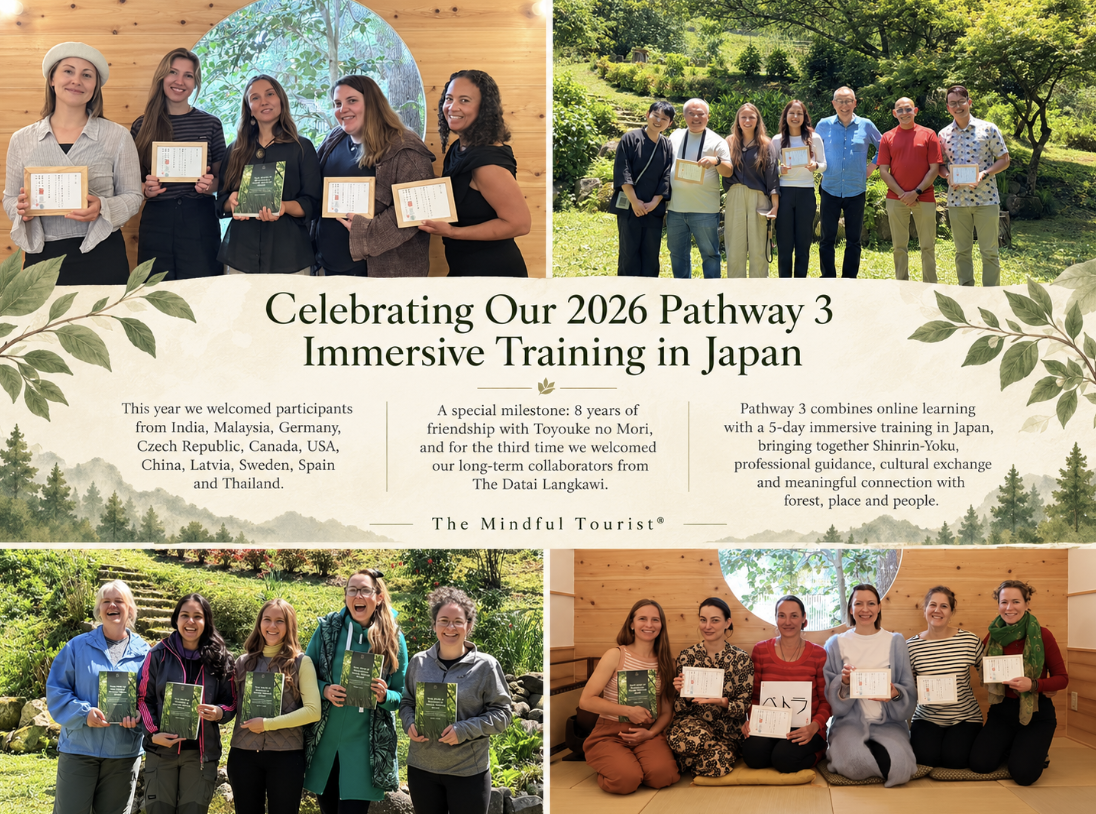
From our first online training programmes in 2021 to our immersive experiences in Japan beginning in 2023, the curriculum has continued to evolve.
Today, approximately 170 certified guides form part of this history.
We extend our sincere appreciation to everyone who has contributed to this journey through learning, practising, questioning, sharing feedback, and continuing their relationship with nature beyond certification.
04 / Upcoming Training Dates
Three Pathways. One Professional Certification Standard.
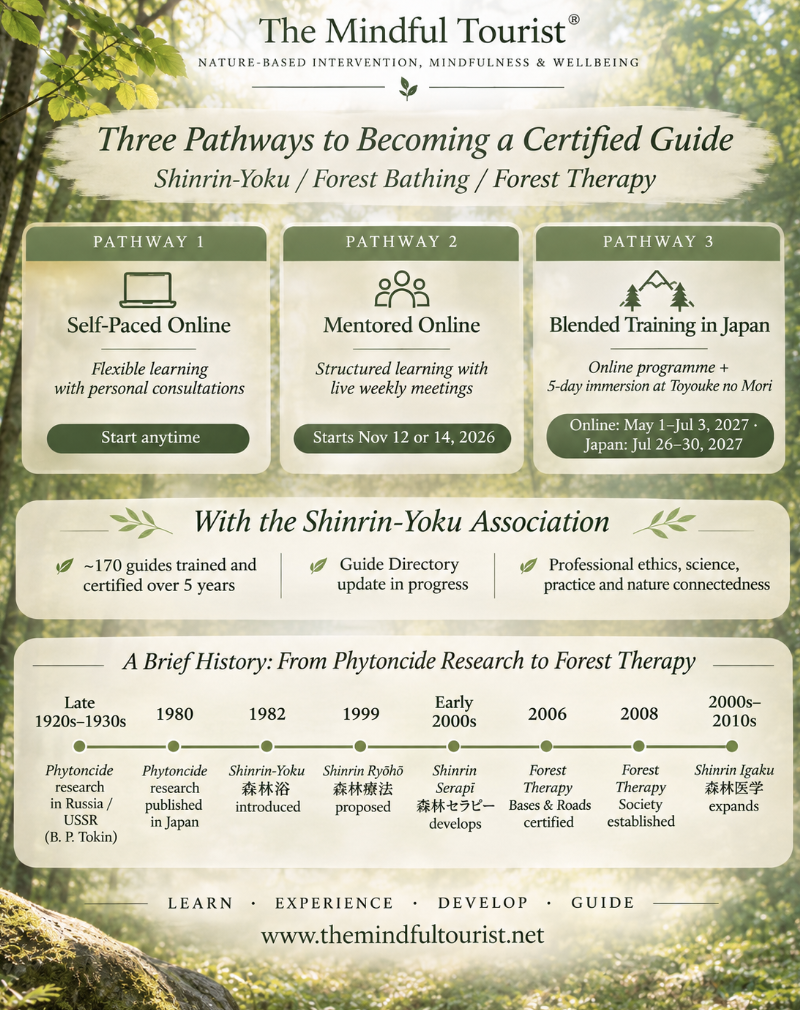
Our three pathways share the same scientific, educational, ethical, and practical foundations. The difference lies in the learning format, the rhythm of mentorship, and opportunities for direct engagement.
PATHWAY 01
Self-Paced Online
Start anytime
Designed for individuals who prefer independent learning and flexibility in organising their studies.
Participants receive access to the complete curriculum, including scientific literature, recorded educational materials, reflective activities, practical assignments, session-planning resources, and opportunities for consultation.
The programme follows a structured 15-week curriculum that students may complete at their own pace.
- Flexible online study
- Four milestone consultations
- Practical guiding assignments
- 12 months to complete certification
Particularly suitable for those who cannot commit to fixed weekly meetings or prefer to organise learning around work, family, and other responsibilities.
Explore Pathway 1 ↗PATHWAY 02
Mentored Online
Structured online education with scheduled live meetings, shared discussion, personal reflection, practical preparation, and feedback from the instructor.
The training includes 15 live teaching weeks, with holiday breaks incorporated into the published schedule.
Starts: 12 November 2026
9:00 a.m. Argentina time (GMT−3)
Final meeting: 22 April 2027
Asia-Pacific friendly
Starts: 14 November 2026
2:00 p.m. Argentina time (GMT−3)
Final meeting: 24 April 2027
Europe & Americas friendly
This pathway offers ongoing conversation, questions, reflection, and gradual development of professional confidence.
Particularly valuable for students who prefer regular instructor contact and a clearly organised schedule.
Explore Pathway 2 ↗PATHWAY 03
Blended Training in Japan
Japan: 26–30 July 2027
Ten weeks of online education followed by five days of practical immersive learning at Toyouke no Mori (とようけのもり), Nara, Japan.
Ten Saturday meetings
9:00 a.m. or 2:00 p.m.
Argentina time (GMT−3)
26–30 July 2027
Toyouke no Mori, Nara
During the immersion, participants connect theoretical learning with direct experience, develop guiding skills, explore Japanese cultural perspectives, and learn through observation, supervised facilitation, and shared reflection.
Our collaboration and friendship with Toyouke no Mori, developed over eight years, remains an important part of this experience.
The immersion contributes to practical training requirements. Remaining sessions and documentation are completed for final certification.
Explore Pathway 3 ↗05 / Professional Standards
What Is Required to Become Certified?
All three pathways lead toward the same Shinrin-Yoku Association-aligned professional certification process.
Participants are required to complete the theoretical and reflective curriculum, demonstrate appropriate knowledge of professional ethics and risk assessment, and develop their competence through real-world practice.
Physical and emotional risk assessment, informed participation, professional boundaries, and respect for the natural environment are integral to the learning process.
Certification follows successful completion and assessment of the required work. It is not automatically awarded at the end of online meetings or the Japan immersion.
We believe this distinction is essential to professional credibility and responsibility.
Explore SYA Code of Conduct ↗06 / Questions from Our Community
Why Do We Need Forest Therapy Guides?
During our recent Q&A session with Dr. Milena A. Guziak, participants raised thoughtful questions about professional authority, certification, commercialisation, and the value of guided experiences.
If people can already spend time in nature independently, what additional value does a guide provide?
Can a professional guide promise therapeutic outcomes? What makes a certification meaningful? Who determines the standards of competence?
We welcome these questions because they encourage us to examine our assumptions, educational methods, and professional responsibilities.
We believe that a guide's value should not depend on convincing everyone that they need professional guidance to benefit from nature.
Rather, guides may contribute preparation, accessibility, environmental knowledge, safe facilitation, opportunities for reflection, and meaningful shared experiences.
The intention should be to support an individual's capacity to develop their own relationship with nature, rather than create continued dependence on professional services.
Questions About Our Trainings
Explore programme structure, certification requirements, learning pathways and practical questions before enrolment.
Explore Training FAQ ↗Q&A with Milena
Who holds authority in Shinrin-Yoku, Forest Bathing and Forest Therapy? Explore questions from our recent community discussion.
Read the Q&A Article ↗07 / Continuing Scientific Inquiry
Research, Books and the Continuing Development of Our Training
The Mindful Tourist® training programmes are connected to a wider body of scientific research, professional writing, and reflective practice.
Dr. Guziak's publications examine subjects including the historical development of Shinrin-Yoku, forest atmospheres and phytoncides, mindfulness, nature connectedness, the design of sensory invitations, professional ethics, and the relationship between human well-being and natural environments.
This research continues to inform the educational foundations of our training, while encouraging critical examination of established methods and claims.
Our publications also include Your Guide to Becoming a Forest Therapy Guide, which developed from training materials used in Japan and gradually evolved through eight manual editions.
The first public edition is currently out of stock, and a revised second edition is expected by the end of November 2026.
Research Articles
Explore scientific publications, conceptual discussions and research on Shinrin-Yoku, mindfulness, nature connectedness and human well-being.
Explore Research ↗Books by Milena A. Guziak
Discover educational publications, reflective writing and books bringing together science, mindfulness, nature and lived experience.
Explore Books ↗08 / Your Learning Journey
An Invitation to Begin Your Own Journey
Whether you choose to learn independently, join an international mentored cohort, or travel to Japan for an immersive experience, the foundations of our approach remain the same.
We begin with curiosity.
We develop our capacity to observe, reflect, question, and engage with the living world.
We learn about the history and science of Shinrin-Yoku while recognising the limitations of what research can currently establish.
We develop practical knowledge, professional judgement, and ethical awareness.
And gradually, we learn how to share nature-based experiences with others while respecting their autonomy, individual needs, and the environments in which we practise.
As we enter another year of professional education, we remain grateful to the approximately 170 guides who have successfully completed our certification requirements, and to the wider community of students, educators, researchers, and collaborators who continue to shape this work.
Our Certified Guide Directory is currently being updated, and we look forward to sharing the revised directory as this work progresses.
To everyone considering beginning this journey, we warmly invite you to explore our three pathways and the questions that guide our educational philosophy.
Becoming a guide is not the end of learning. It is the beginning of a continuing responsibility toward ourselves, other people, and the living world.
Author: Milena A. Guziak, PhD Founder, The Mindful Tourist & Shinrin-Yoku Association
THE MINDFUL TOURIST® · PROFESSIONAL EDUCATION
What happens when nature is no longer simply the background?
A stone held in the hand. The movement of grasses in the wind. The slow transformation of a desert garden. The mountains that existed long before us.
Such ordinary encounters can invite us to reconsider how we perceive, experience and participate in the natural world.
Perhaps nature connectedness is not about creating a relationship that was absent, but becoming more attentive to the relationships in which we already exist.
From personal observation to professional guidance
The Certified Nature Connectedness Guide Training TMT® explores the science, psychology and lived experience of human relationships with nature. It brings together evidence-informed approaches, reflective practice, sensory engagement, ethical facilitation and ecological responsibility.
The Mindful Tourist® · Professional Education
Your journey can begin here.
Inspired by our international community? Explore the different ways to learn with us, from independent online study to mentored education and immersive experiences in Japan.
Pathway 01 · Online
Learn at Your Own Pace
Enrolment: Open · Start anytime
Self-paced Shinrin-Yoku Guide Training. Follow the 15-week curriculum at your own rhythm, with optional consultations and up to 12 months to complete certification.
Explore Pathway 1 ↗Pathway 02 · Mentored Online
Learn Together
Next start: 12 or 14 November 2026
Fifteen live learning meetings with mentoring, discussion and practical feedback. Choose Thursday mornings or Saturday afternoons (Argentina time).
Explore Pathway 2 ↗Pathway 03 · Japan
Experience Japan
Online: 1 May – 3 July 2027
Japan: 26–30 July 2027
Ten weeks of online learning followed by a five-day practical immersion at Toyouke no Mori, Nara. Experience the forest, develop your guiding skills and learn together.
Explore Pathway 3 ↗Meditation · Professional Training
Meditation Guide Training TMT®
Orientation: 15 December 2026
Personal practice begins: 16 December 2026
A long-term journey beginning with 400 days of personal meditation, reflection and self-inquiry, followed by theory, ethical preparation and professional guiding practice. Proposed dates are subject to confirmation.
Explore Meditation Training ↗Our Community · Memories
Explore Our Photo Album
People, forests, friendships and the moments that shape our journey together. Discover photographs from our Shinrin-Yoku training experiences in Japan and our international community.
Visit the Photo Album ↗
森の心・人の心
The Mindful Tourist®
Nature-Based Intervention,
Mindfulness & Wellbeing
Behind The Mindful Tourist®
Meet the Founder
Dr. Milena A. Guziak
MChem · PhDEng · MScPsy
Founder, The Mindful Tourist®
Founder, Shinrin-Yoku Association
A researcher, educator, author and Shinrin-Yoku instructor, Dr. Milena A. Guziak brings together scientific inquiry, mindfulness, nature connectedness and lived experience.
Having spent approximately a decade living in Japan, including completing her doctorate at Tohoku University, she developed an educational approach that places personal experience, professional ethics, critical inquiry and relationships with the natural world at the centre of learning.
Her work with The Mindful Tourist extends beyond professional guide training into research, writing, meditation and the exploration of human well-being.
"Learning to guide begins with learning to observe, to listen, and to develop our own relationship with nature."