Living with Nature | Luján de Cuyo, Mendoza, Argentina
Lately, I have been thinking more and more about the soil. Perhaps it is because I have begun harvesting the first vegetables and fruits of the season from my little desert garden at the foothills of the Andes.
Garlic, radishes, strawberries, lettuce leaves, Swiss chard (acelga) and other leafy greens. Not enormous quantities, certainly not enough to feed a family throughout the year, but enough to begin experiencing something that I have been working towards for the past year: gradually growing some of my own food. And with every harvest, new questions arise. What exactly is the soil beneath my feet made of? How much sand, silt and clay does it contain? What does it need, and how much should I intervene?
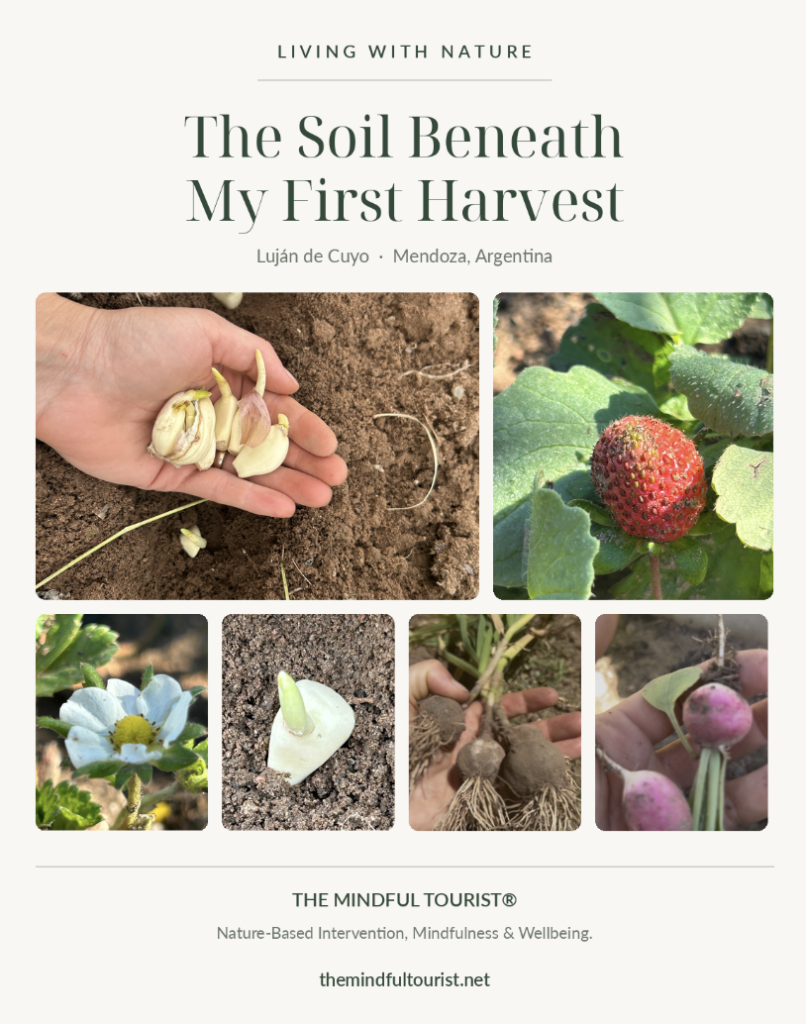
After returning from Japan at the beginning of the Argentine winter, I had quite a lot to attend to in my garden. My husband had left some garlic that had already begun to sprout. Rather than let it go to waste, I decided to experiment. I separated the cloves and planted them directly into the sandy soil. There were white-skinned and purple-skinned cloves, including purple hardneck garlic. I did not prepare the ground extensively. Some organic kitchen scraps had already decomposed in the soil, but I had not added substantial amounts of compost or made any major improvements. Apart from planting and watering, I largely allowed the garlic to grow under the existing conditions.
I knew I was planting rather late, at the beginning of the second month of winter. Although we live at the foothills of the Andes, winters here are not always particularly cold. The lowest temperature I observed this winter was approximately −3°C during the night.
Garlic development depends on several interacting factors, including variety, exposure to cold temperatures, day length, planting time, water and nutrient availability. Cold exposure, known as vernalisation, contributes to the physiological processes involved in bulb development. As the days lengthen, suitable conditions encourage the formation of bulbs divided into individual cloves. However, the process is not determined by cold alone.
Today, November 12, as I prepare parts of the garden for the next growing season, it is time to remove the garlic. The results are modest. The bulbs are small, and some have developed with little or no separation into individual cloves. Was it because I planted too late? Did the garlic receive insufficient cold exposure? Was the sandy soil unable to retain enough moisture and nutrients? Or was it a combination of several factors? I cannot answer these questions with certainty yet. What I do know is that the garlic grew. And the small bulbs and tender green parts can still be used in cooking. Next winter, I will plant earlier and compare the results. What might appear to be an unsuccessful harvest is, for me, another opportunity to understand the conditions under which plants grow.
Another vegetable I have been enjoying growing is the radish. Radishes are relatively undemanding, grow quickly and offer the satisfaction of seeing results within a comparatively short period. This time, I have been growing them in raised beds. One reason is the presence of black leafcutter ants, which have caused considerable damage to plants in my garden. So far, the raised beds seem to be helping, although I continue to observe whether this will remain effective.
But the ants are not my only concern. There is another visitor I have come to know here in Mendoza: the bicho moro, a leaf-eating beetle capable of causing significant damage to vegetable plants. Last year, these insects consumed almost all the leaves of some tomato plants I had planted as an experiment to see what might grow in this environment. Fortunately, some plants were able to produce new leaves. Nevertheless, severe defoliation can weaken a tomato plant and reduce its capacity to produce fruit.
I now wonder whether the bicho moro will return this season. Will it discover the leafy greens before I have the opportunity to harvest them? I am learning that growing food does not mean having complete control over what grows. The garden is shared with many other living organisms, each following its own biological needs. The bicho moro deserves a separate article, particularly because its life cycle and relationship with the surrounding ecosystem are rather interesting. For now, I continue observing.
The more I cultivate, the more I realise how little I know about the soil directly beneath my feet. Luján de Cuyo lies within an arid landscape shaped by the Andes and the long history of geological processes associated with them. Much of the region’s soil originates from materials transported by water, wind and gravity. Depending on the location, the ground may contain different proportions of sand, silt, clay, gravel and larger stones. Entisols and Aridisols are among the soil groups found in the region. These soils are often relatively young or have limited horizon development, and arid conditions can restrict the accumulation of organic matter. Yet not all soils here are the same. Some areas are suitable for agriculture and viticulture, while others are shallow, rocky and vulnerable to erosion.
In my own garden, I can already observe considerable differences between one area and another. Some places are extremely sandy. Others contain large quantities of stones. Some seem to hold moisture longer, while others dry rapidly after watering. But what exactly do we mean when we describe soil as sandy, silty or clayey? When we speak about sand, silt and clay in soil science, we are primarily describing the sizes of the mineral particles, rather than three entirely different chemical substances. These particles originate from the physical and chemical weathering of rocks and minerals over geological time. They differ in size, surface area and the way they influence the movement and retention of water and nutrients.
Sand particles measure approximately 0.05–2 millimetres in diameter. They are large enough that we can often distinguish individual grains with the naked eye. When rubbed between our fingers, sandy soil feels gritty. Because relatively large spaces exist between sand grains, water generally moves through sandy soils quickly. This provides good drainage and aeration but can also mean that water and dissolved nutrients are lost relatively easily. In an arid environment such as mine, this becomes particularly important. Water is already limited, and a soil that cannot retain enough moisture presents additional challenges for cultivated vegetables.
Silt particles are smaller than sand, measuring approximately 0.002–0.05 millimetres. They often feel smooth or floury when dry and silky when wet. Silt generally retains more water than sand because its smaller particles create finer spaces within the soil. However, soils containing large amounts of silt can be vulnerable to erosion and surface crusting, particularly when vegetation cover is limited.
Clay particles are smaller than 0.002 millimetres, or two micrometres. To put that into perspective, one millimetre contains one thousand micrometres. Clay particles are therefore extremely small. Their small size gives them a very large total surface area relative to their volume. Many clay minerals also possess electrical charges on their surfaces, allowing them to retain positively charged nutrient ions such as potassium, calcium and magnesium. This is one reason why clay-rich soils can retain considerable amounts of water and nutrients. However, clay can also create difficulties. Clay-rich soils may become sticky when wet and hard when dry. Water movement and aeration can be restricted, especially when the soil is compacted or its structure is poor. Interestingly, a soil that retains large amounts of water does not necessarily make all that water easily available to plants. Some water can be held too tightly for roots to extract.
Most natural soils contain a mixture of sand, silt and clay. The relative proportions of these particles determine what soil scientists call soil texture. For example, a soil containing a large proportion of sand is described as sandy, while one with substantial clay content may be described as clayey. A loam contains a relatively balanced combination of particle sizes, although not necessarily equal amounts of each. Loamy soils are often valued for cultivation because they can combine useful drainage with water and nutrient retention. But soil texture is only one part of the story. Soil also contains organic matter, water, air and an extraordinary diversity of living organisms.
Bacteria, fungi, insects, earthworms and plant roots contribute to processes that influence soil structure, nutrient cycling and the decomposition of organic material. In other words, soil is not simply crushed rock. It is a dynamic system in which mineral particles, organic matter, water, air and living organisms interact.
I suspect that much of my garden contains a high proportion of sand, but I have yet to perform a proper soil texture test. I would like to collect samples from different parts of the land and examine how their compositions differ. A simple sedimentation experiment using soil and water in a transparent jar may provide an initial indication of the proportions of different particle sizes, although a laboratory test would be more reliable.
I am also interested in measuring the soil’s pH, organic matter and salinity. These characteristics can influence nutrient availability, plant growth and the suitability of the soil for different crops. In sandy soil, adding mature compost and other suitable organic matter can gradually improve water retention, nutrient availability and soil structure. But I do not want to change the entire landscape into a conventional green garden. The native vegetation already growing here has adapted to conditions that many cultivated vegetables would struggle to survive. I would rather learn which parts of the land can be cultivated and which are better left to their natural ecological processes.
Among the first harvests are also my strawberries. Small, imperfect and not always as beautiful as those displayed in shops. But they are growing here, in this arid landscape, where establishing a productive garden requires attention to water, soil and seasonal conditions. Watching a strawberry develop from a small white flower into a green fruit and finally turn red has become another opportunity to observe a process that is so familiar and yet so easily overlooked. The fact that we can buy strawberries throughout the year does not necessarily mean that we understand how they grow. There is something quite different about watching a fruit develop day after day. And even more meaningful about eventually eating something that has grown in the soil you have been caring for.
Over the past year, I have put an enormous amount of work into this little piece of land that I now call home. And nature has been generous in helping me. Sometimes, when I look at the garden and compare it with how it appeared a year ago, I become quite emotional. Not because the garden is perfect. It is actually far from that. But because I can see how much has changed, how much I have learned, and how I am slowly beginning to produce some of my own food. I come from a large farming family. Mostly my parents. I grew up in the suburbs of a city of about 40.000. Growing up, I watched my mother work in her garden. She grew potatoes, tomatoes, lettuce, radishes, and many other vegetables. Her garden was beautiful. At the time, I do not think I fully understood how much those experiences were becoming part of me. My mother passed away last year. Since then, something has gradually changed in the way I experience my own garden.
When I wake up in the morning, one of the first things I do is walk outside and spend some time among the plants, stones and soil. And somehow, I feel that my mother is there with me. Not necessarily because I consciously think about her while gardening, but because I recognise something familiar in what I am doing. The movements of my hands. The attention given to a small plant. The pleasure of seeing something grow. The curiosity about what might appear next. These are things I remember from watching her. Perhaps we do not always recognise the influences that shape us while they are happening. We observe, experience and learn, sometimes without knowing what will remain with us. And then, years later, something in our lives brings those experiences back. We begin to recognise connections that were there all along.
Today, as I harvest my first garlic, radishes and strawberries from the desert soil of Mendoza, I realise that I am not only learning how to grow food. I am also rediscovering something from my childhood, something my mother shared with me without necessarily intending to teach it. A way of caring for the land. A way of paying attention. A way of living with nature.
And this is one of the most meaningful things about this little garden. It is slowly becoming productive, but it is also helping me understand my own story.
Some influences take years to become visible. And sometimes, it is through the simplest actions that we finally recognise where they came from.