Living with Nature | Luján de Cuyo, Mendoza, Argentina
Today, as I was eating a grapefruit, a question returned to me. It is a question that first appeared many years ago, during a period of my life when I was living on Koh Samui, an island in Thailand.
Thailand is a wonderful place to discover the diversity of food. I remember the richness of its cuisine, the extraordinary combinations of herbs and spices, the sweetness of tropical fruits, and the sourness of limes that brought everything together. There were flavours I had never encountered before, and combinations that were difficult to describe to someone who had never experienced them. It was there that I began paying closer attention to citrus fruits. I remember noticing limes that seemed to have no seeds at all. I found this rather surprising. How could a fruit develop without seeds? And if there were no seeds, how could another tree grow? Of course, there are other ways to propagate plants, including cuttings and grafting. But the question stayed with me. Years later, now living in Argentina, I began noticing something similar.
Here in Argentina, I have encountered oranges sold as naranjas de jugo, intended primarily for making juice. Some contain very few seeds, while others contain more. And then there are grapefruits. I love grapefruit, including its characteristic bitterness. In the grocery shop where I buy my fruit, I usually find a pink or reddish variety, with flesh that is also pinkish-red. It seems less bitter than some of the grapefruits I remember eating elsewhere. But something else has caught my attention, too. Every time I eat a grapefruit, I look for seeds. Often, I find none. Sometimes, after eating approximately six grapefruits, I discover just one.
One little seed.
And I find myself wondering again: where have all the others gone? Some citrus varieties naturally produce few seeds. Seedlessness may result from several biological processes, including the development of fruit without fertilisation, failure of developing seeds to mature, or characteristics introduced through conventional plant breeding. This does not automatically mean that the fruit has been genetically modified through genetic engineering. Many seedless citrus varieties were developed through traditional breeding, selection or naturally occurring mutations. Some varieties have also been developed through mutation breeding, in which radiation is used to produce genetic variation that breeders can select. Commercial citrus trees are commonly propagated through grafting, allowing growers to preserve desirable fruit characteristics. I find this fascinating because it reminds me that plant reproduction is far more diverse than simply placing a seed in the ground.
As I continued thinking about the seeds, another question appeared. Why is the grapefruit I eat in Argentina pink or reddish inside? And why does it seem less bitter than the varieties I remember eating elsewhere? This is where chemistry becomes particularly interesting. Grapefruit, scientifically known as Citrus × paradisi, contains numerous naturally occurring chemical compounds that contribute to its colour, aroma and flavour.
The pink and red colours of grapefruit flesh are largely associated with a group of pigments called carotenoids. One of the most important is lycopene (C₄₀H₅₆), a red pigment also found in tomatoes and watermelons. Lycopene is a hydrocarbon containing a long chain of alternating single and double carbon–carbon bonds. This arrangement of conjugated bonds allows the molecule to absorb certain wavelengths of visible light, contributing to its characteristic red appearance. Other carotenoids, including beta-carotene, can also contribute to the overall pigmentation. The concentration and distribution of these pigments vary among grapefruit varieties and can be influenced by growing conditions and fruit development. So the colour of my grapefruit is not simply a visual characteristic. It reflects the presence and behaviour of particular molecules within the fruit.
The bitterness of grapefruit is also chemical. Two compounds are particularly important:
Naringin (C₂₇H₃₂O₁₄) — a flavanone glycoside that contributes substantially to grapefruit’s characteristic bitterness.
Limonin (C₂₆H₃₀O₈) — a compound belonging to the limonoid family, which also contributes to bitterness in citrus fruits.
The perceived flavour depends not only on these bitter compounds but also on the balance of sugars, organic acids and other substances. This means that two grapefruit varieties may differ considerably in taste, even when both are pink or red. A redder grapefruit is not necessarily less bitter simply because it contains more lycopene. The compounds responsible for pigmentation and those responsible for bitterness are chemically different. I find this distinction particularly interesting. We often describe a fruit using a few simple words: sweet, sour, bitter, red or yellow. Yet behind those sensory experiences are complex combinations of molecules interacting with our sensory systems.
This question led me to investigate the varieties cultivated in Argentina. Several pink- and red-fleshed grapefruit cultivars are known here, including Ruby Red, Star Ruby and Rio Red. One particularly interesting possibility is Star Ruby. This variety is known for its intensely red flesh, relatively thin peel, juicy fruit and very small number of seeds. Some fruits contain only one or two seeds, while others contain none. It is also often described as sweeter and less bitter than certain traditional grapefruit varieties. Another possibility is Ruby Red, which generally has pink to reddish flesh, or Rio Red, which is also a pigmented grapefruit variety. From the appearance, taste and scarcity of seeds I have observed, Star Ruby seems a plausible candidate. However, without information from the grower or a reliable cultivar identification, I cannot be certain. What interests me most is that the characteristics I have been observing — colour, taste and the absence of seeds — are connected to different aspects of plant biology and chemistry. A simple breakfast fruit has become another small investigation. 😅
Another interesting question is what happens when we plant a seed from a grapefruit purchased in a shop. Will the new tree eventually produce the same fruit? Not necessarily. Citrus genetics can be surprisingly complex. Some citrus seeds contain embryos formed through sexual reproduction, while others may contain embryos that develop from maternal tissue and are genetically very similar to the parent plant. Consequently, a tree grown from seed may resemble its parent, but the characteristics of its future fruit cannot always be predicted. There is also the matter of time. A grapefruit tree grown from seed may take many years to reach reproductive maturity, considerably longer than a commercially grafted tree. Nevertheless, I find something beautiful in the uncertainty.
My Two-Year-Old Grapefruit Tree
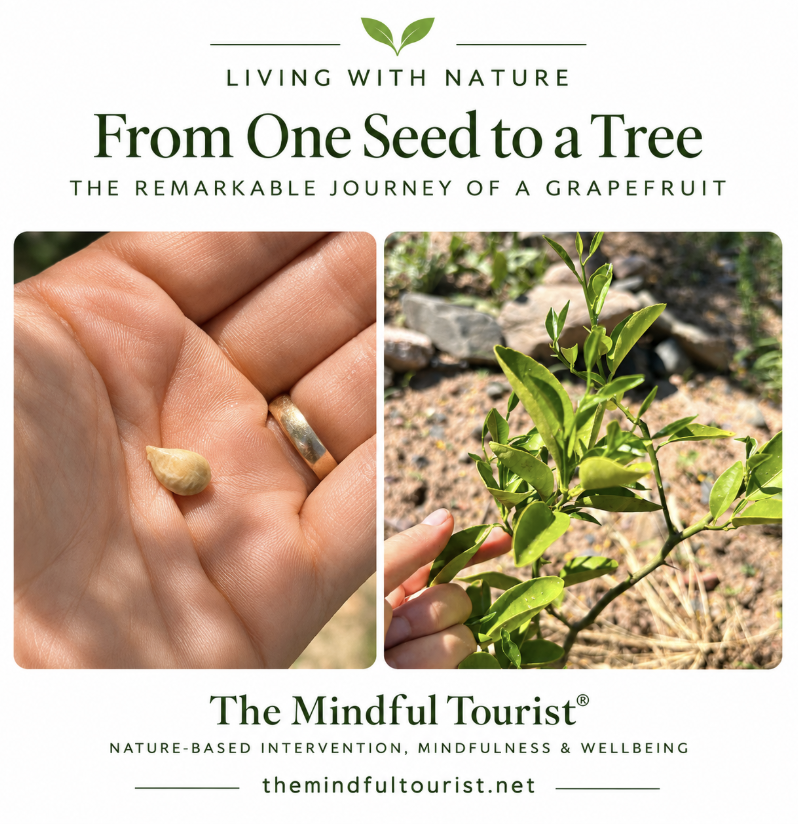
Two years ago, when I was still living in the city, I planted a grapefruit seed. The second photograph shows what has become of it. A small tree, growing in the arid landscape that I now call home, at the foothills of the Andes. I look at its leaves and remember that everything began with something so small that I could hold it between my fingertips. It is remarkable how much biological information is contained within a single seed. The seed contains an embryo and stored resources that support its earliest development. Under suitable conditions, it begins to germinate, producing a root and a shoot. Over time, through photosynthesis, the developing plant captures energy from sunlight and uses carbon dioxide and water to build the organic substances required for growth. The tree that now stands in my garden has gradually constructed its leaves, branches and roots from the resources available in its surroundings.
All of this began with a seed.
And today, I found another one. You can see it in the first photograph, resting in the palm of my hand. I have decided to plant it too. Perhaps it will germinate. Perhaps it will not. Perhaps, in several years, another grapefruit tree will stand beside the one already growing here. I do not know. And that is part of what makes the experience so meaningful.
Of course, growing grapefruit in Luján de Cuyo presents certain challenges. Although Mendoza receives plenty of sunshine, this is an arid region, and winter temperatures can fall below freezing. I have observed temperatures around −3°C during winter nights. Young citrus trees are particularly vulnerable to frost ( actually any young trees), and grapefruit is not among the most cold-hardy citrus species. Even mature trees can suffer damage during sufficiently cold conditions. For this reason, I will need to protect the young seedlings, particularly during their first winters. A sheltered location, suitable soil moisture and temporary frost protection can make a considerable difference. As the trees mature, they may become more resilient, although their survival will still depend on the severity and duration of winter frosts. I am learning that cultivating a garden here is not simply a matter of planting something and expecting it to grow. It is about understanding the soil, the water, the seasonal temperatures and the needs of each plant. It is also about patience.
There is something extraordinary about the possibility that a single seed may eventually become a tree capable of producing hundreds of fruits over its lifetime. And within those fruits, perhaps more seeds. I cannot help thinking about the contrast between the small object in my hand and the living organism it may one day become. The seed does not contain a miniature, fully formed tree. It contains a living embryo and the biological capacity to develop, provided the necessary conditions are met. What it will become depends on an ongoing relationship with its environment. Water. Soil. Temperature. Sunlight. Microorganisms. Time. And, in my garden, a little human care.
As I continue transforming this small piece of desert land into a place where native vegetation and cultivated plants can coexist, I am discovering that gardening offers an extraordinary opportunity to observe processes that are often hidden from our everyday attention.
We buy fruit. We eat it. We discard what remains.
But how often do we stop to consider the life cycle behind what we are eating? How often do we hold a seed and wonder what it might become?
Today, I found one small grapefruit seed. I will plant it and see what happens.
From one seed, the possibility of a tree. From one tree, the possibility of many fruits. And from one moment of curiosity, another opportunity to connect with nature.