Living with Nature | Luján de Cuyo, Mendoza, Argentina
This spring has been quite extraordinary here in Mendoza. Rain, rain and more rain. Days passed with hardly any sunshine, and at times it felt as though the rain would never stop. For a region where spring normally brings increasingly warm, dry and sunny days, the experience has been rather unusual.
At first, I was delighted. I imagined the rain penetrating the dry ground, reaching the roots of plants that had been waiting for moisture, and gradually regenerating this arid landscape. I thought about how much water I would save in my garden and how many plants might begin growing without my intervention.
But then I began thinking about the consequences.
This year, a strong climatic phenomenon known as El Niño has been developing in the tropical Pacific Ocean. El Niño is part of the El Niño–Southern Oscillation (ENSO), a naturally occurring pattern of interactions between the ocean and atmosphere. During its warm phase, sea surface temperatures in parts of the central and eastern equatorial Pacific become unusually high, altering atmospheric circulation and influencing rainfall and temperature patterns in different parts of the world. The expression Super El Niño has appeared frequently in the news this year. Although it is a popular rather than a separate official scientific classification, it refers to an exceptionally strong event. According to NOAA’s assessment of 12 November 2026, El Niño has continued to strengthen, with strong to very strong conditions likely to persist into early 2027.
Its effects, however, are not uniform. Some regions experience increased rainfall, while others may become drier. Even within Argentina, the consequences vary geographically. In Mendoza, October 2026 was exceptionally wet. At the Mendoza Airport weather station, 72.8 millimetres of rain were reported, compared with a historical October average of approximately 11.2 millimetres. Suddenly, what I was observing in my little garden became part of a much larger climatic story. And although I was happy to see the land receiving so much water, I began wondering about the farmers.
Mendoza is known internationally for its vineyards, but its agricultural landscape is much more diverse. Peaches, plums, almonds, walnuts, olives and numerous vegetables are also cultivated here. What might persistent rain, cloud cover, strong winds and cooler daytime temperatures mean for these crops? Rainfall is essential for agriculture, particularly in an arid region dependent on irrigation. Yet its timing matters. Prolonged wet weather can complicate fieldwork, encourage certain plant diseases and interfere with flowering and fruit production.
Last year, I planted five young almond trees in my garden. This spring, each of them produced flowers. Not many, perhaps around ten per tree, but I was delighted to see them blooming. I watched the flowers appear, hoping that at least some would develop into almonds.
In the end, I found only two almonds. Naturally, I wondered whether the rain had something to do with it. Almond trees depend heavily on successful pollination, often involving bees transferring pollen between compatible flowers. During periods of rain, strong wind and low temperatures, pollinating insects are generally less active. Wet conditions during flowering may also affect pollen viability and fertilisation. However, I cannot conclude that the weather alone caused my small harvest. The trees are still young, and factors such as compatible almond varieties, flowering overlap and general tree development may also influence fruit production. Nevertheless, watching those few flowers develop into only two almonds made me think differently about the consequences of this unusually wet spring. My little harvest is hardly comparable to the livelihood of a farmer whose income depends on thousands of trees.
There was another consequence of all this rain. The plants. Everywhere. Normally, during spring, I spend relatively little time clearing the walking paths around my garden. The sun is intense, the soil dries quickly, and many small plants that germinate without irrigation struggle to survive.
Not this year…
The paths became covered with vegetation. Dandelions, plants resembling wild mustard, grasses and numerous others that I have not yet identified began appearing in places where I had never seen them before. I started pulling them out.
And pulling.
And pulling.
Then I began wondering: what exactly makes a plant a weed? Some of these plants also grow naturally in other parts of my land, where I welcome them. They provide ground cover, flowers, habitat for insects and a changing landscape that I enjoy observing. Yet when the same plants grow in my vegetable beds or walking paths, I call them weeds. Nothing about the plant itself has changed. Only its location, and my intention for that particular space. I am still learning to distinguish plants that may be useful, plants that compete strongly with my crops, and plants that could become invasive or difficult to manage. But I have become increasingly reluctant to remove vegetation simply because I have not planted it myself.
So What Should I Do with Everything I Remove?
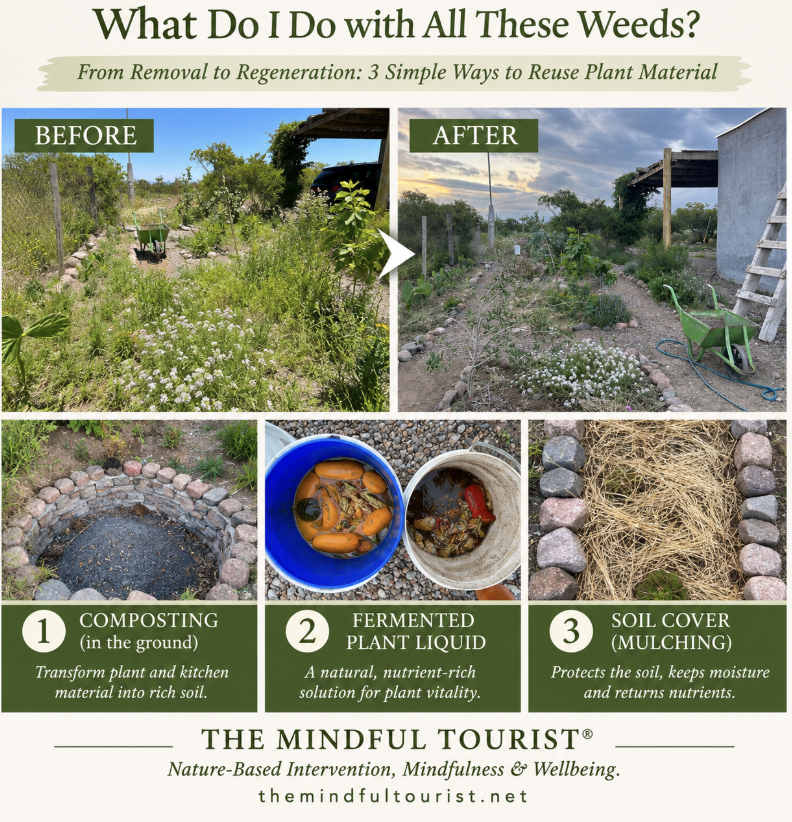
Over the past year, I have already been composting some of the organic material from my garden and kitchen. This spring, however, the amount of vegetation I have collected is enormous. I started wondering how I could use it rather than simply dispose of it. And so I have been experimenting with three different ways of returning plant material to the garden.
1. Traditional Composting
The first is ordinary composting. I collect suitable plant material and combine it with other organic matter, allowing microorganisms to gradually break it down. Composting involves the activity of bacteria, fungi and other organisms that transform plant residues into a more stable organic material. The process requires an appropriate balance of moisture, oxygen and carbon-rich and nitrogen-rich materials. Eventually, the resulting compost can help improve soil structure, support water retention and contribute nutrients to the soil. This is particularly interesting to me because much of my garden soil is sandy and contains relatively little visible organic matter.
There is one important consideration, however. I need to be selective about what enters my compost pile. Plants containing mature seeds, persistent underground stems or diseases may survive ordinary backyard composting and create problems when the compost is returned to the garden.
2. Fermented Plant Liquid
The second method is something I have recently started exploring: soaking collected plant material in water and allowing it to ferment. This is sometimes called weed tea or a fermented plant extract. I have seen it described as a way to recycle nutrients contained in plants. During soaking and decomposition, some soluble compounds may enter the water, including mineral ions and various organic substances. However, their concentrations depend on the plant species, the amount of material, the water, temperature, oxygen availability and the duration of fermentation. This means that the resulting liquid is not a standardised fertiliser. It is also not quite the same as compost tea, which is prepared from already decomposed compost. I am learning that fermented plant extracts need to be approached carefully. Their composition is unpredictable, and strong or poorly prepared liquids may damage plants. Dilution alone does not guarantee that a preparation is safe.
For now, I regard this as an experiment rather than an established solution. I would not apply an untested fermented mixture directly to the edible leaves of my vegetables, and I would rather begin with small trials away from plants intended for immediate consumption.
3. Covering the Soil with the Plants I Have Removed
The third approach is perhaps the one that excites me most. Instead of taking all the plants away, I have started using suitable collected vegetation to cover the exposed soil around my vegetables. In gardening, this is known as mulching. I had already been thinking about ways to protect the soil from the intense summer sun and reduce evaporation. Then I realised that the material I needed was growing all around me. Why buy mulch when some of it might already be available in my garden?
Of course, I need to be careful. Plants with mature seeds, persistent roots or stems capable of growing again are not good candidates for direct mulching. I also need to avoid diseased material and make sure that freshly cut plants do not form a thick, wet layer that prevents air from reaching the soil. But suitable seed-free vegetation, allowed to wilt or dry when necessary, can become a useful protective layer. And this is where the process becomes particularly interesting.
What Happens Beneath the Mulch?
A layer of organic mulch does more than cover the ground. By reducing direct sunlight reaching the soil surface, it can slow evaporation and help moderate soil temperature. It may also suppress the germination and growth of some unwanted plants by limiting the light available to them. Over time, the plant material begins to decompose. Bacteria, fungi and soil invertebrates participate in breaking down the organic residues. Some of the nutrients contained in the plant tissues may eventually become available to other plants through microbial processes. Part of the organic matter may also contribute to the development of more stable soil organic matter. For sandy soils, this is especially valuable because organic matter can improve the soil’s capacity to retain water and nutrients.
I have already written about the importance of sand, silt and clay in determining soil texture. But soil texture is only part of the story. The presence of organic matter, soil organisms, roots and the structure they help create can also influence how soil functions. What I find particularly remarkable is that this process does not require me to manufacture anything. The organisms are already present in the environment. My role is to provide conditions in which natural decomposition can take place. Of course, I cannot control precisely which fungi or bacteria will develop, or assume that every microorganism will benefit my vegetables. Soil biology is much more complex than that. But I can begin to create conditions that support a more active soil ecosystem. And maybe, just maybe, over the coming years, the sandy ground beneath my vegetables will gradually become richer in organic matter.
As I spread the collected plants around my vegetables, I began reflecting on how my relationship with this land has changed. A year ago, I might have looked at all this unwanted vegetation and seen only another task waiting to be completed. Now I see something different. I see plants that have captured sunlight, absorbed water, developed roots, taken up nutrients and produced organic material. Even after I remove them from the ground, that material does not necessarily become useless. It can become part of another process. I also realise that working with nature does not mean leaving everything untouched. I am cultivating vegetables and fruit trees. I choose where to plant them, where to create paths and where to allow spontaneous vegetation to grow. I remove some plants because they compete with the food I am trying to produce.
There is still intervention. But I am learning to question the extent of that intervention and to consider what happens to the material I remove. Yes, the difference lies in whether I treat the garden as something that must constantly be controlled or as a living environment with which I can work.
In the photographs accompanying this post, I am sharing some of the changes taking place in my garden: the areas before and after clearing, the collected vegetation, and the ways I have begun returning organic material to the soil. I do not yet know how successful these experiments will be.
I will continue observing how the mulch decomposes, how the soil responds, whether unwanted plants return and how much irrigation my vegetables require during the coming summer. There will certainly be mistakes.
Perhaps some plants will grow back from material I thought was no longer alive. Perhaps I will discover that certain kinds of vegetation are unsuitable for mulching. Perhaps some of my assumptions about the soil will need to change. That is part of learning.
What began as a practical question — What should I do with all these weeds? — has become another opportunity to understand the relationships between climate, plants, soil, microorganisms and human intervention.