The Mindful Tourist® · Research News
Meditation, Nature, and the
Changing Experience of Self
A longitudinal first-person phenomenological
inquiry into 480 days of meditation, consciousness,
personal identity, embodiment, nature connectedness,
and the relationship between contemplative
experience and everyday life.
November 2026 · Research by Milena A. Guziak
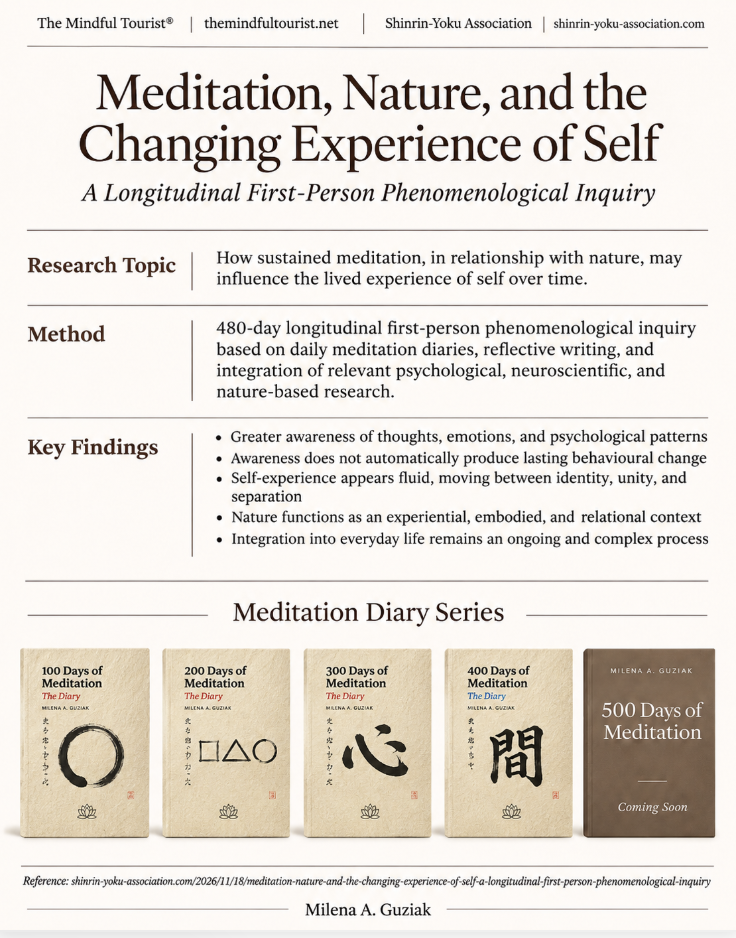
Does sustained meditation change who we are,
or does it change how we experience being ourselves?
This question lies at the centre of a new research
article by Milena A. Guziak, founder of
The Mindful Tourist® and the
Shinrin-Yoku Association.
The article, Meditation, Nature, and the
Changing Experience of Self: A Longitudinal
First-Person Phenomenological Inquiry,
examines sustained meditation through the
relationship between personal experience,
psychological research, neuroscience,
philosophy, and the natural world.
The inquiry draws upon an extended daily
meditation diary, considering how thoughts,
emotions, bodily sensations, personal identity,
and relationships are noticed and interpreted
across changing circumstances.
480 days
Longitudinal meditation inquiry
First-person
Phenomenological and reflective research
Interdisciplinary
Psychology · Neuroscience · Nature
What happens when we observe ourselves every day?
Meditation is frequently associated with calmness,
emotional regulation, mindfulness, and psychological
wellbeing. However, sustained contemplative practice
can also reveal uncertainty, conflicting motivations,
recurring emotional reactions, and questions that
do not disappear simply because we recognise them.
One of the central observations concerns the
difference between awareness and change.
Recognising a psychological pattern does not
necessarily mean understanding its origins,
and understanding does not automatically
lead to different behaviour.
Throughout the diary, questions concerning
acceptance and resistance, individuality and
unity, bodily existence and apparent transcendence,
and personal values and everyday responsibilities
return under different circumstances.
Rather than demonstrating a simple progression
toward permanent stillness or selflessness,
the study considers the possibility that
contemplative development involves recurring
tensions and changing interpretations.
Key research observations
01 · AWARENESS
Awareness is not the same as change
Becoming aware of thoughts, emotions,
and habitual reactions does not guarantee
immediate or lasting behavioural transformation.
02 · SELF-EXPERIENCE
The self is experienced in changing ways
The diary explores how personal identity,
bodily awareness, and the observing perspective
may change across contemplative experiences.
03 · UNITY AND SEPARATION
Contradictions can coexist
Experiences of unity and separation,
acceptance and resistance, and certainty
and uncertainty do not necessarily occur
as separate stages of development.
04 · EVERYDAY LIFE
Insight and action are different
The practical significance of contemplative
understanding may depend upon how it becomes
expressed through relationships, communication,
decisions, and responsibility.
Nature as part of the research
Nature has been an important part of the author's
meditation journey, from experiences in Japanese
forests to everyday life within the arid landscapes
of Mendoza, Argentina.
These contrasting environments provide opportunities
to examine the relationship between sensory attention,
bodily participation, personal memory, environmental
context, and nature connectedness.
Gardening, observing plants and insects, working
with soil and stones, and simply remaining still
outdoors can become meaningful forms of attentive
engagement.
Within this perspective, nature is not merely
a background for meditation. It is part of the
circumstances through which human beings
experience themselves and their relationship
with the wider living world.
Self-honesty and the limits of knowing ourselves
Another recurring theme concerns self-honesty.
We may believe that we understand our motivations,
values, and emotions while remaining unaware
of assumptions or habitual responses that
influence our behaviour.
The inquiry therefore distinguishes sincere
self-reflection from accurate self-knowledge.
It also considers self-honesty as a methodological
responsibility: a willingness to question preferred
interpretations and acknowledge uncertainty.
Why first-person research matters
Scientific investigations of meditation often involve
psychological questionnaires, behavioural tasks,
brain imaging, or physiological measurements.
These methods can reveal important information
about particular psychological and biological
processes.
A longitudinal personal diary offers a different
perspective. It allows recurring experiences,
contradictions, and changing meanings to be
considered across time.
The present research is exploratory. Its first-person
observations do not independently establish that
meditation caused particular psychological changes
or prove a definitive theory of consciousness.
Its contribution lies in bringing lived experience
into dialogue with scientific evidence.
Published research · Shinrin-Yoku Association
Read the full scientific article
Explore the theoretical foundations,
longitudinal diary observations,
scientific perspectives, discussion,
methodological limitations,
and directions for future investigation.
Read the Full Research Article →
The Mindful Tourist® · Professional Education
From research and personal practice to
professional education
The questions explored in this research are
also relevant to the educational philosophy
of The Mindful Tourist®. Understanding
mindfulness and meditation requires more
than learning a sequence of techniques.
It involves examining scientific evidence,
contemplative traditions, direct experience,
ethical responsibility, and the limitations
of what a guide can claim or provide.
Two professional training programmes
offer different opportunities to engage
with these subjects.
Professional Education · Mindfulness
Mindfulness Guide Training TMT®
Explore mindfulness through contemporary
psychology and neuroscience, historical
and cultural perspectives, Japanese
contemplative traditions, embodiment,
compassion, ethical facilitation,
and professional responsibility.
The programme examines both the
possibilities and limitations of
mindfulness practice.
Explore Mindfulness Training →
Professional Education · Meditation
Meditation Guide Training TMT®
A long-term learning pathway beginning
with 400 days of personal meditation
and reflective journaling, followed
by theoretical study and practical
preparation for guiding others.
The emphasis is on direct experience,
scientific understanding, personal
inquiry, and ethical responsibility.
Explore Meditation Training →
Books · Personal Reflection · Research
The Meditation Diary Series
The ongoing diary series includes
100 Days of Meditation,
200 Days of Meditation,
300 Days of Meditation,
and 400 Days of Meditation.
The next volume,
500 Days of Meditation,
is in preparation.
Explore the Books and Publications →
A question that remains open
Perhaps the most important question is not
whether meditation ultimately reveals a
permanent or unchanging self, but how
our relationship with thoughts, emotions,
identity, bodily existence, and the
surrounding world continues to change.
And within that changing relationship,
how do we come to live more consciously,
honestly, compassionately, and responsibly?
The inquiry remains open.