Living with Nature | Luján de Cuyo, Mendoza, Argentina
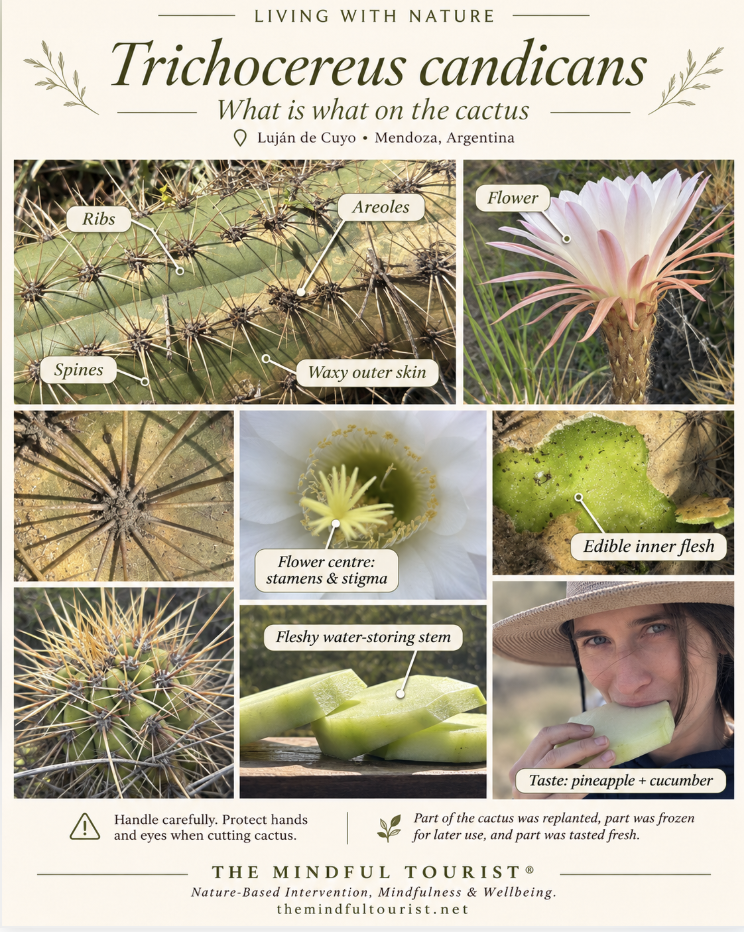
Pineapple and cucumber! That is the closest description I can give of the surprising taste I experienced when trying the fleshy stem of Trichocereus candicans, a cactus growing naturally in the arid landscape around my home in Mendoza, Argentina. I am sure almost everyone has heard that cacti contain water. We have all seen images of these extraordinary plants surviving in deserts, exposed to intense sunlight and long periods without rainfall. But have you ever wondered where that water comes from? In what form is it stored? Why does the inside of a cactus feel so moist? And what biochemical mechanisms allow a plant to survive in an environment where water can be scarce for months?
After a year of living at the foothills of the Andes, I am still discovering how much there is to learn about this landscape. Recently, what began as a rather difficult gardening task became another unexpected investigation into plant anatomy, chemistry, nutrition and the adaptations that allow life to persist in arid environments. Trichocereus candicans, also known under the botanical name Echinopsis candicans, belongs to the Cactaceae family. In Argentina, it is known by several common names, including cardoncito and manca caballo. This species is native to Argentina, occurring across the Monte and parts of the Espinal ecoregions. It commonly develops clusters of thick, ribbed stems, often growing outward rather than forming a single tall column. Some stems can approach a metre in length, while the central spines may reach approximately 11 centimetres.
It also produces extraordinarily beautiful flowers. The flowers are large, usually white with subtle pinkish or reddish tones on their outer segments, and may reach approximately 20 centimetres across. They are lightly fragrant, and their reproductive structures include numerous stamens surrounding a prominent stigma. The fruits are rounded or slightly elongated, changing towards golden-yellow, pink or reddish shades as they mature. Inside, they contain sweet pulp and numerous small, dark seeds.
Argentina’s National Parks Biodiversity Information System provides a detailed botanical description, while a CONICET Mendoza educational guide documents the species’ distribution, characteristics and edible fruits.
Unfortunately, I had to remove some of these cacti from parts of my land. With such long, strong spines, this required proper preparation. I needed heavy protective gloves, suitable clothing and a great deal of patience. But the biggest surprise was not above the ground. It was beneath it. As I began digging and pulling, I discovered roots extending much farther than I had anticipated. I kept digging, pulling and following them through the soil. Sometimes, I wondered whether I would ever reach their ends. I had previously thought about cactus roots primarily as structures responsible for anchoring the plant. But their role in water acquisition is especially fascinating.
Many desert cacti develop extensive, relatively shallow root systems that allow them to exploit rainfall before moisture disappears into deeper soil layers or evaporates. Some cactus roots can also respond rapidly when water becomes available, increasing their capacity to absorb it. The extensive network I encountered suddenly made much more sense. It was not simply an obstacle to removing the plant. It was part of a sophisticated system for surviving in an environment where water availability is unpredictable.
I decided to replant some of the removed sections. Others were set aside and frozen, while older, tougher lower sections were discarded. I was impressed by the apparent resilience of the plants and their ability to recover after disturbance. However, successful re-rooting depends on their condition, the season and whether cut surfaces can heal without developing rot.
When I examined the inside of the stem, I noticed how different it was from the dry, tough exterior. The internal tissue was pale, moist and fleshy. But where exactly was the water? In most cacti, water is primarily stored within specialised living cells called parenchyma cells, particularly in the stem’s inner cortex and pith. These cells contain large vacuoles: membrane-bound compartments that can occupy much of the cell’s volume. Water accumulates inside these vacuoles, helping the tissue remain swollen and hydrated. The cactus does not contain a hollow reservoir of freely flowing water. Instead, water is distributed throughout an extensive system of living cells. This is what allows the stem to function as a biological water-storage organ.
A 2022 review, Elastic and Collapsible: Current Understanding of Cell Walls in Succulent Plants, explains how specialised cell walls and highly vacuolated tissues enable succulent plants to expand and contract as water availability changes. In other words, the structure of the cactus is designed not only to store water but also to accommodate fluctuations in water content without its tissues being easily damaged.
Another important component is mucilage. Cactus mucilage consists largely of complex polysaccharides: long carbohydrate molecules made from smaller sugar units. These can include residues of arabinose, galactose, rhamnose and uronic acids, depending on the species and the particular mucilage fraction. Many of these molecules contain numerous hydroxyl groups (–OH), which can interact with water through hydrogen bonding. Together with their branched molecular structures, these interactions help create water-binding, gel-like systems. Mucilage therefore contributes to the physical and water-retaining properties of cactus tissues. This is particularly interesting from a chemical perspective. The plant’s ability to retain moisture does not depend on one substance alone. It emerges from the interaction of cellular compartments, membranes, cell walls, dissolved ions and water-binding polysaccharides. The moist texture I observed is therefore a manifestation of the plant’s remarkable internal organisation.
Storing water is only one part of surviving in the desert. The cactus must also avoid losing too much of it. One of the most remarkable adaptations is Crassulacean Acid Metabolism, commonly called CAM photosynthesis. In many plants, stomata — small pores involved in gas exchange — open mainly during the day to absorb carbon dioxide for photosynthesis. However, opening these pores also allows water vapour to escape. In an arid environment, that can become costly. Many cacti use a different strategy. Their stomata open predominantly at night, when temperatures are generally lower and humidity may be higher. Carbon dioxide absorbed during the night is converted into organic acids, primarily malic acid, and stored in cellular vacuoles. During the day, when the stomata are largely closed, the stored acids are processed to release carbon dioxide internally for photosynthesis. This means the plant can continue fixing carbon while greatly reducing the amount of water lost through transpiration.
Research on this process is reviewed in The Diverse Diaspora of CAM: A Pole-to-Pole Sketch. Interestingly, because malic acid concentrations fluctuate over the daily CAM cycle, the acidity of cactus tissues may also vary between morning and evening. Whether such changes noticeably influence the flavour of Trichocereus candicans has not, to my knowledge, been established. But it would be a fascinating question to investigate.
And now we return to my original discovery. The fleshy part of the stem reminded me of pineapple mixed with cucumber. Fresh, watery, slightly fruity and unexpectedly refreshing. But what creates that sensation? Flavour is not determined by one chemical compound. What we experience as taste is the combined result of several sensory processes: sweetness, acidity, bitterness, texture, temperature and aroma molecules reaching the olfactory receptors through the back of the mouth.
The characteristic fresh, green aroma of cucumber is strongly associated with certain volatile aldehydes. One particularly important compound is (E,Z)-2,6-nonadienal, which has a distinctive cucumber-like aroma even at very low concentrations. Other compounds, including hexanal, (E)-2-hexenal and (E)-2-nonenal, contribute to green, fresh and vegetal notes.
A study titled Profiling of Volatile Compounds and Associated Gene Expression and Enzyme Activity during Fruit Development in Two Cucumber Cultivars investigated how these aroma compounds change during cucumber development. This provides a useful chemical reference for understanding why certain plant tissues smell or taste cucumber-like. However, it does not establish that those molecules are present in Trichocereus candicans.
Pineapple has a very different aromatic profile. Its characteristic fruity smell involves several volatile esters, including ethyl 2-methylbutanoate, ethyl butanoate and ethyl hexanoate, alongside other aroma-active compounds. These molecules can contribute sweet, fruity and tropical notes. In a study titled Characteristic Aroma Compounds from Different Pineapple Parts, researchers used headspace sampling combined with gas chromatography–mass spectrometry to investigate the compounds responsible for pineapple aroma. The important point is that a relatively small number of highly aroma-active molecules can contribute significantly to our perception of a fruit.
Could my cactus contain a combination of green-smelling aldehydes and fruity esters? Possibly. =)
But I have not found a published species-specific volatile profile that would allow me to identify the compounds responsible for the flavour I experienced. For now, the pineapple-and-cucumber comparison remains my personal sensory observation. To investigate it scientifically, we would need to analyse the cactus tissue using techniques such as headspace solid-phase microextraction and gas chromatography–mass spectrometry (HS-SPME-GC-MS), ideally combined with sensory evaluation.
I find it fascinating that something I can describe in a few simple words might involve an intricate mixture of molecules that has not yet been characterised.
This question led me to another interesting area of research. If the stem contains so much water, what else is present within its tissues? A particularly relevant Argentine study was published in 2022: Chemical Profiling of Trichocereus Species from Northern Argentina, by Barbarich and colleagues, in the Journal of the Professional Association for Cactus Development. The researchers analysed four species: T. atacamensis, T. terscheckii, T. tarijensis and T. schickendantzii. They measured moisture content, carbohydrates, proteins, reducing sugars, fibre, phenolic compounds, antioxidant activity and selected vitamins. One particularly striking result was the high water content of the stems. Depending on species and season, the measured moisture content ranged from approximately 90% to almost 98%. The researchers also reported differences in carbohydrate and fibre composition, and detected compounds including thiamine (vitamin B1), riboflavin (vitamin B2), tocopherols (vitamin E compounds) and beta-carotene in the species assessed for vitamins. These results demonstrate that cactus stems contain much more than water. They are chemically complex living tissues containing structural carbohydrates, mineral constituents, metabolic compounds and substances involved in protection against environmental stress.
However, there is an important limitation. The study did not analyse Trichocereus candicans. Its findings cannot be used to assign a particular nutrient concentration or health benefit to the cactus growing in my garden.
Another extensive review, Opuntia spp.: An Overview of the Bioactive Profile and Food Applications of This Versatile Crop Adapted to Arid Lands, describes the nutritional composition of edible prickly pear cacti, including their dietary fibre, minerals and phytochemicals. But Opuntia and Trichocereus are different genera. Their chemical compositions and food-safety profiles should not be assumed to be identical. For T. candicans, more species-specific research is needed.
The fruit of Trichocereus candicans is documented as edible in Argentine botanical literature. However, evidence supporting the consumption of its fruit does not automatically establish that its stem or flowers are suitable for human consumption. I tried and it is delicious, too! =)
In fact, an older chemical study published in 1976, N-Methylated Tyramines from Trichocereus spachianus, T. candicans, and Espostoa huanucensis, reported alkaloid compounds in this species. This is an important reminder that plant tissues may contain biologically active compounds that cannot be detected through taste or appearance alone. My experience of tasting the stem is therefore a personal observation, not evidence of its safety as food. The material I froze would also require an appropriate food-safety assessment before any further consumption, since freezing does not remove such compounds. It is another example of why curiosity about nature needs to be accompanied by careful investigation.
The fruit offered an entirely different sensory experience. To me, its flavour and texture were reminiscent of a combination of kiwi and dragon fruit. Unlike the stem, the fruit is specifically described as edible in Argentine botanical references. The National Parks description identifies sweet pulp, while CONICET Mendoza describes juicy fruits with small, dark seeds. From a botanical perspective, these fruits also have an important ecological function. They protect and disperse seeds, making it possible for new plants to establish themselves. The fruit is therefore not simply a possible food resource. It is part of the cactus’s reproductive strategy and its relationships with other organisms. Although studies on other cactus fruits have identified sugars, organic acids, minerals, pigments and various phytochemicals, the precise nutritional profile of the fruit of T. candicans remains insufficiently documented. Once again, the observations invite further questions.
Another aspect that has fascinated me is how these cacti survive winter. Here in Luján de Cuyo, nighttime temperatures can occasionally fall to approximately −3°C. I have watched some of my aloe plants suffer severe damage during cold weather, while the cacti continue to survive. Why? Cold tolerance in plants involves several interacting factors, including membrane stability, tissue water content, the accumulation of certain dissolved compounds and the ability to avoid or tolerate freezing injury. However, I have not found sufficient species-specific experimental evidence to explain exactly how Trichocereus candicans tolerates the temperatures I have observed. Its growth habit may also influence the conditions experienced by individual stems. The cactus grows in dense clusters, and I wonder whether the outer stems provide some protection for those growing within. It seems possible that clustered growth might modify exposure to wind, sunlight and temperature, but I cannot conclude that this is the principal reason for its winter survival. I have also noticed pale or yellowish scars on the outer surface of some stems. Could these be caused by frost, intense sunlight, natural ageing or physical damage?
At present, I cannot be certain.
The distinction matters because similar-looking marks may arise from quite different causes. Nevertheless, the contrast between the harsh exterior and the living, water-filled tissue inside continues to fascinate me.
When I first started removing these plants, I was simply trying to make space in my garden. I expected hard work, long spines and complicated roots. I did not expect to find myself reading about water-storage parenchyma, polysaccharide chemistry, CAM photosynthesis, volatile organic compounds and nutritional research on Argentine cacti. Some sections were replanted. Some were discarded. Others became the starting point for questions about their chemical composition and potential uses. What began as a physical task gradually became a scientific investigation. That is what I find most meaningful about living with nature. Curiosity has no limits.
We often think that we must travel somewhere extraordinary to encounter something worth studying. Yet here, in a small garden at the foothills of the Andes, I continue discovering organisms whose biology is far more complex than I previously imagined. A cactus is not simply a plant covered in spines. It is a living system that captures water when it becomes available, stores it within specialised cells, manages its carbon metabolism according to the daily cycle of light and darkness, and survives environmental conditions that would be difficult for many other plants. Its flowers, fruits, roots and stems participate in different ecological relationships, many of which I am only beginning to understand. And its unexpected flavour has raised questions that I cannot yet fully answer.
The more time I spend with nature, the more I realise that observation is only the beginning of understanding.
Sometimes, all it takes is one cactus — and an unexpected reminder of pineapple and cucumber — to open an entirely new world of questions.