Emotional expression
Giving language to feelings that may be difficult to recognise, communicate or hold in awareness.
Sometimes we write not to explain our lives, but to encounter them. A page can become a place to notice a feeling, follow a question, remember, and gently discover what an experience means to us.
Some experiences ask to be lived.森の心 ・ 人の心
Others ask to be written.
Expressive writing is a form of private written reflection in which we explore our thoughts and feelings about experiences that matter to us. In research, it often involves writing continuously for approximately 15–20 minutes over several short sessions, without worrying about spelling, style, or the judgment of a reader.
Giving language to feelings that may be difficult to recognise, communicate or hold in awareness.
Considering what happened, why it matters, and how our understanding may change over time.
Paying attention to thoughts, memories, questions, and patterns without needing an immediate answer.
Not all journaling is the same. A daily log records events. Gratitude writing attends to things we value. Creative writing may transform experience into stories or poems. Expressive writing, as studied experimentally, usually invites exploration of personally significant emotions and experiences.
These approaches can overlap, yet their aims and evidence should not be treated as identical. There is no requirement to publish, share, or even reread what you write.
Writing does not need a special studio, a long retreat, or a carefully prepared ritual. The small moments in between can be enough to meet the page.

Beside a window, with a warm drink, or at the kitchen table—allow the everyday surroundings to become a place for honest reflection.
Photo: Letícia Alvares / Pexels ↗
Take a journal into the garden or a quiet green place. You might write about what you see, but also about what seeing awakens within you.
Photo: Kevin Malik / Pexels ↗
Carry a little notebook and pen. A sentence on a bus, a question after a walk, or a sudden moment of gratitude may become worth remembering.
Photo: Linh Tran DR / Pexels ↗Over the years, writing has become another way for me to observe life. It has taken the shape of poems, reflections, notes from the forest, and daily meditation journals. What began as moments of observation gradually became a record of hundreds of days: questions, uncertainty, quiet discoveries, and the changing movement of the mind.
Many of these reflections emerged alongside meditation and time spent in nature—from the forests of Japan to everyday encounters with the landscape around my home in Argentina. I began to notice that writing offered something different from thinking. When I put words on a page, I could return to an experience more attentively, without always needing to resolve it.
Some writing eventually became books. Some remains private. I do not write because I have all the answers. I write because I am still learning how to live, how to observe, and how to remain open to the human experience in all its complexity.
Writing is not always an attempt to understand an experience. Sometimes it is simply a willingness to stay with it.
A reflection on writing and attention
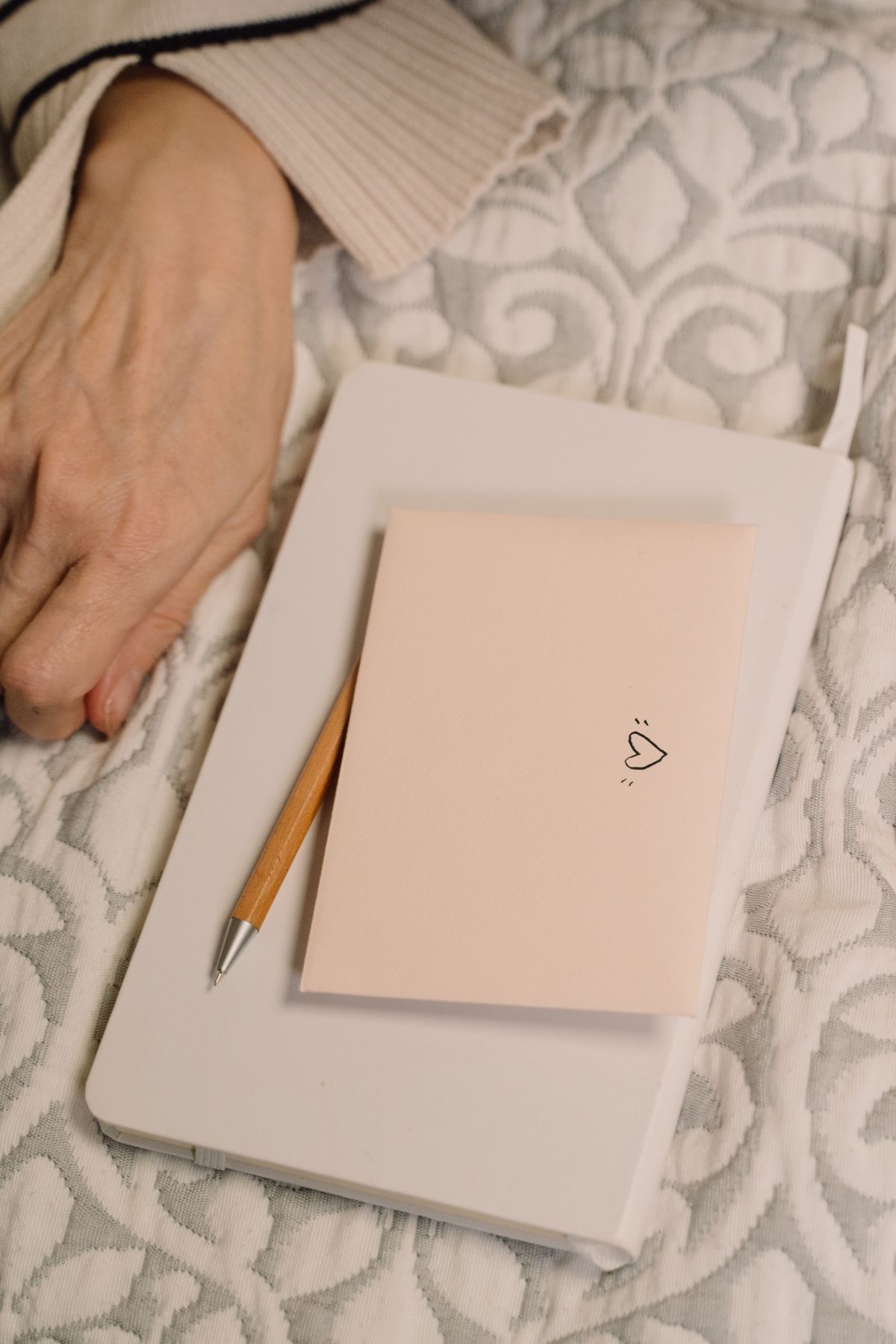
Some words arrive slowly. Others seem to have waited a long time to be heard. Writing from the heart is not about finding the most beautiful sentence, but allowing the page to hold something real.
It might be a letter to someone you love, words for someone you miss, a conversation with your younger self, or a private acknowledgment of joy, grief, hope or uncertainty.
You do not need to know what the next sentence will say in order to begin.
Let the words be unfinished if they need to be. You can decide later whether to keep them, share them, or simply let them go.
Discover the writing invitations ↗Expressive writing has been investigated for decades, beginning with pioneering studies by James W. Pennebaker and colleagues. The overall evidence is interesting, but it is not a promise that writing will improve health for everyone.
A 2006 meta-analysis of 146 randomised studies found a small average benefit across outcomes. A 2023 review of 31 studies found small improvements in depression, anxiety and stress symptoms at follow-up in healthy and subclinical samples. Frattaroli, 2006 ↗ Guo, 2023 ↗
Other reviews have found little or no benefit for particular outcomes. For example, a 2018 meta-analysis did not identify significant long-term reductions in depressive symptoms among physically healthy adults. Effects may depend on the person, context and writing approach. Reinhold et al., 2018 ↗
Researchers have considered emotional expression, cognitive processing and the construction of a coherent narrative as possible pathways. Simple emotional venting alone has not been established as the explanation for any benefits. Baikie & Wilhelm, 2005 ↗
Writing about an upsetting event is not the same as writing gratitude lists, recording everyday moments, or creating poetry. Each can have a place in life, but findings from one style should not automatically be applied to another.
The steps below are inspired by the expressive-writing research tradition, adapted as a gentle introduction. They are an invitation, not a prescription.
Find a place where you feel comfortable and can write privately. A notebook or blank document is enough.
Select something meaningful but manageable today. You do not need to begin with your most painful experience.
If it feels right, write for 15–20 minutes. Explore what happened, what you felt, and what the experience means to you.
Finish without judging the page. Look around, take a few comfortable breaths, and notice how you feel. You can stop at any time.
“What is present in me today that I have not yet given words to?”
“What did I notice outside today, and what did it awaken in me?”
“What is changing in my life, and how am I meeting that change?”
“What would I like to say to myself with more kindness?”
These open-ended invitations are original reflection prompts, not a clinical protocol or a validated intervention.
Follow this subject through personal reflections, published books and research-informed resources on The Mindful Tourist.
Browse the blog and select the Writing category for personal reflections, essays and questions from lived experience.
Explore the blog ↗ 02 / Books by MilenaExplore meditation diaries, forest poetry, Shinrin-Yoku writing and longer works that grew from observation and practice.
Discover the books ↗ 03 / Research by MilenaRead scholarly writing on nature connection, mindfulness, emotion regulation, forest experience and professional practice.
Explore research articles ↗A brief starting library of primary studies, reviews and meta-analyses. Some publisher pages may require institutional or paid access.
J. W. Pennebaker & S. K. Beall · Early experimental work on writing about upsetting experiences.
Open publication ↗ Meta-analysis · 2006J. Frattaroli · Analysis of 146 randomised studies, reporting a small average effect.
Open publication ↗ Clinical overview · 2005K. A. Baikie & K. Wilhelm · Overview of the approach, proposed mechanisms and important considerations.
Open publication ↗ Meta-analysis · 2018M. Reinhold, P.-C. Bürkner & H. Holling · A review reporting no significant long-term effect on depression in its selected population.
Open publication ↗ Meta-analysis · 2023L. Guo · Finds small symptom improvements at follow-up across included healthy and subclinical samples.
Open publication ↗ Systematic review · 2025A review of positive-focused approaches such as gratitude and best-possible-self writing, with limitations in study quality.
Open publication ↗Explore Opening Up by Writing It Down by Pennebaker & Smyth and Expressive Writing: Words That Heal by Pennebaker & Evans.
No. Expressive writing is about exploring experience, not producing polished prose. Grammar, spelling and style do not need to matter. You may write only for yourself.
No. You choose what feels manageable, and you can stop or change topics at any point. If you are dealing with trauma, significant distress or intrusive memories, supported work with a qualified mental-health professional may be more appropriate than an unguided exercise.
There is no requirement to reread or share the writing. Decide what feels appropriate for your privacy and wellbeing. Publication and private reflection serve different purposes.
No. Some people experience temporary sadness or discomfort, and research findings vary. A practice can be meaningful without creating an immediate mood improvement. If it repeatedly makes you feel worse, it is reasonable to stop.