The Life Beneath the Living with Nature | Luján de Cuyo, Mendoza, Argentina
As I work through the sandy soils, moving rocks of different sizes in an attempt to create a regenerative and sustainable desert garden, I have slowly come to realize that almost everything here has a function. Even the things I once considered obstacles, unwanted plants, or simply empty spaces.
One of my greatest discoveries has been the grasses. Where I come from, in Europe, grass seems to serve a few rather familiar purposes. It covers the ground, provides a soft surface on which to sit or walk, and creates the impression of a green, organised, and well-maintained garden. It is something we regularly mow, trim, water, and keep under control.
Here, in the desert landscape of Luján de Cuyo, Mendoza, I have begun to see grasses very differently. There are so many varieties of native grasses growing naturally among the sand, stones, and larger rocks. Strangely enough, many of these would probably be considered ornamental grasses if they were planted in a European city garden. Some grow in small, delicate tufts only a few centimetres above the ground. Others form rounded clusters of thin, elegant leaves, while certain species produce flowering stems that can reach approximately one metre or more in height. Their colours also change throughout the seasons. Some remain green, while others become silvery, golden, straw-coloured, or almost white. And all of this happens without anyone having deliberately designed the landscape.
The surprising diversity of native desert grasses
The Monte desert of Mendoza supports a remarkable variety of native grasses, many of which have evolved strategies for surviving long periods of limited rainfall, intense sunlight, wind, and considerable seasonal temperature variation. Among the species documented in Mendoza’s Monte vegetation are:
Flechilla (Aristida mendocina) — a perennial grass with slender leaves and characteristic narrow, bristle-like flowering structures.
Pasto criollo (Pappophorum caespitosum) — a tuft-forming perennial grass, recognised for its delicate flowering heads and tolerance of arid conditions.
Plumerito (Trichloris crinita, also known as Leptochloa crinita) — a native perennial grass with attractive feathery flowering structures, often reaching considerable height.
Pasto plateado (Digitaria californica) — a perennial grass that forms clumps and contributes to the herbaceous vegetation of dry landscapes.
Setaria leucopila — a perennial grass producing cylindrical, bristly flowering heads that resemble small foxtails.
Sporobolus cryptandrus — a perennial grass with fine leaves and airy flowering structures, associated with dry, sandy environments.
Panicum urvilleanum, commonly known as tupe or paja voladora — a perennial grass particularly interesting for its underground spreading system.
Neobouteloua lophostachya, sometimes called pasto crespo — a relatively low-growing perennial grass that forms part of the native Monte vegetation.
Munroa mendocina — a very small annual grass, sometimes only five to ten centimetres tall, capable of spreading across the surface through short horizontal stems.
These grasses differ considerably in their growth forms. Some remain low to the ground, others form compact tussocks, and some develop taller flowering stems. Not all of them necessarily grow on my land, and I am still learning to identify the species I encounter. But knowing that such diversity exists has changed the way I look at every small patch of vegetation. What I once might have called simply grass is now something I want to understand more closely.
Xerophytic plants: learning to live with little water
Many of these grasses, like other native desert plants, are adapted to dry environments. They are often described as xerophytic plants, or plantas xerófilas in Spanish. The word xerophilous comes from the Greek xēros, meaning dry, and philos, meaning loving or having an affinity for something. In botanical terms, xerophytic plants are those adapted to environments where water is scarce, either permanently or seasonally. This does not mean that they do not need water. All plants require water for their physiological processes. Rather, they possess different adaptations that allow them to survive where water availability is limited. Some develop narrow or reduced leaves, helping minimise water loss. Others have protective waxy surfaces or fine hairs that influence how the plant interacts with sunlight and the surrounding air. Some reduce their above-ground activity during dry periods, while others develop extensive root systems to make use of available moisture. Certain native perennial grasses also use the C4 photosynthetic pathway, which can provide advantages under warm, bright conditions, including relatively efficient water use.
What fascinates me is that there is no single solution to surviving in the desert. Each plant seems to have developed its own way of responding to the same environment. Some conserve water. Some wait for it. Some reach deeper into the ground, while others spread their roots through the upper soil layers to make use of rainfall when it arrives. And some almost disappear from view, only to return when conditions become favourable.
A hidden world beneath the ground: roots, rhizomes, and regeneration
One of the most interesting discoveries has been understanding that plants differ not only in how they appear above the ground, but also in how they grow beneath it. The root systems of native grasses are particularly important in desert ecosystems. Many grasses possess dense, fibrous root systems composed of numerous fine roots. These roots spread through the soil, helping anchor the plant, absorb water, and bind soil particles together. Such systems are especially valuable in sandy environments where the soil can be easily displaced by wind or running water.
But not all grasses grow in the same way.
Some form individual clumps or tussocks, gradually increasing in size as new shoots develop around the base of the plant. Others spread horizontally through underground stems known as rhizomes. Rhizomes are not technically roots, although they grow below the surface. They are modified stems capable of producing new shoots and roots at different points along their length. A remarkable example is Panicum urvilleanum, a native perennial grass whose spreading rhizomes allow it to extend into surrounding sandy soil. What appears above ground as several separate grasses may sometimes be connected through an underground network belonging to the same plant.
Other species spread through stolons, horizontal stems that grow along the soil surface. These may produce roots and shoots at their nodes, allowing vegetation to extend across the ground. The small annual grass Munroa mendocina is an example of a stolon-producing species.
There is also regeneration from surviving underground structures. During unfavourable periods, some perennial grasses lose much of their visible foliage while their underground or basal growing tissues remain alive. When water and suitable temperatures return, new shoots begin to emerge. This means that cutting away the visible grass does not necessarily remove the plant. Something continues living beneath the surface. And I find this particularly fascinating.
Olivillo: another beautiful plant that grows beneath the surface
Another plant that has captured my attention is olivillo (Hyalis argentea), a native Argentine species with beautifully silvery foliage and delicate pale-violet flowers. Although its narrow leaves and upright growth may sometimes make it resemble a grass from a distance, olivillo actually belongs to the Asteraceae family, the same large botanical family as daisies and sunflowers. Its silvery appearance comes partly from fine hairs covering its leaves and stems. Olivillo is particularly interesting because it is also a rhizomatous perennial plant. Its underground stems can spread horizontally and produce new growth, allowing it to form colonies in sandy environments. The species is recognised for its ability to colonise and stabilise sandy areas and dunes. This ability to spread and regenerate makes me reflect again on the importance of what happens beneath the surface.
What we see above the ground is only one part of the plant. Its capacity to survive, expand, and renew itself often depends on structures that remain completely invisible to us.
From a green lawn to a living desert garden
At the beginning of my relationship with this landscape, I wanted to create a nature connectedness path around the land where I live. That idea has not changed. The path exists today, winding among native grasses, flowering desert plants, and various species I have cultivated, including lavender and tomero, together with native shrubs such as jarilla and zampa that I have helped establish in different parts of the terrain.
But my understanding of what I was trying to create has changed considerably. Having grown up in Europe, I carried with me an image of what a green garden should look like. Grass was useful when it formed a lawn. When it appeared between flowering plants or in places where I had not intended it to grow, I would often regard it as something to remove… a weed.
I also associated a short, evenly maintained grass surface with a garden that was easy to use and manage. Yet I now realise how much continuous work is involved in maintaining that appearance. Short grass often requires regular mowing or trimming, particularly during periods of active growth. Edges must be maintained, taller plants removed, and the vegetation repeatedly prevented from developing its natural form. A conventional green lawn in an arid environment can also demand considerable irrigation.
There is something rather paradoxical about this.
In an attempt to create a garden that appears naturally green, we may end up working continuously against the natural growth patterns of the plants. Of course, shorter vegetation can be useful in places where people need to walk, sit, or gather. But does an entire garden need to be maintained in this way?
I am beginning to think that perhaps the path itself is the only place where I need to keep the vegetation relatively low. The surrounding grasses could simply be allowed to grow. Some would remain naturally small. Others would develop into beautiful clumps, with their flowering stems moving in the wind. The garden would still require care and occasional intervention, but my work would become more selective. Rather than repeatedly trimming everything to create a uniform surface, I could maintain the places needed for access while allowing the remaining vegetation to develop according to its own growth cycles. I am beginning to understand that a sustainable garden does not necessarily mean a garden without maintenance. It may mean a garden in which we learn when intervention is necessary and when leaving something alone is the more appropriate choice.
Grasses as protectors of the soil
As I observe the vegetation more closely, I am also beginning to understand the many ecological functions that native grasses perform. Their roots help hold the soil together, reducing erosion. Their leaves and stems provide partial shade, which can influence soil temperature and reduce evaporation from exposed surfaces. Dense clumps slow the movement of wind close to the ground, while their stems can trap windblown sand, seeds, and organic material. As older leaves and other plant material gradually decompose, they contribute organic matter to the soil. Native grasses also provide shelter and resources for insects and other animals, while influencing the conditions in which neighbouring plants establish themselves.
Not every interaction is beneficial. Grasses also compete with neighbouring plants for water, nutrients, sunlight, and space. But competition is part of an ecological community too.
The important lesson for me has been recognising that grasses are not simply occupying ground that could otherwise be used for more attractive plants. They are already participating in the functioning of the land. And much of their work takes place without us noticing.
Native grasses, fruit trees, and the black leaf-cutting ants
There is another relationship I have been observing here, although it is one I am still trying to understand. The black leaf-cutting ants. These small creatures seem particularly fond of my fruit trees. Sometimes I find them moving along established routes, carrying pieces of freshly cut leaves towards their underground nests. Leaf-cutting ants are fascinating organisms. They do not simply collect leaves to eat directly. They transport plant material to their nests, where they use it to cultivate the fungi on which their colonies depend. Their ability to select vegetation, organise collective work, and maintain underground fungal gardens is remarkable.
Of course, when they remove leaves from a young fruit tree that I have been trying to establish in the desert, my appreciation of their ecological role becomes somewhat more complicated. I have started wondering whether maintaining a greater variety of native vegetation, including grasses, around the cultivated areas might influence their foraging behaviour.
Different species of leaf-cutting ants have different preferences. Some specialise in broad-leaved plants, others harvest grasses, and some are capable of collecting both. Could the presence of alternative native vegetation sometimes reduce the attention given to cultivated plants? Perhaps, under certain circumstances. But this is still a question rather than a conclusion. Native grasses are not a proven or dependable barrier against leaf-cutting ants, and some ant species may harvest the grasses themselves. Their food choices depend on the species, the available vegetation, and local conditions.
What interests me is the possibility that the surrounding vegetation plays a role in the relationship between cultivated fruit trees and the insects already living on the land. Instead of viewing the ants solely as pests, I am beginning to observe their routes, preferences, and interactions with different plants. I still want to protect the young fruit trees, particularly while they are vulnerable. But I also want to understand the ants as part of this ecosystem.
Once again, I find myself confronted with the same question.
How much do I understand about the relationships already taking place here before deciding what should be removed, controlled, or protected?
The invisible garden waiting for water
I did not have to look very far for flowering plants either. What was initially required, in many places, was water. For approximately two months, I watered parts of the land every day. I had loosened some areas of soil, moved stones and rocks of different sizes, and prepared sections along the nature connectedness path. Then something rather extraordinary began to happen. Plants started emerging from places where I had seen nothing growing before. Small leaves appeared between stones. Delicate shoots began pushing through sandy surfaces. What had seemed to be bare earth slowly became populated with grasses, flowering plants, and other vegetation. Some may have emerged from seeds that had been lying dormant in the soil, waiting for suitable conditions. Others may have regenerated from roots, rhizomes, or other underground structures that had survived the dry period. And some seeds may have arrived more recently, transported by the wind or animals.
Water did not create life from nothing. It provided conditions in which life that was dormant, hidden, or not yet established could begin to emerge.
The desert, I began to understand, was not necessarily empty. Much of its life had simply remained beyond my perception.
The seasonal rhythms of the desert
Another discovery came through observing the plants across the seasons. Many native grasses and flowering plants are perennial, while others are annual species that survive unfavourable periods as seeds. Some perennial grasses remain partially green during the cooler months, while others gradually lose their colour and become pale yellow, golden, or brown. Their visible growth may slow considerably during winter or dry periods, only to resume when temperatures and moisture become more favourable. Some flowering plants continue to bloom during parts of winter, while others disappear almost entirely from view before returning in spring or summer. In my first encounters with this landscape, I sometimes interpreted dry grasses as dead plants. Now I am learning that dormancy is not necessarily death. The golden grasses of winter may still possess living structures beneath the ground. What appears to be an ending may simply be a period of reduced activity. And this offers another important reflection. Not every stage of life needs to be visibly productive. Sometimes the work of surviving, conserving, and preparing for renewal is happening where we cannot see it.
A garden that gradually requires less intervention
After one year of continuous work, I am beginning to notice another change. Many of the plants that have established themselves are gradually becoming more capable of surviving with less supplemental watering. Their root systems have developed. The grasses provide more ground cover, and accumulated plant material helps protect parts of the soil from direct sunlight and wind. The garden is slowly developing its own structure. Of course, establishing a garden in an arid environment requires careful use of water, and not every plant will become self-sustaining. Native plants differ in their moisture requirements, and some may still need assistance during extended periods of drought. But the more locally adapted vegetation becomes established, the more opportunities there may be to reduce irrigation and other interventions.
My role is changing. At the beginning, I was primarily trying to create a garden. Now, I increasingly find myself observing how a garden develops when given the conditions and time to do so. I still intervene, of course. I move stones when necessary, create and maintain walking spaces, water vulnerable plants, and sometimes remove vegetation that grows where it may interfere with the path or with newly established plants. But I am gradually learning to distinguish between work that is necessary and work that originates from my own expectations of how a garden should look. Even the rocks, which I initially considered obstacles, have become part of this learning. They influence the movement of water, create small sheltered spaces, and contribute to the physical structure of the terrain. The soil itself tells a story of this region, shaped by erosion, sediments, and the movement of materials from the Andes.
Perhaps the rocks do not all need to be removed.
Perhaps the grasses do not all need to be trimmed.
Perhaps the garden does not need to look like the gardens I once knew.
The limitations of human perception
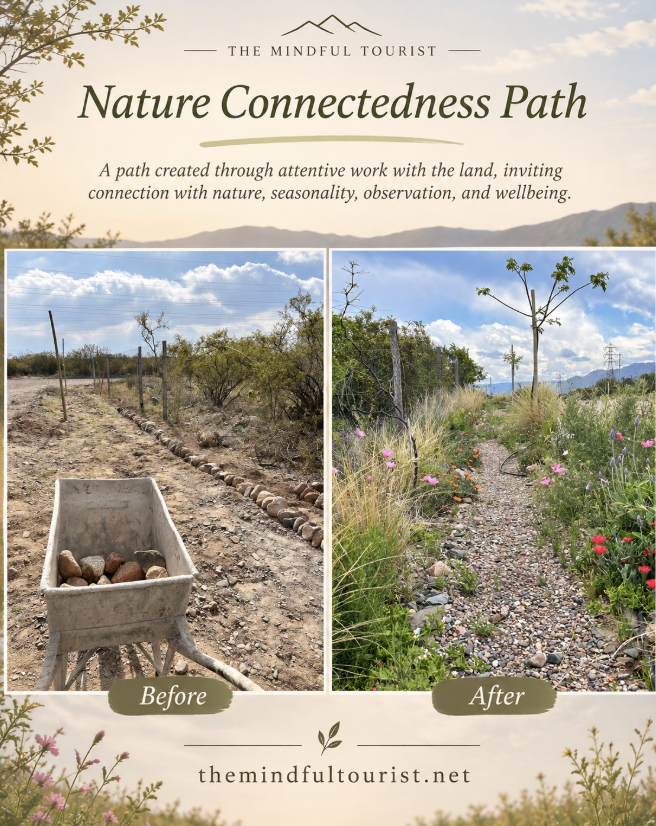
One year ago, much of the nature connectedness path was simply sand and rocks. At least, that was what I saw. Today, those same places are alive with native grasses, flowering plants, and an increasing variety of visible life. What has changed? Certainly, water has made a difference. My interventions have changed some of the physical conditions, while time has allowed the vegetation to develop. But another important change has occurred.
I have learned to see differently.
This experience has made me reflect on how easily we confuse what is visible with what exists. Just because something cannot be seen does not mean it is absent. We see bare soil and conclude that nothing grows there. We see dry grasses and assume they are dead. We see an arid landscape without the familiar greenery of our childhood and perhaps consider it poor, harsh, or lacking life. Yet beneath the sand may lie dormant seeds, surviving rhizomes, intricate root systems, and countless organisms that contribute to the functioning of the ecosystem. And beyond what is physically hidden, there are relationships we may not recognise simply because we have not observed them long enough. What if the problem is not always the absence of life? What if, sometimes, it is our inability to recognise the forms in which life exists? How much of the world remains invisible to us because we have not learned how to observe it? And how often do we intervene before understanding what is already taking place? These questions have gradually become as important to me as the practical work of cultivating the garden.
The gift of water, time, and observation
After one year of working with this land, the nature connectedness path has become something quite different from what I initially imagined. It is no longer simply a path that I am creating through the desert. It is a place where I am learning to recognise the desert itself. Native grasses grow between flowering plants. Some areas are dense with vegetation, while others remain open, exposing sand, stones, and rocks. There are plants I deliberately cultivated, plants I helped establish, and many others that appeared without my having planted them. The garden is becoming a mixture of human intention and ecological processes that extend far beyond my control. And I find something deeply beautiful in that. The gift of water. The gift of time. The gift of observing something previously invisible becoming visible. But perhaps, above all, the gift of recognising that nature does not necessarily need us to decide what belongs where, what is beautiful, or what deserves to remain. Rather, it invites us to observe more carefully, to understand relationships, and to recognise the consequences of our interventions. One year of continuous work has taught me much about soil, rocks, roots, rhizomes, grasses, water, and the many forms of life that inhabit the desert. It has also taught me about patience, perception, and the limitations of what I think I know. What I once saw as an almost empty landscape of sand and stones, I now recognise as a living ecosystem. A place where life may remain dormant for months, where underground structures allow plants to regenerate, where grasses protect the soil, and where even the smallest organisms participate in relationships that I am only beginning to understand.
I came here wanting to make the desert green. During one year, I have begun to understand that the desert was already alive.
And I wonder how much more there is still to discover.