Living with Nature | Luján de Cuyo, Mendoza, Argentina
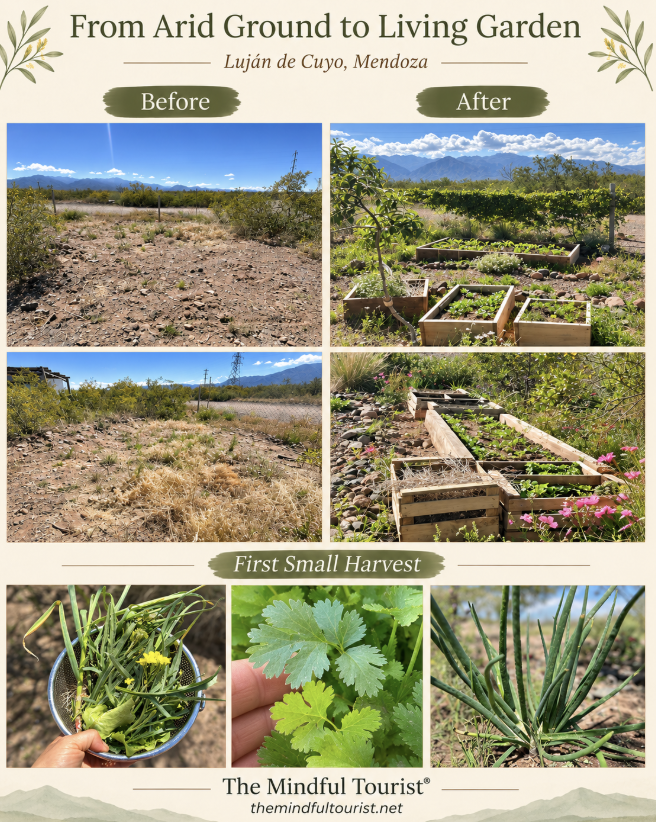
A handful of coriander, green onions, and tender leafy greens. Not much compared with what one might expect from a conventional vegetable garden, but for me, a meaningful beginning. For the past year, I have been working with the arid land surrounding my home in Luján de Cuyo, at the foothills of the Andes, learning about its sandy soils, countless stones, native vegetation, and the challenges of cultivating plants where water is such a precious resource. Some things grow beautifully. Others struggle. Some surprise me by emerging without being planted at all. And many of my original ideas about gardening have gradually changed.
Growing up in Europe, I developed a particular understanding of what a garden should look like and how it should function. I was accustomed to the idea that, with sufficient preparation, most areas of land could eventually become suitable for cultivation. Here, I am discovering something quite different. Not every part of the land is suitable for growing vegetables, at least not without extensive intervention. Well… perhaps not every part of the land needs to be transformed.
Learning to recognise the differences beneath my feet
There are two particularly challenging types of soil across the terrain I now call my garden. The first contains an extraordinary number of stones, ranging from small gravel to rocks that require considerable effort to remove. Sometimes, when digging, it seems there are more stones than soil. To transform these areas into conventional vegetable beds, I would need to excavate large quantities of material, remove what could amount to tonnes of stones, and replace much of the existing ground with soil suitable for cultivation. There would be a substantial financial cost. But there would also be an ecological cost. The stones are not simply obstacles. As I have been discovering over the past year, they influence erosion, water movement, soil temperature, and the small habitats that exist around them. Removing them on such a scale would mean substantially altering the structure of the terrain. I began to question whether this was really necessary.
The second type of ground is much looser and sandier. Here, roots may encounter fewer physical obstacles, and the soil is considerably easier to work. But sandy soil brings its own challenges. Water can drain rapidly, nutrients may be easily lost, and organic matter is often limited. The exposed surface can become extremely hot during Mendoza’s summer months. And then there are the animals living beneath the ground.
The little tuco-tucos beneath the garden
One of the most fascinating, and occasionally frustrating, inhabitants of this landscape is the tuco-tuco, a small native subterranean rodent belonging to the genus Ctenomys. These animals spend much of their lives underground, constructing networks of tunnels and galleries. Different species inhabit different parts of Argentina, including the arid landscapes of Mendoza. They feed on plant material, including roots and other vegetation, and their digging activities influence the physical structure of the soil. I have so much to say about these little creatures that they probably deserve an article of their own. They are rather endearing animals, although I must admit that living alongside them has introduced some unexpected gardening challenges. On one occasion, I noticed that a young native tree I had planted had suddenly begun to lean. At first, I could not understand what had happened. It had appeared to be establishing itself, and there had been no obvious reason for it to lose its stability. When I investigated, I discovered that its root system had been severely damaged, apparently eaten by the animals living beneath the soil. Eventually, the tree had to be removed. It was a disappointing experience, particularly because I had invested time and care in helping it become established. Yet I am also learning that tuco-tucos are not simply animals that interfere with my gardening plans. Their excavation activities move soil, influence its physical structure, and affect how water, nutrients, and vegetation are distributed. In other words, they are participating in the functioning of this desert ecosystem. This creates an interesting dilemma. I want to grow plants and protect their roots. But I also recognise that these animals belong to the landscape, and that my garden is developing within their habitat. How do we cultivate food without assuming that every animal interfering with our plans must be removed? I am still learning how to navigate this relationship.
And then there are the black leaf-cutting ants
While the tuco-tucos challenge what grows beneath the ground, the black leaf-cutting ants have introduced another problem above it. I have written about these remarkable insects before. They seem particularly interested in some of the fruit trees and other cultivated plants I have been trying to establish. Their collective organisation is fascinating. Workers travel along established routes, cutting pieces of vegetation and carrying them back to their underground nests. The collected plant material is used to cultivate the fungi on which their colonies depend. It is an extraordinary relationship between insects and fungi. But watching them remove leaves from a young tree that I have spent months trying to establish can be rather discouraging.
I am beginning to understand that cultivating plants in this environment requires considering not only soil, water, sunlight, and temperature, but also the existing relationships between plants and animals. The garden is not an isolated space. It is part of a much larger ecological community.
Why I decided to create raised vegetable beds
After considering these challenges, I decided to change my approach. Rather than attempting to transform large areas of rocky ground into conventional vegetable gardens, I began constructing raised beds and wooden planting boxes.
Some are made from timber I found, while others use repurposed wooden pallets and materials already available to me. This approach allows me to cultivate food in areas that would otherwise require extensive excavation and soil replacement. Instead of removing tonnes of stones, I can create a contained growing space above the existing ground.
I purchased approximately three cubic metres of growing soil to fill the beds and provide a better starting environment for vegetables. The raised beds offer several advantages. They allow me to improve soil composition in a relatively small, defined area. They make watering and plant care more manageable. They also reduce the need to disturb the surrounding rocky terrain. Depending on how their bases are constructed, raised beds can offer some protection against burrowing animals, although an open-bottomed wooden bed alone will not necessarily stop tuco-tucos from reaching the roots. Similarly, the beds do not automatically prevent leaf-cutting ants from climbing up and accessing the plants. These problems still require observation and thoughtful management. But the raised beds offer a more manageable way of responding to the challenges of the terrain without attempting to completely reconstruct it. And most importantly, they allow me to cultivate food while leaving much of the surrounding native vegetation undisturbed.
Composting: learning to return organic matter to the soil
Another important part of this garden began last year, when we dug a large hole to create a composting area. Since then, we have been collecting suitable organic kitchen scraps and garden materials, allowing them to gradually decompose. What was once considered waste becomes part of a process through which organic matter can eventually return to the soil. In a dry environment such as Mendoza, composting requires attention to moisture and the balance of materials, since decomposition can slow considerably when conditions become too dry. I have also experimented with digging smaller holes in appropriate areas of the garden to incorporate organic material and gradually enrich the ground. I am learning to distinguish between adding fresh organic scraps and incorporating properly decomposed compost, particularly near food crops where hygiene and plant health are important.
This process is slow.
It does not transform sandy or rocky soil overnight. But over time, mature compost can improve soil structure, contribute nutrients, support soil organisms, and increase the capacity of sandy soils to retain moisture. I find this process particularly meaningful. The remains of vegetables and other organic materials do not simply disappear. They become part of a continuing cycle of decomposition and renewal. Something that once nourished us can eventually contribute to the nourishment of future plants.
Growing food alongside native desert vegetation
One of the things I appreciate most about the garden now is that the vegetable beds do not stand apart from the surrounding landscape. They are situated among native grasses, shrubs, flowering plants, stones, and the nature-connected paths I have been developing over the past year. There are cultivated herbs and vegetables, but also plants that appeared naturally, without my intervention. Some of these have grown after I began watering areas that had previously appeared almost entirely barren. Others were already there, although I had not initially recognised their importance. The garden is gradually becoming a mixture of deliberate cultivation and natural ecological processes.
I am not trying to recreate a European garden in the desert. At least, not anymore.
I am beginning to appreciate that the beauty of this landscape lies partly in its differences from the places where I grew up. The grasses do not need to remain uniformly green throughout the year. The soil does not need to be completely covered. The stones do not all need to be removed. And not every plant needs to be cultivated for human consumption. Some plants provide shelter for insects. Others help stabilise the soil. Some contribute organic matter as they grow and decompose. Others simply belong to this landscape and have established themselves through processes that existed long before I began working here. The vegetable beds are only one small part of this developing relationship.
The garden is far from finished
Looking at the photographs from last year and comparing them with how the garden appears today, I can see that a great deal has changed. Areas that once appeared almost entirely covered with stones and dry vegetation now contain raised beds, cultivated plants, flowering areas, and emerging grasses. But the garden is far from finished. There are still places where plants struggle to establish themselves. There are sections where the soil needs improvement, where irrigation must be adjusted, and where the growth of native vegetation changes my original plans. There are animals whose behaviour I am only beginning to understand. And there are still many days when I question whether a particular intervention was necessary or beneficial.
I am learning that creating a sustainable and regenerative garden is not simply about choosing the right plants or installing the right structures. It is about developing an understanding of the ecological relationships that already exist. It involves experimentation, observation, mistakes, adaptation, and sometimes the willingness to abandon an original idea. What works in one part of the garden may not work in another, even when the distance between them is only a few metres.
There is no universal approach that can be imposed on every landscape without considering its particular conditions.
A handful of vegetables, and a different understanding of abundance
And so, after a year of working with this land, I find myself holding my first small harvest. A handful of coriander. Some green onions. A few tender leafy greens. They may appear insignificant compared with the abundance of a well-established vegetable garden. But when I look at them, I see much more than food. I see the rocky ground that I decided not to excavate. I see the sandy soil that taught me about the importance of organic matter and water. I remember the native tree whose roots were damaged beneath the surface. I think about the leaf-cutting ants, the tuco-tucos, and the countless other organisms that inhabit this landscape. I see the wooden beds we constructed, the soil we brought in, and the compost that has been slowly developing since last year.
And I remember all the moments when I had to reconsider what I thought I knew about gardening. There is something particularly satisfying about gathering food that I have watched develop from a tiny seed. But the greatest satisfaction comes from recognising how much I have learned through the process.
Gardening is not simply about producing food. It is about understanding the conditions that allow life to grow, learning when to intervene, and recognising that every landscape has its own rhythms. This small harvest has made me reconsider the meaning of abundance that abundance should not always be measured by the quantity of what we produce – it can also be found in the relationships we develop, the knowledge we gain, and the care with which we participate in the living world.
My first harvest may be small, but the experience that brought it into existence has been immeasurably rich. Before a sald made of gathered greens, with my husband we said words gratitude to the universe and pachamama.