The Invisible Chemistry of the Forest: Understanding Phytoncides
Exploring the ecological origins, chemical diversity, and possible relevance of forest volatile organic compounds to human well-being and Shinrin-Yoku.
What exactly are phytoncides?
Forest air contains a complex mixture of naturally occurring chemical compounds.
Some originate from trees, others from surrounding vegetation and organisms within the ecosystem.
When we enter a forest, we encounter more than its visible landscape. We also enter a chemically dynamic atmosphere shaped by living organisms and their interactions.
Among the substances associated with forest environments are compounds commonly referred to as phytoncides.
The term frequently appears in discussions of Shinrin-Yoku, forest bathing, and forest therapy, particularly in connection with possible human health benefits.
However, the scientific meaning of phytoncides is more complex than the popular description of "healing substances released by trees."
To understand their significance, we must consider their historical origins, ecological functions, chemical diversity, and the limitations of current health research.
More than forest fragrance
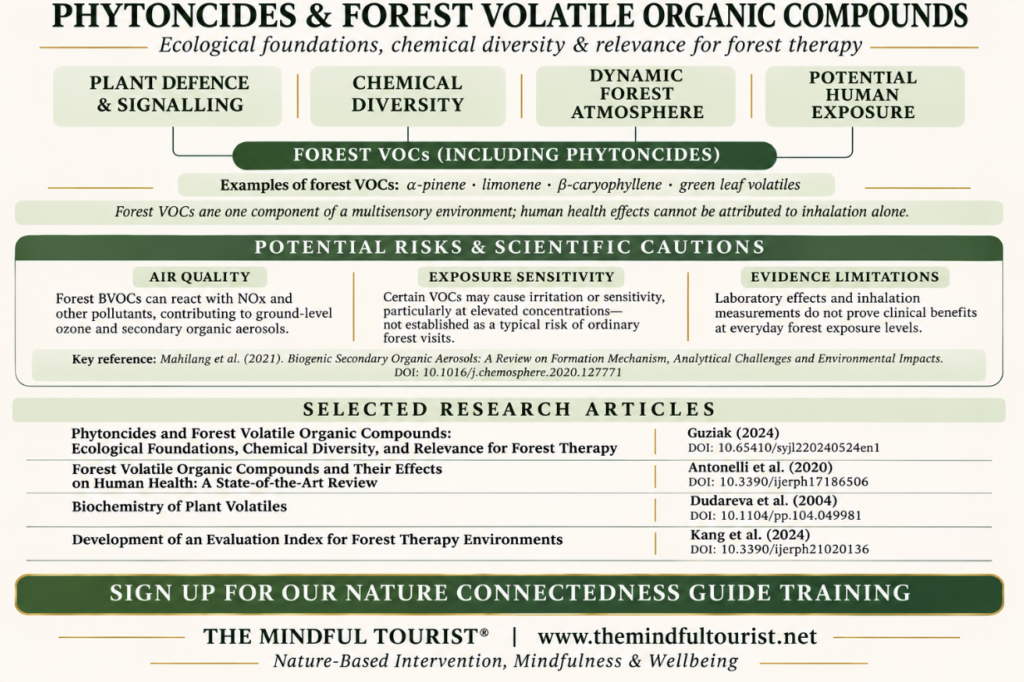
Phytoncides and forest volatile organic compounds can be investigated through several interconnected scientific perspectives.
Ecological Functions
Plants produce biologically active substances involved in defence and ecological interactions. Their chemical activity extends beyond the boundaries of the individual organism.
Molecular Diversity
Forest emissions contain multiple classes of organic compounds. Differences in molecular structure influence their properties, atmospheric behaviour, and biological activity.
Potential Physiological Relevance
Researchers are investigating whether exposure to certain plant-derived volatile compounds contributes to physiological responses associated with spending time in forests.
A scientific concept with a longer history
The concept of phytoncides predates the contemporary development of Shinrin-Yoku and forest therapy.
Its historical foundations are associated with research on biologically active substances produced by plants, particularly the work of Soviet biologist Boris P. Tokin.
What began as investigations into plant antimicrobial activity opened broader questions about chemical interactions between plants, microorganisms, and their environments.
These origins are important because they place phytoncides within plant biology and ecology, rather than defining them primarily through their possible effects on humans.
Forest air is not chemically static
In contemporary environmental chemistry, the broader term biogenic volatile organic compounds (BVOCs) is useful when discussing volatile substances emitted by living organisms.
Forest VOCs include chemically diverse compounds, among them several classes of terpenes and other plant-derived volatiles.
Their presence and concentration may vary considerably between forest environments and across different conditions.
This variability has implications for how forest atmospheres are measured and compared, and for how evidence concerning forest exposure is interpreted.
What shapes forest air?
These variables do not determine health outcomes by themselves, but they help explain why forest VOC exposure varies.
Can forest VOCs influence human physiology?
This question has attracted increasing scientific interest, especially within research on forest bathing and nature-based health interventions.
Certain plant-derived compounds demonstrate biological activity under experimental conditions, and researchers have explored possible relationships with immune function, inflammation, stress physiology, and nervous-system processes.
However, an important distinction must be made between demonstrating biological activity in laboratory experiments and establishing clinically meaningful effects from ordinary exposure to forest air.
Spending time in a forest is a multisensory and context-dependent experience.
Visual surroundings, sounds, physical activity, environmental conditions, psychological expectations, and personal experience may all contribute to observed responses.
Forest VOCs are therefore best investigated as one possible component of a broader environmental experience, rather than as a complete explanation for the effects associated with forest bathing.
Why does this matter for forest therapy guides?
Understanding forest environments involves more than recognising that trees release chemical compounds into the atmosphere.
It also requires awareness of ecological variability, environmental conditions, and the limitations of scientific interpretation.
For Shinrin-Yoku and forest therapy guides, this raises questions about how knowledge of forest chemistry can inform site assessment, session planning, and communication with participants.
The full research publication examines these questions and considers the relevance of environmental science to responsible guided practice.
Phytoncides and Forest Volatile Organic Compounds: Ecological Foundations, Chemical Diversity, and Relevance for Forest Therapy
This article introduces several of the scientific questions examined in my original publication in the Shinrin-Yoku Journal.
The complete research explores the historical development of the phytoncide concept, chemical and ecological characteristics of forest VOCs, environmental variability, research concerning human health, and implications for forest therapy.
Readers interested in the scientific evidence, detailed comparisons, references, and critical discussion are invited to explore the original article.
Full-text access is available through free Shinrin-Yoku Association membership.
Explore Nature Connectedness Guide Training TMT®
Discover the science, psychology, and lived experience of human relationships with nature, alongside ethical and evidence-informed guiding practice.