The Mindful Tourist Nature-based Interventions, Mindfulness & Wellbeing
✦ SHINRIN-YOKU GUIDE TRAINING TMT® ✧ PATHWAY 1: SELF-PACED ✧ START ANYTIME ✧ COMPLETE WITHIN ONE YEAR ✧ USD $599 ✧
The Mindful Tourist TMT® · Professional education · 森林浴

Shinrin-Yoku
Guide Training

Learn to guide people into a more attentive relationship with nature. An experiential, research-informed education in Shinrin-Yoku, forest bathing and forest therapy—with ethics, reflection and responsible practice at its heart.

Three learning modules10 required practice sessionsSYA-accredited training
Beyond a collection of forest activities

The art of guiding begins with how we relate.

Becoming a Shinrin-Yoku Guide is not about learning a fixed script to deliver to others. It is about developing the sensitivity, knowledge and practical judgement to work with people and living environments.

We bring together the historical and cultural roots of Shinrin-Yoku, scientific inquiry, nature connectedness, ethical reflection, sensory invitations and carefully planned practice sessions. Guides learn to observe rather than impose, to adapt rather than repeat, and to acknowledge both the possibilities and limitations of their role.

The aim is to foster thoughtful, independent practice that considers the wellbeing of the guide, participants and the forest itself.

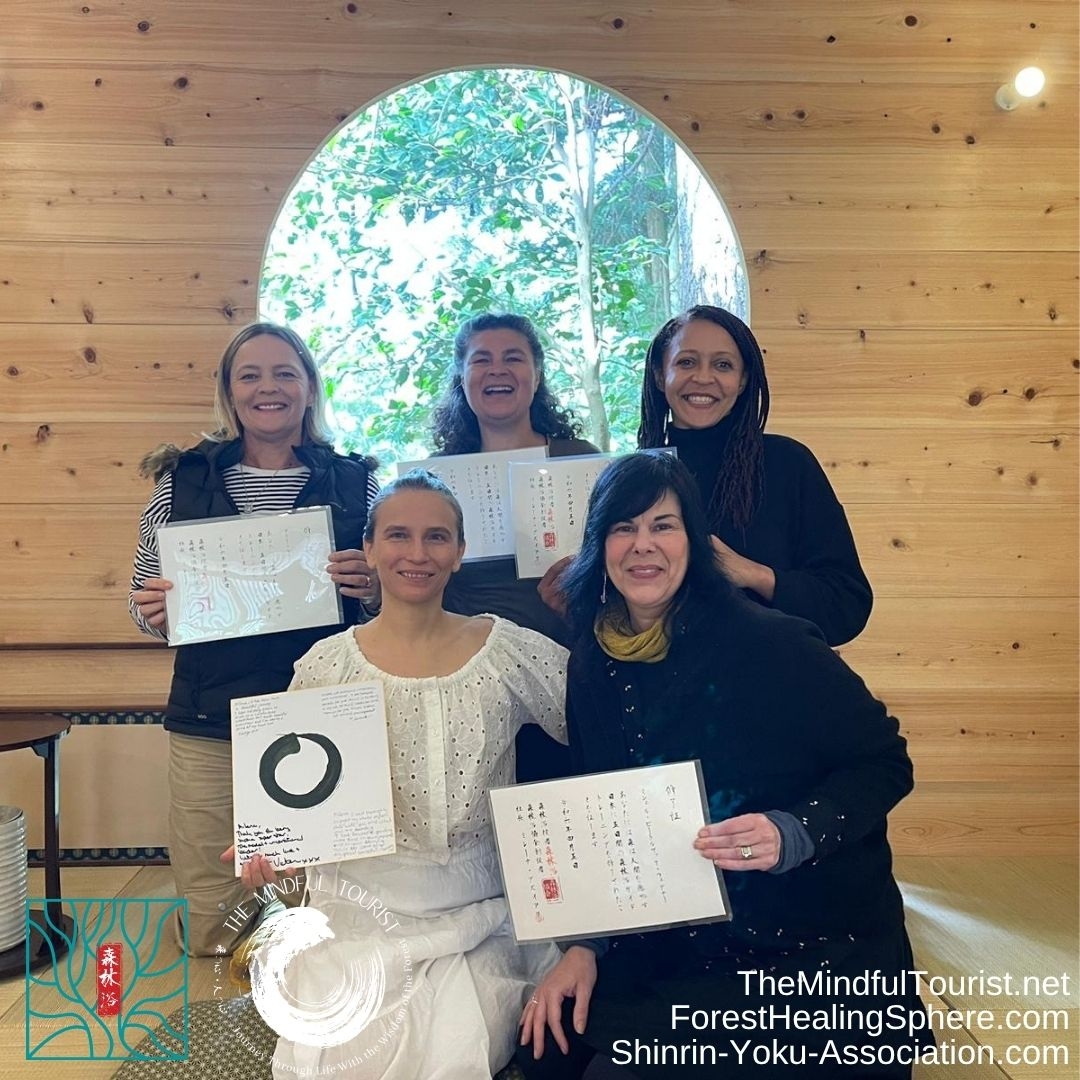
Shinrin-Yoku Guide Training participants celebrating completion of their training in Japan Professional learning through reflection, practice and human connection.
15Core curriculum weeks
3Learning modules
10Required guide-led sessions
20+Practice contact hours
Choose your way of learning

Three pathways. One commitment to responsible guiding.

Our learning routes accommodate different circumstances. All follow the professional principles of the Shinrin-Yoku Guide Training TMT®; support format, pacing and practical arrangements vary.

A winding path within a green forest Independent learning
01
Independent · Online

Self-Paced Training

Work through the 15-week course structure at your own pace, with readings, reflections, invitations, assignments, practice documentation and feedback as described on the official course page.

Explore Pathway 1
Gentle sunlight shining through a forest canopy Guided mentorship
02
Mentor-Assisted · Online

Learn With a Mentor

A structured online option with guided discussion, reflective assignments, practical learning and mentor support. Availability and meeting arrangements depend on the current cohort.

Explore Pathway 2
Japanese-language certificate presented during a Shinrin-Yoku immersion in Japan Japan immersion
03
Online + In Person · Japan

Blended Immersion in Japan

Ten weeks of online study followed by a five-day immersion in Japan, integrating cultural context, nature connection, practice and reflection. See the course page for future edition dates.

Explore Pathway 3

Schedules, fees, places and mentoring arrangements may change. The linked enrollment pages are the source for current availability and binding terms.

A thoughtful rhythm · one week at a time

How every week is structured

The training offers an intentional balance between learning from others and learning directly from nature. Rather than treating knowledge, reflection and practice as separate activities, we invite you to bring them into conversation.

In Weeks 1–10, you will typically find weekly requirements, learning resources, an invitation, guidance for your solo practice and reflective questions. In Weeks 11–15, the emphasis gradually shifts towards your own guided sessions, documentation and evaluation. The precise format of meetings and feedback depends on the pathway you choose.

Reflection without performance: your personal Reflection Journal is a place for sincere observation. Required module submissions and practical documentation are identified separately in the course.
Soft morning light illuminating a quiet woodland
A little time in nature, returned to each week, becomes a way of learning.
01

Read & understand

Begin with the weekly requirements, research-informed readings, video presentations and cultural or scientific context.

02

Receive an invitation

Explore a weekly Shinrin-Yoku invitation. Notice not only what you do, but how different invitations change the quality of attention.

03

Go into nature

Undertake regular solo forest or nature practice. Your own relationship with the living environment is part of your education.

04

Reflect & record

Use the week’s reflective prompts in your personal journal. You are not expected to answer every question or arrive at a “correct” answer.

05

Prepare to guide

Complete relevant practice-preparation tasks: observe sites, consider the group, design invitations and learn to document decisions.

06

Integrate & connect

Bring your insights into assignments, forum discussions and module review meetings. Instructor feedback supports your development.

At the end of each module: submit the required work, arrange a summary conversation with the founder/instructor as specified in your programme, and receive feedback before continuing. An additional consultation takes place before the practical module, followed by a final check-out after all requirements are fulfilled.
The learning journey · Full 15-week core

From foundations to lived practice.

The curriculum moves through three connected modules. Select any week below to explore its learning focus. Every week also incorporates appropriate course reading, invitations, preparation and reflection.

Module 01 · Weeks 1–5
森林浴

Shinrin-Yoku

The foundations: history, science, ethical conduct, forest environments and nature connectedness.

Week 01From Phytoncide Therapy to Forest Therapy
  • Historical perspectives on phytoncide therapy and the evolution of the field.
  • Scientific and cultural roots of Shinrin-Yoku.
  • Preparing for solo practice, invitations and reflection.
Week 02SYA Code of Conduct & Applied Ethics
  • Shinrin-Yoku Association professional principles.
  • Adapting sessions for different target groups.
  • Ethical scenarios, role boundaries and responsible decisions.
Week 03Shinrin-Yoku in Japan
  • The Japanese cultural and historical context of Shinrin-Yoku.
  • Links between local practice, cultural understanding and guiding.
  • Practice preparation and weekly reflection.
Week 04Phytoncides & Forest Environments
  • Discovery and understanding of phytoncides.
  • Evaluation of forest therapy environments.
  • Seasonal and geographical variation in forest volatile compounds.
Week 05Five Pathways to Nature Connectedness
  • Urban Shinrin-Yoku and forest bathing.
  • The Five Pathways to Nature Connectedness.
  • Vertical and horizontal nature connection.
At the end of the module: submission requirements and a Module 1 summary meeting, as applicable to your pathway.
Module 02 · Weeks 6–10
心

Kokoro
The Art of You

Understanding the inner qualities of guiding: wellbeing, sensory awareness, values, empathy and compassion.

Week 06Wellbeing of the Guide, Participants & Forest
  • Shinrin-Yoku as a nature-based intervention.
  • Motivations and expectations of guides and participants.
  • Hedonic and eudaimonic wellbeing within a wider circle of influence.
Week 07Sensory Activation & Invitations
  • The senses as a foundation for designing invitations.
  • Degrees of Freedom of Invitations TMT®.
  • Practice in flexible, participant-centred facilitation.
Week 08Personal Values & Values Towards Nature
  • Values in the human relationship with nature.
  • Why personal values matter to professional guiding.
  • Reflection on how values shape session decisions.
Week 09Gratitude, Empathy & Compassion
  • Research perspectives on gratitude.
  • Empathy and compassion in the guide–participant relationship.
  • Ethical and responsive approaches to facilitation.
Week 10Designing Your Shinrin-Yoku Session
  • Integrating knowledge into an adaptable session design.
  • Documentation and forms required for practice sessions.
  • Assignments, session preparation and reflective evaluation.
At the end of the module: a Module 2 summary meeting and preparations for the practical phase.
Module 03 · Weeks 11–15 + practice completion
森の中

Mori no Naka
The Art of Your Practice

Moving from preparation to professional practice, documentation, feedback and final assessment.

Week 11Practice Orientation & Session Design
  • Practice requirements, registration forms and session protocols.
  • Session elements and degrees of freedom in invitations.
  • Preparation for facilitating and documenting real sessions.
Week 12Practice Session 1
Plan, conduct and reflect on your first guide-led practice session, with documentation and an invitation.
Week 13Practice Session 2
Build on initial experience, participant feedback, safety planning and self-evaluation.
Week 14Practice Session 3
Further develop facilitation, pacing, presence, group or individual responsiveness and reflective learning.
Week 15Practice Session 4
Complete the fourth scheduled practice, evaluate your progress and plan the remaining sessions.
After Week 15Practices 5–10 & Final Evaluation
Complete the remaining practice sessions, required documentation and the final assessment. Certification follows successful fulfillment of the applicable requirements.
The practical component requires 10 sessions in total, not only the first four scheduled in Weeks 12–15.

The outline above follows the current Pathway 1 lesson listing. The learning platform also contains orientation, copyright information, solo-practice guidance, professional resources and assessment instructions.

A Japanese-language Shinrin-Yoku Guide certificate being presented during immersion training
Learning that connects understanding, practice and professional responsibility.
What your training includes

More than course access. A foundation for your own practice.

The programme is designed to support the whole journey—from first reading and reflection through to real sessions, professional feedback and a community of guides who continue to learn together.

Specific mentoring and in-person components differ across the three pathways. Please refer to the linked enrolment offer for the precise meetings, benefits and membership conditions included in your chosen training.

12 months on the learning platform

Study with videos, presentations, downloadable materials, weekly invitations and practice exercises.

International guide community

Connect with Shinrin-Yoku practitioners in Poland and around the world.

Forum & continuing meetings

Discuss your questions, exchange experience and join community opportunities following training.

Practical facilitation toolkit

15 invitations, sample session protocols, reflection cards and examples of essential session documents.

Ten guided practice sessions

Progress through five individual and five group sessions, applying your learning in real settings.

Certificates in English & Japanese

Receive your training certification documents upon successfully meeting the requirements.

SYA professional standards

Certification assessed against the Shinrin Yoku Association educational and ethical framework.

SYA graduate membership

The updated programme describes lifetime SYA membership for successful graduates; please confirm the benefit in your current enrolment terms.

Module consultations

Review your progress after Modules 1 and 2 and meet before entering the practice module, according to your pathway.

Final check-out

Complete a final evaluation and check-out conversation after all required documentation and practice are submitted.

From learning to certification

Practice is not an optional extra.

The final certificate represents demonstrated learning and responsible guiding practice—not simply attendance or watching recorded lessons.

What you will work toward

  • Required weekly study, reflections and ongoing solo Shinrin-Yoku practice.
  • 15 Shinrin-Yoku invitations, 3 full session protocols and 5 forest meditations, as specified in the course.
  • 10 independently facilitated practice sessions of at least two hours each.
  • Appropriate session planning, registration, informed consent, risk assessment and documentation.
  • SYA self-evaluation forms and reflection after practice sessions.
  • Final evaluation and commitment to the Shinrin-Yoku Association Code of Conduct / SYA Pledge.

Review the current enrollment agreement and in-course requirements for the exact submissions and deadlines applicable to your intake.

Hands-on facilitation

At least 20 hours in actual guide-led sessions.

Experience in both one-to-one and group facilitation is essential. These sessions help you develop confidence, assess your decisions and refine your own way of guiding.

5individual sessions
5group sessions

Each session lasts a minimum of two hours. The course structure schedules the first four practice sessions in Weeks 12–15; the remaining six follow according to your plan and applicable deadlines.

Your practice · your responsibility

Ten experiences in which you become the guide

Your qualification is earned not only through study but through real sessions with real people. Every session is an opportunity to practise sensitivity, ethical decision-making, careful planning and the ability to respond to what unfolds.

You will facilitate five individual sessions with one participant and five group sessions with more than one participant, each lasting at least two hours. The first four guided practices are scheduled in Weeks 12–15; the remaining six can be completed as you become ready, within the overall 12-month certification period.

Complete within 12 months of enrolment. The deadline applies to the full certification process, including session documentation and final evaluation. Extensions may be available for important circumstances at an additional fee.
Woodland path surrounded by flourishing green trees
Learning to care for the environment, the participant and the process.
The complete certification journey

What you are required to complete

01 · Study & integrate

Work through the 15-week core curriculum, its readings, invitations, preparation activities and required module submissions. Maintain a personal Reflection Journal.

02 · Design your material

Develop professional session protocols and invitations using the TMT® Scaffolded Model of Engagement and Degrees of Freedom. The course resources include three full protocols, 15 invitations and five forest meditations.

03 · Meet with your instructor

Participate in the module review meetings, pre-practice consultation and final check-out described for your pathway. Incorporate feedback into subsequent decisions.

04 · Facilitate 10 sessions

Conduct 5 individual and 5 group sessions, each a minimum of two hours, while respecting the SYA Code of Conduct and limits of the guide's role.

05 · Document each session

Before each session, complete a fresh site risk assessment and a session planning form, with registration, consent and other required participant documents.

06 · Evaluate & complete

Submit required practice records, reflect through SYA Assessment Markers, facilitate any agreed participant-feedback process, and complete final evaluation.

Before and after every guided session

Three essential practice documents

Before every session

Physical Risk Assessment

Assess weather, terrain, trees, wildlife, insects, air quality, accessibility, permissions, group needs, emergency communications, exit routes and your final go/no-go decision. Repeat it even when using the same location.

View the risk assessment form ↗
Design the participant journey

Session Planning Form

Record participants, date, theme, timing, route, map, accessible alternatives, stops, invitations, Degrees of Freedom, hazards, emergency exits and adjustments. It is your session blueprint.

View the planning form ↗
After every session

SYA Assessment Markers

Evaluate your guiding choices, participant inclusion, sequence, pacing, safety and responsiveness. This is for your professional self-reflection and instructor feedback; it is not a handout for participants.

View the assessment markers ↗

Participant consent and privacy matter. Explain your trainee status, agree on terms, collect the appropriate registration and informed-consent documents, and ask permission before sharing a participant’s contact details with your instructor for feedback. Do not dispense medication or work outside your professional competence.

Finding people to practise with

Your first participants may be closer than you think

Start within your trusted network, then consider local community groups, wellness studios, environmental organisations, appropriate volunteer settings, local events and partnerships. You can also use social media and word of mouth. Whatever the setting, choose people and places thoughtfully, explain the training context, and protect participants' privacy.

Friends & family Community groups Nature organisations Volunteer initiatives Local outreach Personal recommendations
Filtered sunlight brightening an inviting forest trail
There is no single correct way to encounter a forest.
The Reflection Journal

A place to notice how you are changing

Your journal accompanies you throughout the training. It can be a notebook, a dedicated paper journal or a digital document—whatever allows you to return to your observations with honesty and curiosity.

Each week includes reflective questions. These are invitations rather than an examination. You do not need to answer every prompt; notice which questions are meaningful to you, what changes through solo practice and what you still wonder about.

At the end of each module, a required reflection and the specified documents are submitted for review. The journal itself remains a personal record of your developing relationship with the forest and your emerging approach as a guide.

Practical preparation

What you will need

You do not need specialist outdoor equipment to begin, but you do need the space and commitment to study, observe and practise consistently.

Reliable internet
Computer or tablet
Quiet study time
Access to nature
Notebook or digital journal
Regular time and dedication
Shinrin-Yoku trainees with their certificates at a graduation gathering in Japan
The Mindful Tourist's educational approach

The TMT® Scaffolded Model of Engagement

A structure for designing experiences without prescribing what participants must feel, discover or take away.

Through the model, guides learn to arrange session elements, develop purposeful invitations, offer meaningful degrees of freedom and adapt to participants and place. It supports deliberate planning while preserving personal agency and space for unanticipated experience.

Guides also attend to ethical boundaries, physical and emotional safety, ecological responsibility and post-session reflection. A guided Shinrin-Yoku session supports wellbeing and nature connectedness; it does not itself confer authority to diagnose or treat medical or psychological conditions.

Co-creationCo-responsibilityCo-beingParticipant agency
“A competent guide does not need to control the forest or the participant's experience. They learn to create conditions in which meaningful encounters may emerge.”
The Mindful Tourist · Our educational philosophy
Frequently asked questions · All seven original course questions + practical guidance

Good questions deserve thoughtful answers.

Explore our philosophy, the structure of learning and exactly what is expected of a guide in training. Select a question to read its answer.

Understanding our approach

Why we do not draw a distinction between Shinrin-Yoku / forest bathing and forest therapy

Our position comes from studying Japanese scientific literature, the history of forest-based wellbeing practice and contemporary professional standards. We regard Shinrin-Yoku (森林浴), Shinrin Therapy (森林セラピー), forest therapy and forest medicine as terms that developed within a closely related field rather than as proof of entirely separate methods. Some institutions use them differently, and those differences should still be understood in their own contexts.

Interest in the health-related properties of forests predates the Japanese term Shinrin-Yoku, introduced in 1982. Earlier work by B. P. Tokin on phytoncides contributed to research about biologically active substances released by plants. Some earlier literature on phytoncides also circulated in Japanese translation during the emerging Japanese public-health interest in forests. Over time, Japanese initiatives, experimental research and international literature introduced additional expressions and ways of describing forest environments and human wellbeing. The word serapī (セラピー) in Shinrin Therapy is a katakana borrowing of the English word “therapy”; by itself it does not establish a separate clinical discipline.

In our interpretation, Japanese usage does not consistently support the rigid division sometimes taught elsewhere between a “forest bathing guide” and a “forest therapy guide”. The Japanese titles 森林セラピーガイド (Forest Therapy Guide) and 森林セラピーセラピスト (Forest Therapy Therapist) belong to specific certification contexts, not universally separate systems of forest facilitation.

The important distinction is between facilitating a nature-based wellbeing experience and providing clinical treatment. A forest can offer a supportive environment, but a guide is not qualified to diagnose or deliver psychotherapy simply by using the word “therapy”. What matters most is methodology, participant safety, emotional and physical risk assessment, ethics and practical competence.

Our curriculum integrates Russian and Japanese historical perspectives, current nature connectedness research, reflective learning and the TMT® Scaffolded Model of Engagement to prepare guides who can design and facilitate sessions thoughtfully. Read more in the book Your Guide to Becoming a Forest Therapy Guide ↗

Who are we? What is new in the training?

The Mindful Tourist — 森の心・人の心 (Mori no Kokoro, Hito no Kokoro, “The Heart of the Forest, the Heart of the Human”) is an international educational organisation founded in Japan. Our work is dedicated to Shinrin-Yoku, forest-based experiences, nature connectedness and thoughtful professional education.

Our founder, Milena A. Guziak, has been teaching online guide training for more than six years and organising immersive programmes in Japan for the past four years. She spent almost a decade living and working in Japan, researching Japanese writing on Shinrin-Yoku history, Shintō perspectives and cultural relationships with the natural world. She subsequently pursued a master’s degree in psychology at the University of Derby, specialising in Nature Connectedness; this informs the integration of cultural and scientific perspectives.

Milena also founded the Shinrin Yoku Association (SYA) to encourage shared standards of professional education, ethical conduct and ongoing development among guides internationally. The current course expands the science- and research-informed material, introduces applied ethics, the wellbeing of guides and forests, Degrees of Freedom in invitations, and carefully documented practical assessments.

We are interested not simply in issuing certificates, but in supporting guides who can contribute responsibly to the wellbeing of people and the places they visit.

Why do we not distinguish between 森林セラピーガイド and 森林セラピーセラピスト as two separate methods?

In the Japanese contexts in which these titles are used, 森林セラピーガイド (Forest Therapy Guide) and 森林セラピーセラピスト (Forest Therapy Therapist) can indicate different levels of preparation or roles within a specific organisation. The names themselves do not establish two fundamentally different forest-experience methods, nor do they confer universal healthcare credentials.

In particular, the word therapist in a programme title should not be confused with the regulated role of a psychologist, psychotherapist or medical practitioner. A suitably qualified clinician may work outdoors, including in forests, but it is that professional’s independent training and legal scope of practice—not the location—that determines whether they are providing clinical care.

A Shinrin-Yoku Guide is a facilitator and steward. The guide selects suitable sites, plans routes, manages risks, explains informed consent, offers invitations, supports respectful group processes and allows participants the freedom to relate to nature in their own way. The guide does not prescribe healing, force emotional disclosure or provide clinical diagnosis.

We welcome trainees from a wide range of backgrounds. The essential conditions are a growing relationship with nature, methodological preparation, ethical awareness, safety competence and the ability to conduct thoughtful and inclusive guided sessions.

Is this training a psychotherapy or healthcare qualification?

No. SYGT TMT® prepares people to guide nature-based wellbeing sessions. It does not qualify graduates to diagnose or treat medical or psychological conditions, administer medicines or provide psychotherapy. People already holding regulated healthcare qualifications may incorporate nature-based work within the scope permitted by their own profession and local laws.

Learning & what is included

What exactly is included in the training?

The updated programme includes 12 months of platform access to video lessons, presentations, downloadable reading material, invitations and practical exercises; access to an international SYA guide community; discussion opportunities and continuing online community meetings; and a practical toolkit with 15 invitations, sample session protocols, reflection cards and session-related resources.

Certification involves ten independently facilitated sessions, self-evaluation, documented preparation and the final check-out. The course offers module review conversations and a consultation before the practice module, with scheduling and instructor contact varying by pathway. Successful graduates receive Shinrin-Yoku Guide certification in English and Japanese, under the SYA educational and ethical framework.

The updated programme describes lifetime SYA membership after successful certification. Please check the precise membership terms in the enrolment offer, since older course listings refer to annual membership. The self-paced, mentor-assisted and Japan immersion options do not include identical meeting schedules or location-specific benefits.

What is required to complete the certification?

Complete the core learning and required module submissions, take part in the review and pre-practice consultations specified by your pathway, develop your own session protocols and invitations, and facilitate 10 practice sessions of at least two hours each: 5 individual and 5 group.

Each guided session requires advance planning and a fresh site risk assessment, appropriate registration and informed consent, the applicable session records, and post-session self-evaluation using the SYA Assessment Markers. Complete the final evaluation and check-out after your practical documentation is reviewed. The course includes examples of three full protocols, 15 invitations and five forest meditations to support learning.

The full certification process must be completed within 12 months from enrolment, unless an extension has been granted.

How is each training week organised?

Weeks 1–10 generally follow a repeated learning rhythm: weekly requirements; videos and readings; a topic-specific invitation; preparation for solo forest practice; reflective prompts; and any designated submissions. This gives you a stable structure while allowing your own observations to deepen over time.

Weeks 11–15 concentrate on orientation, practical documents, session design and the first four required guided practices. At the end of Modules 1 and 2 you submit specified work and meet your instructor. An additional consultation prepares you for the fieldwork module. The final check-out follows completion of all requirements.

How does the Reflection Journal work? Must I answer every question?

The journal is an invitation to record what you notice: personal insights, questions, changing feelings, encounters with nature and emerging understanding of the guide’s role. Use a paper notebook or digital file. You are not required to respond to every weekly prompt.

Your private journal is different from formal coursework. When a module requires a reflection or submission, that requirement is clearly indicated, and it must be completed for assessment.

What equipment or conditions do I need?

You will need a stable internet connection, a computer or tablet, a relatively quiet study space, a journal or note-taking method, and regular access to a forest, park, garden or other suitable outdoor environment for personal observation. You also need time and dedication to study and to organise real practical sessions.

You do not need to purchase an expensive kit to get started. For guiding sessions, however, the site, participants and local regulations will determine the appropriate safety equipment and preparedness.

Do I have access to a community and instructor feedback?

The course provides access to an international community and discussion opportunities. The published self-paced offer describes direct feedback on assignments and a check-out after completion; mentor-assisted training has additional scheduled instructor meetings. Your updated training description also includes module review sessions and a pre-practice consultation. Confirm the precise meeting arrangement for the pathway in which you enrol.

Which training pathway should I choose?

Pathway 1 is self-paced online learning, with independent scheduling and specified review and assessment support. Pathway 2 adds structured mentoring, online meetings and a more guided pace. Pathway 3 combines online study with five days of experiential immersion in Japan; the published programme describes a minimum of three guided practices during the stay.

All pathways work toward the same core guiding responsibility, but price, mentoring availability, location, dates, practice arrangements and included services differ. See the linked course descriptions before enrolling.

Practical sessions & documentation

How many practical sessions do I have to facilitate, and with whom?

You must conduct 10 sessions lasting at least two hours each: 5 with one participant and 5 with a group of more than one participant. Individual sessions develop attunement and personalised facilitation. Group sessions help you practise inclusive guidance, group pacing and dynamics, and support for shared experience.

The third module sets out the first four sessions in Weeks 12–15. You can organise the remaining six when ready, as long as the full requirements and documentation are completed within the allowed certification period.

How do I find participants for practice sessions?

Begin with friends, family and colleagues, then consider community groups, wellness centres, appropriate senior programmes, hiking or nature organisations, volunteer initiatives, local events, social media and word of mouth. Partnerships with aligned professionals can also help you find interested participants.

Always explain that the session is part of your guide training and invite participation without pressure. Use proper registration and informed consent, make no inappropriate health claims, and design the experience around participants’ needs and the chosen environment.

Do I really need a fresh physical risk assessment every time?

Yes—even when you return to the same forest or route. Weather, fallen branches, mud, vegetation, wildlife, maintenance work, visitor traffic, air quality, water levels or fire risk can change between sessions. You must consider the site as it exists on the day of your activity.

Your review should cover physical and emotional risks, communications, access, allergies and participant readiness, route alternatives and emergency plans, local permissions and a final decision on whether it is safe to proceed. Open the risk assessment form ↗

Why do I have to submit the Session Planning Form?

It documents your intentions and makes your design accountable. You record the group, location, accessibility, theme, route and timing, key stops, invitations and Degrees of Freedom, alternative routes and contingencies. It lets your instructor assess whether the pace, progression and group context make sense before reviewing the lived session.

After guiding, you can record adjustments and discoveries. This connects safety, pedagogy and reflective improvement. Open the session planning form ↗

What are the SYA Assessment Markers?

These are structured self-evaluation criteria that support reflection on what happened during a session and on your developing guiding competence. Complete them after each practical session and use them in dialogue with your instructor. They are not intended as a participant handout.

Your instructor may seek feedback directly from participants, but their contact details must be shared only after they have given specific permission for that purpose, with privacy appropriately protected. Open the SYA Assessment Markers ↗

Do my practice sessions need to take place in a forest?

The programme encourages regular direct relationship with forests while also addressing urban Shinrin-Yoku and different forms of nature connection. Select a site that offers a suitable nature-based experience and meets the educational, practical, safety and accessibility requirements of your particular session. Check with your instructor before using a setting where the fit with the required assessment is uncertain.

Timing, support & completion

How long do I have to complete the required practical sessions?

You have 12 months from the date of enrolment to complete the entire certification process, including all practical Shinrin-Yoku sessions, required documents and final assessment. For important personal reasons, an extension may be possible, subject to the current fee and written conditions.

Although the taught curriculum is organised into 15 weeks, that is not a guarantee that all ten guided practice sessions must be finished in fifteen consecutive weeks. The twelve-month certification window gives room for preparation, scheduling participants and applying feedback.

Why is there an additional fee for extending the certification period?

Training continues beyond access to videos and reading. During the practical phase the training team reviews session plans and documentation, provides methodological or academic feedback, assesses progress and administers the certification process. Extending the period therefore requires further time and professional support.

The twelve-month completion framework also encourages steady progress. Over the years, we observed that when there was no clear deadline, approximately half of enrolled trainees did not complete the programme. A realistic completion period helps us support people towards active, competent practice rather than indefinite access without qualification.

We recognise that circumstances change. If you need additional time, please contact the training team before your access expires. The fee and duration of any extension follow the current policy and should be confirmed in writing.

Why is the training so long?

We believe a capable guide needs time to develop more than knowledge of a few forest activities. Responsible guiding combines scientific understanding, an authentic nature relationship, applied ethics, participant-centred facilitation, risk awareness, protocol design and the ability to reflect on real experience.

The first two modules provide ten weeks of taught foundations. The next five weeks introduce fieldwork and the first four supervised or reviewed practice submissions. Completing ten real sessions often takes several additional months; at about two sessions a month, fieldwork alone can take roughly five months.

A few days of inspiring immersion may be valuable, but on their own they may not prepare someone to design safe, professional sessions independently. Each trainee studies the materials, spends time alone in nature, develops invitations and protocols, prepares forms, assesses hazards and responds to feedback.

Our aim is not a quick title or a fixed script. It is to help you become a thoughtful, responsible and active guide whose practice supports the wellbeing of people and forests.

Is the optional IKIGAI programme included?

The core certification presented on this page spans 15 weeks. Additional professional development or IKIGAI coursework may be offered separately and is not automatically included in every pathway. Check the current course offer for pricing and inclusion.

Where do I find current fees, enrolment information and dates?

Visit the official course catalogue ↗ or open your chosen pathway above. Fees, consultation schedules and Japan immersion dates can change; only the current enrolment offer and terms are authoritative.

Your path begins with a question

What kind of guide do you want to become?

Explore the course information, choose the pathway that suits your circumstances and begin developing your own grounded, ethical way of guiding Shinrin-Yoku experiences.

error: Content is protected !!
Text size
100%
Member Login Login