01 / About the Association
Introducing the Shinrin-Yoku Association
The Shinrin-Yoku Association was established to support ethical, inclusive, responsible, and professionally competent practice in Shinrin-Yoku, Forest Bathing and Forest Therapy.
Founded by Dr. Milena A. Guziak, the Association brings together professional education, scientific inquiry, ethical standards, and continuing reflection on the responsibilities associated with guiding people in nature.
Its work draws upon the historical development of Shinrin-Yoku in Japan, contemporary scientific research, international educational experience, and the understanding that meaningful relationships with nature cannot be reduced to one method, technique, or professional title.
The Association recognises substantial overlap between Shinrin-Yoku, Forest Bathing and Forest Therapy, while acknowledging the differences found in particular institutional, cultural, and clinical contexts.
Professional certification as a guide does not itself authorise psychotherapy, medical diagnosis, or other regulated healthcare treatments.
02 / Continuing Development
Why Update the Code of Conduct?
Since the beginning of The Mindful Tourist® guide training programmes in 2021, the field of Shinrin-Yoku and Forest Therapy has continued to develop internationally.
Over this period, approximately 170 guides have completed the professional certification requirements through TMT training.
As nature-based education expands, important questions arise about competence, accessibility, participant safety, commercialisation, scientific integrity, and professional authority.
These questions cannot be answered by certification alone. They require continuing dialogue, evaluation, practical experience, and reflection.
The updated Code reflects this commitment to ongoing development rather than treating ethics as a completed document.
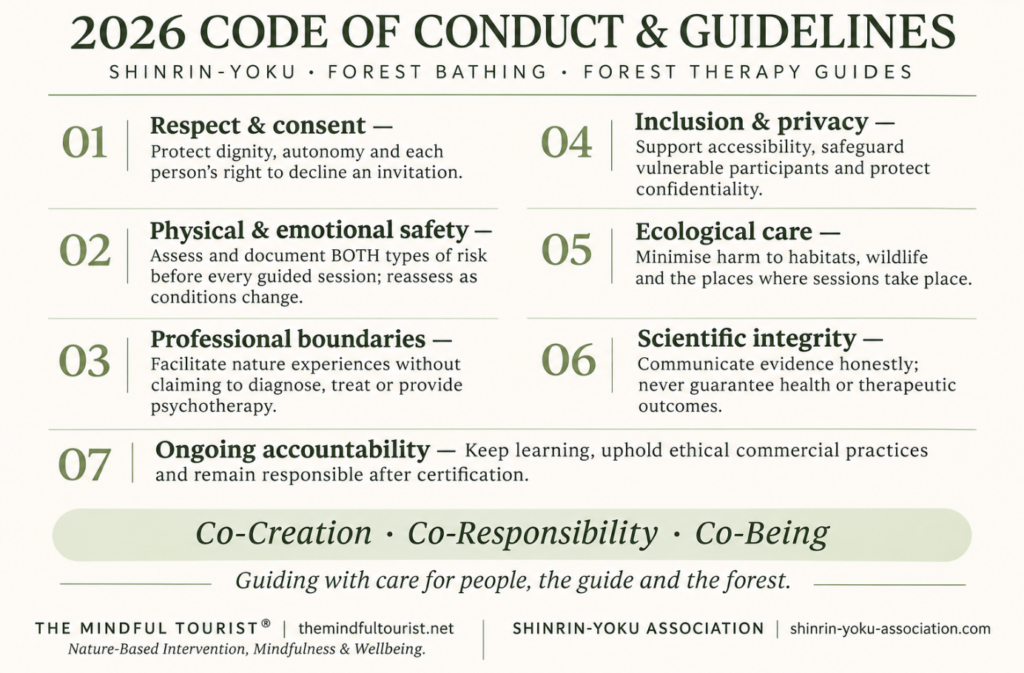
Its twenty professional sections address responsibilities extending from informed consent and safeguarding to ecological care, ethical communication, professional boundaries, and continuing professional development.
03 / Safety & Professional Care
Physical and Emotional Risk Assessment
One of the central requirements of the updated Code is the preparation of separate physical and emotional risk assessments.
Natural environments are dynamic. Weather, terrain, vegetation, wildlife, accessibility, and individual participant needs may influence physical safety.
Yet a forest experience may also include silence, mindfulness, personal reflection, emotional responses, and group interaction. These dimensions deserve thoughtful preparation.
Physical Safety
Guides assess environmental hazards, weather, terrain, accessibility, planned activities, and foreseeable emergency situations.
Emotional Safety
Guides consider participant autonomy, reflective invitations, psychological comfort, emotional boundaries, communication, and appropriate responses to distress.
SYA trainees submit both assessments before each mandatory practical session. Certified guides continue completing and documenting appropriate risk assessments throughout their professional practice.
Safety remains a dynamic responsibility, requiring attention before, during, and after a session.
Risk assessment is not intended to control how people experience nature. It is intended to support informed, respectful, and responsible facilitation.
04 / Our Relational Approach
Co-Creation, Co-Responsibility and Co-Being
The SYA Code includes three interconnected relational principles developed within The Mindful Tourist® educational approach.
Co-Creation
Experiences emerge through interactions among participants, their environment, the guide, and the wider social context.
Co-Responsibility
Participation involves mutual respect and informed choice, while guides retain distinct professional responsibilities for decisions within their control.
Co-Being
People may share the same natural environment while experiencing it differently, without pressure to achieve prescribed outcomes.
These principles encourage professional guides to respect the individuality, agency, and experiences of the people they accompany.
A guided forest experience does not need to produce relaxation, happiness, gratitude, or transformation in every participant.
The guide's responsibility is to prepare thoughtfully, facilitate sensitively, and respect the autonomy of the individual.
05 / Ecological Responsibility
Caring for the Forest, Not Only the Participants
The Code recognises that forests and natural environments are living ecological systems, not simply resources for human well-being.
A guided session may be meaningful to participants while still affecting vegetation, soil, wildlife, or other ecological processes.
Professional preparation must therefore include the environmental consequences of our activities, group sizes, route selection, and behaviour within natural spaces.
At TMT, we encourage guides to consider their own well-being, the well-being of participants, and the well-being of the forest within one interconnected ethical framework.