First, we paused.
We began with ten minutes of silent meditation, with our eyes closed. We observed the breath, the body, and the movement of thoughts. Not to force calm, but to notice how we were arriving.
We began with silence, a comfortable place, and a notebook. Although we shared the same invitation to write, each of us started with a different question. Simple beginnings are not always easy.
We began with ten minutes of silent meditation, with our eyes closed. We observed the breath, the body, and the movement of thoughts. Not to force calm, but to notice how we were arriving.
Comfortable clothes, a quiet corner, a notebook, a pen, and perhaps our favourite cup filled with tea. Sometimes these small familiar things help us settle into a reflective moment.
Some participants turned inward, observing thoughts, emotions, and bodily sensations. Others began with the world around them: the view from a window, the garden, an object, or a sound.
We explored our experiences without worrying about perfect sentences. Writing did not need to become dramatic, profound, or beautifully structured. Even a small observation could open a meaningful reflection.
After writing, we could reread a sentence, notice a feeling, or leave the page closed. Some moments were shared voluntarily. Others remained private. There was no expectation that everyone should experience the same thing or arrive at a particular conclusion.
A question does not have to lead directly to an answer. Sometimes it simply helps us notice something we had overlooked.
What would I like to be asked today?
Writing may begin with something external: a flower, a stone, a piece of music, or the light entering through a window. We can observe what is happening around us and notice what that observation brings up within us.
“I looked at a pink flower. I do not know what it is called, but it caught my attention. It made me feel joy in my heart.”
Thank you to everyone who joined us. What we carry in our minds and bodies may find expression through words, movement, images, conversations, or quiet observation. Each person's experience is different, and private writing remains their own.
Thank you for joining our Expressive Writing session — a reflection on silence, attention, and finding our own words.
I would like to thank everyone who joined today’s Expressive Writing session. It was a pleasure to share this time together, to pause, reflect, and explore the different ways in which we can begin expressing ourselves through writing. What I found particularly beautiful was that each participant began from a different place. Some turned their attention inward, towards their thoughts, emotions, and bodily sensations. Others began with something happening around them: a view through the window, a small observation in the garden, or an ordinary event from the day. There was no single correct starting point. And it may be that that was one of the most meaningful discoveries of our session.
We often think that writing begins when we pick up a pen and place the first word on paper. But I have come to recognize that, for many of us, the process begins much earlier. It begins with finding a moment in which we can actually stop. And this, despite how simple it may sound, is not necessarily easy. Our everyday lives are filled with responsibilities, conversations, expectations, unfinished tasks, and an almost continuous movement of thoughts. Even when we sit down physically, our minds may remain occupied with what happened yesterday, what needs to be done tomorrow, or what we believe we should be doing right now. We may have a comfortable chair, a notebook, and a pen ready, yet find ourselves unable to write a single sentence. Why? Because we have not yet settled into the experience of being where we are? This is why we began our session with ten minutes of silent meditation, with our eyes closed. There was nothing particularly complicated about it. We simply sat together, allowing ourselves a little time to notice our breathing, our bodies, and the movement of our thoughts. The intention was not to eliminate thoughts, force relaxation, or achieve a particular state of mind. Rather, it was to observe what was already happening within us.
For some, closing the eyes and sitting in silence may feel natural. For others, it may be uncomfortable. Sometimes the moment we stop doing something is precisely when we become aware of how much is happening within us. And that observation itself can become the beginning of writing.
Research on mindfulness and attention suggests that practices involving present-moment awareness may influence how we notice and relate to thoughts, emotions, and bodily sensations. However, these effects vary between individuals, and a brief meditation does not necessarily produce calm or clarity for everyone. What matters here is not achieving a perfect state before writing, but beginning to notice our experience.
There is also something meaningful about the small circumstances in which we choose to write. Perhaps we settle into our favourite chair, wrap ourselves in comfortable clothes, and place a notebook beside a cup of tea. And not just any cup, perhaps, but our favourite one. The cup we reach for in the morning. The one that feels familiar in our hands. The one we associate with a quiet moment in the day. Such details may seem insignificant, but they form part of our experience. The warmth of the cup, the fragrance of the tea, the feeling of the chair supporting the body, or the light entering through the window can all become points of attention.
Sometimes we search for something profound to write about, while overlooking what is already present around us.
A comfortable place does not have to mean a perfectly quiet room or a beautiful garden. It may simply be somewhere we feel relatively undisturbed and able to direct our attention towards writing.
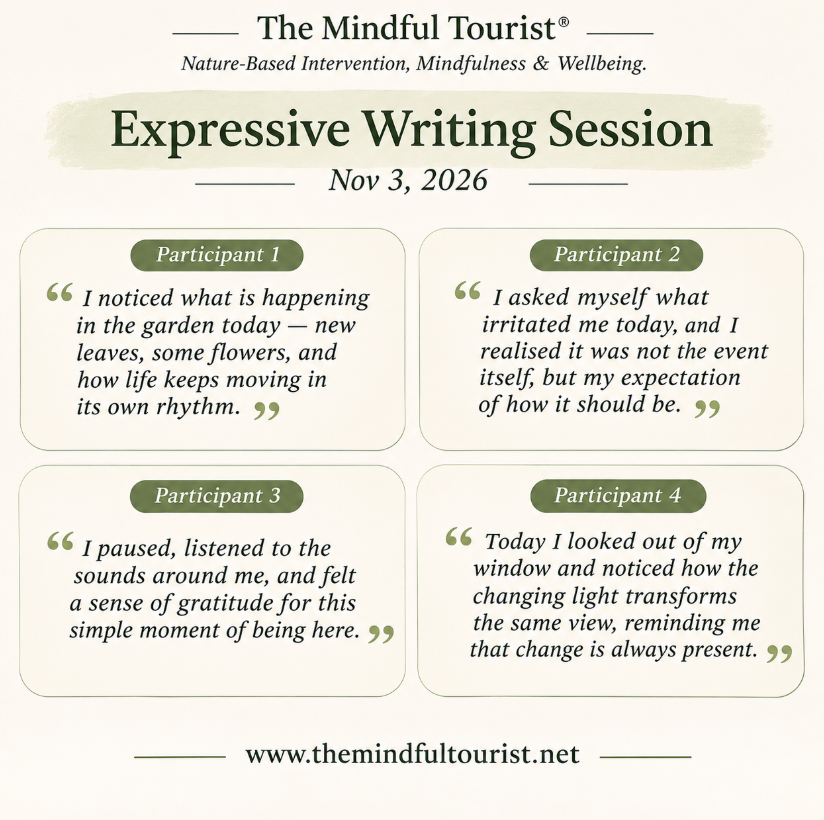
During today’s session, each participant started with a different question. Some were interested in what had happened during the day. Others were curious about their emotional or physical experience. Some preferred to begin with an observation of their surroundings.
Here are some of the questions we explored:
What happened today?
What do I feel in my body?
What thoughts have I had today?
What irritated me?
What can I see from my window?
What is happening in the garden?
What am I grateful for?
They are simple questions. Yet simple questions do not always lead to simple answers.
Consider, for example, What irritated me today? We may begin by describing an ordinary situation. Perhaps someone interrupted us while we were working, something did not go according to plan, or a conversation left us feeling unsettled. But as we write, other questions may emerge. Why did that particular situation bother me? Was I already feeling tired? Was I expecting something different? Did the situation remind me of an earlier experience? We do not necessarily need to answer these questions. Sometimes simply noticing that they have appeared is meaningful.
The same applies to a question such as What am I grateful for? Perhaps we begin by writing about a friend, a conversation, the sunlight entering our home, or a cup of tea. But as we continue, we may notice what these experiences mean to us and why they have become important.
The first question is not necessarily the subject of the entire reflection. It may simply open the way towards something we had not anticipated.
One aspect of expressive writing that I find especially interesting is that we do not always have to begin by examining our emotions, memories, or personal difficulties. Sometimes looking inward feels challenging. We may not know what we are feeling. We may struggle to identify our thoughts. Or perhaps we simply do not feel like writing about ourselves. On those days, we can begin with something outside of us. An object on the table. A plant by the window. A bird in the garden. The movement of clouds. A familiar piece of music. We can describe what we see, hear, or notice. And then, if we wish, we can explore what the observation brings up within us. For example, we might listen to a piece of music and write about its rhythm, melody, or the memories it evokes. Or we might look at a flower and notice its colour, shape, and movement in the wind.
Yes, the writing begins with an ordinary observation, as well:
I looked at a pink flower today. I do not know what it is called, but it caught my attention. It made me feel joy in my heart.
That is all.
And that may be enough. There is no dramatic event, no painful memory, and no extraordinary revelation. Yet a small encounter has been noticed, experienced, and expressed. There is a possibility that the writer continues and wonders why that particular flower brought joy. Perhaps it reminded them of someone, of childhood, or of another garden. Or perhaps nothing further emerges.
The reflection does not need to become anything more than it already is.
This approach is not identical to the traditional expressive-writing protocols studied in psychology, which often focus on emotionally significant or stressful experiences. Rather, it is a broader reflective practice that brings together observation, attention, and personal expression. For some people, beginning with the external world may offer a more accessible starting point than immediately exploring difficult emotions. And it is worth remembering that the external and internal are not entirely independent within our experience.
What we observe may affect how we feel, while our emotional state may influence what attracts our attention and how we interpret it.
Sometimes none of the suggested questions feels appropriate. We sit with a notebook, read through the prompts, and find that nothing particularly meaningful comes to mind. Perhaps we are tired. Perhaps we are distracted. Or perhaps we simply do not know where to begin. On such occasions, I would like to offer another question:
What would I like to be asked today?
I find this question particularly interesting because it changes the direction of our attention. Instead of asking ourselves to respond to a question chosen by someone else, we begin wondering what kind of question we actually need. Perhaps we wish someone would ask how we have really been feeling lately. Perhaps we would like to be asked what has brought us joy or there is something we have been carrying silently, waiting for someone to show an interest in understanding it. We might discover that the question we would most like to be asked is one that we have not yet asked ourselves. Of course, there may be days when even this question brings no response. And that is perfectly possible too. Writing does not need to happen on demand, and I am a huge proponent of giving ourselves times to write when it feels right for us.
Throughout our lives, we accumulate experiences. Some are remembered clearly. Others gradually fade from conscious awareness. Some remain emotionally significant long after the events themselves have passed. Our thoughts, emotions, and bodily sensations interact continuously. We may notice tension in our shoulders when we feel overwhelmed, a change in breathing when we are anxious, or a sense of warmth and ease when something brings us joy. Not every bodily sensation has a clear psychological explanation, and we should be careful not to assume that physical discomfort necessarily represents an unexpressed emotion. Nevertheless, paying attention to the relationship between thoughts, emotions, and bodily experience can be a meaningful part of self-reflection. Sometimes what we carry is difficult to describe. We may know that something has affected us without fully understanding what it was. We may feel unsettled after a conversation but be unable to explain why. We may experience gratitude, sadness, or love without finding words that adequately describe it.
Writing offers one possible way to explore these experiences.
But expression does not belong exclusively to language. We may express ourselves through drawing, music, movement, gardening, poetry, conversation, or simply through the way we interact with the world. Not everything needs to become a written sentence. And not everything that has remained unexpressed must necessarily be brought into words. The important thing is to become more familiar with our experiences and discover which forms of expression feel meaningful to us.
One of the misconceptions I would like to challenge is the idea that expressive writing must involve significant suffering, painful memories, or emotionally intense experiences. Such subjects may certainly become part of writing. In my own journey, writing about difficult experiences has sometimes been meaningful, although not always easy. But expressive writing, understood more broadly as personal expression through words, can also begin with the ordinary.
A flower.
A cup of tea.
A thought that appeared while washing the dishes.
An unexpected moment of irritation.
A bird that visited the garden.
A feeling of gratitude that lasted only a few seconds.
There is no need to make the experience more dramatic than it was.
In fact, I wonder whether the expectation that something important must happen before we can write is itself one of the obstacles that prevents us from beginning. Perhaps we overlook how much of our lives takes place in small, ordinary moments and perhaps learning to notice those moments is already a meaningful practice.
The final part of our session was an invitation to pause again. After writing, we may choose to read what we have written, notice what stands out, or simply observe how we feel. Sometimes a sentence surprises us, a question remains. Sometimes there is a subtle shift in how we understand a situation. At other times, nothing seems particularly different. We may also choose not to reread what we have written, especially if doing so feels uncomfortable.
Scientific research on expressive writing has explored its possible effects on emotional processing, psychological wellbeing, and health. Some studies and reviews have reported small benefits in particular circumstances, while others have found limited or inconsistent effects. Responses may depend on the individual, the writing approach, the topic, and the context. Writing is therefore not a guaranteed method of emotional relief, nor is it a substitute for appropriate psychological or medical support. But it can become a practice of observation and inquiry. A way of making some of our thoughts visible, of noticing what changes, and sometimes, simply a way of spending a little more time with ourselves.
I would like to thank everyone who joined today’s session, not only for taking the time to participate, but also for being willing to explore something that may appear simple and yet can be surprisingly challenging. I was touched by the different starting points each participant chose. It reminded me that even when we share the same space, the same silence, and the same invitation to write, our experiences remain uniquely our own. We arrive with different histories, emotions, questions, and ways of understanding the world. And our writing reflects that diversity. Below, I am sharing photographs that some of today’s participants kindly chose to share with me, showing moments or experiences they felt comfortable making visible to others. These images are not intended to demonstrate what expressive writing should look like or what anyone should feel during the process. They are simply glimpses of individual experiences, shared by the people who lived them.
To everyone who joined, thank you for your presence, your curiosity, and your willingness to explore. The most meaningful thing we can carry from the session is not a particular technique or a perfectly written reflection, but the realization that we can begin almost anywhere.
Sometimes the simplest beginning is the most difficult. And sometimes it is enough to begin there.
Below are photographs kindly shared by participants following our Expressive Writing session. Each reflects something they noticed, experienced, or wished to share.
Author: Milena A. Guziak, PhD Founder, The Mindful Tourist & Shinrin-Yoku Association
Join another live online Expressive Writing session. Beginners are welcome. Together, we explore mindful preparation, private writing, personal questions, and optional reflection.
Different ways of understanding ourselves through meditation, reflective writing, and the experiences we encounter in life.
Discover our 400-day personal meditation journey, followed by theoretical learning and practical guide training.
Explore the training → 02 / REFLECTIONExplore writing as a way to observe thoughts, reflect on emotions, and deepen understanding of personal experience.
Discover expressive writing → 03 / READINGExplore books by Milena A. Guziak, including her meditation diaries, reflections on nature, and contemplative writing.
Explore the books →