Are We Respecting the Japanese Origins of Shinrin-Yoku?
How can we acknowledge Japan's cultural and scientific contributions without misrepresenting the history of human relationships with nature?
11.1 · A Modern Term Within a Much Older History
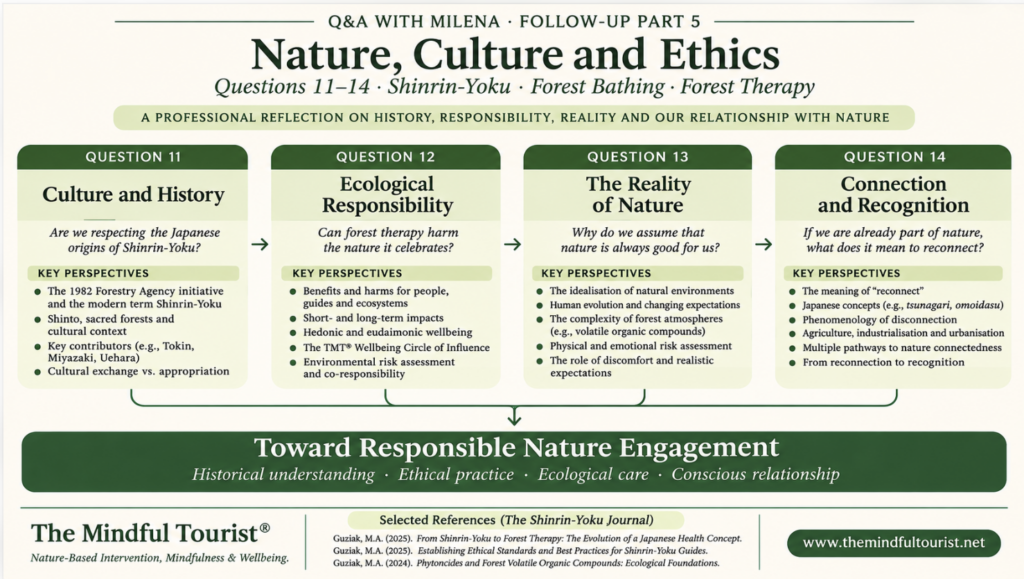
Shinrin-Yoku was introduced as a modern Japanese concept through the Forestry Agency in 1982.
However, the introduction of a term does not mean that the underlying experience began at that moment.
Human relationships with forests extend across evolutionary and cultural history.
People have interacted with natural environments through survival, observation, agriculture, spirituality, recreation and scientific inquiry.
We should therefore distinguish the origin of the modern term from the much older experience of being within a forest.
11.2 · Shinto, Sacred Forests and Modern Shinrin-Yoku
A frequent misunderstanding is that Shinrin-Yoku is an ancient Shinto ritual.
This is not an accurate account of its modern origin.
Shinto traditions include complex relationships with kami, sacred places, shrines and natural environments.
Chinju no mori, the sacred groves associated with shrines, may hold religious, cultural, historical and ecological meaning.
These older traditions deserve recognition, but they are not interchangeable with the 1982 Forestry Agency initiative.
Cultural respect involves understanding the distinctions rather than presenting all Japanese relationships with forests as one practice.
11.3 · Giving Credit to Scientific Contributors
The scientific development of forest-related health research involved numerous contributions.
Boris Petrovich Tokin's twentieth-century investigations of phytoncides preceded the modern Shinrin-Yoku initiative.
The Japanese Forestry Agency introduced Shinrin-Yoku in 1982.
Yoshifumi Miyazaki and colleagues contributed significantly to physiological investigations of forest environments.
Other researchers expanded the field through studies of immune function, stress responses, psychology and ecology.
Iwao Uehara's work also contributed to discussions of forest therapy in health, rehabilitation and education.
These developments should not be reduced to the achievements of only one person or institution.
11.4 · Cultural Exchange or Appropriation?
Teaching Shinrin-Yoku outside Japan is not inherently an act of cultural appropriation.
Cultural exchange and international scientific collaboration can be valuable.
Concerns arise when Japanese traditions are misrepresented, cultural symbols are used without context, or organisations claim authority they do not possess.
Including a Japanese cultural practice within a training programme should involve appropriate understanding, acknowledgement and collaboration.
Living in Japan or studying Japanese practices does not automatically make a person an authority on every aspect of Japanese culture.
I believe respect requires humility, historical accuracy and recognition of local contributors.