The Mindful Tourist Nature-Based Intervention, Mindfulness & Wellbeing
The Mindful Tourist

We Are Updating Our Website

We are currently updating The Mindful Tourist website, including pages, articles and resources dating back to 2021.

Bringing everything up to date will take some time. During this process, certain pages and links may not yet work as expected.

We sincerely apologise for any inconvenience. You are warmly invited to continue exploring the website and the content already available.

Thank you for your patience and understanding.

Q&A with Milena — Follow-up Part 6: The Future of Professional Guiding. Shinrin-Yoku, Forest Bathing and Forest Therapy Guide Training. What Does It Mean to Be a Guide in a Changing World?

The Mindful Tourist® · Q&A with Milena

The Future of
Professional Guiding

Shinrin-Yoku · Forest Bathing · Forest Therapy

Follow-up Part 6 · Questions 15–18

Milena A. Guziak, MChem, PhDEng, MScPsy

As we reach the final four questions of our Q&A series, I would like to reflect upon the purpose and future of professional guiding.

What makes Shinrin-Yoku different from other forms of nature engagement? What environmental responsibilities should professional guides accept?

Should guides maintain their own personal practice? And what exactly is their professional role when nature itself contributes to the experience?

These questions connect the themes explored throughout our earlier discussions: professional competence, scientific evidence, agency, ethics, nature connectedness and the relationship between structure and freedom.

The purpose is not to establish one universal model of guiding, but to examine how we can practise responsibly, critically and with appropriate humility.

Four Questions About the Future

QUESTION 15

Environment

Forest-specific Shinrin-Yoku and broader nature connectedness.

QUESTION 16

Responsibility

Ecological standards, conservation and professional ethics.

QUESTION 17

Personal Practice

Lived experience, ongoing learning and authenticity.

QUESTION 18

Professional Roles

Education, facilitation, safety, companionship and ecological care.

Responsible Professional Guiding

Competence · Autonomy · Ethics · Ecological Awareness · Continuing Development

Question 15 · Environment & Practice

Is a Forest Necessary for Shinrin-Yoku?

Can meaningful practice take place in a garden, urban park or desert? And how do we distinguish forest-specific practice from broader nature connectedness?

15.1 · What Do We Mean by Practice?

Before discussing the environment, I think we should examine the meaning of the word practice.

Someone may participate in one professionally guided session. Another person may visit a forest independently every week.

Both may experience meaningful encounters, but they are not necessarily engaging in identical activities.

Practice may involve frequency, repetition, continuity, intention and integration into everyday life.

Yet repeated exposure does not automatically establish a particular quality of attention or emotional connection.

A person may walk through a forest daily without consciously reflecting upon it.

Another may experience a meaningful encounter during one short visit.

These distinctions are explored in my research on modalities of spending time in forests.

15.2 · Guided and Independent Shinrin-Yoku

Professional guidance is not a necessary condition for meaningful forest engagement.

A person may spend time in a forest independently, with attention, curiosity and personal meaning.

A guided session introduces additional elements, including preparation, invitations, facilitation, professional support and group interaction.

These elements may influence the experience, but they do not guarantee superior outcomes.

We should therefore distinguish the forest encounter from the professional methodology used to facilitate it.

The forest does not require a guide in order to exist, and a meaningful experience does not require a certificate.
15.3 · Why the Forest Environment Matters

The Japanese term Shinrin-Yoku includes the word shinrin, meaning forest.

In this sense, the forest is not simply an interchangeable background.

A forest environment has physical, chemical, biological and sensory characteristics that may differ from those of gardens, urban parks or deserts.

Important characteristics can include vegetation density, canopy structure, temperature, humidity, air composition, sunlight, sound and ecological interactions.

My research on physiological markers and forest volatile organic compounds examines why such factors matter.

Yet the presence of trees does not guarantee therapeutic effectiveness.

We need to distinguish environmental exposure from a claim about a specific health outcome.

15.4 · Urban Forest Bathing in Japan

The Japanese concept of urban forest bathing, toshi shinrin-yoku (都市森林浴), introduces another dimension.

Research associated with Chiba University's Nature Therapy Laboratory considers a broad range of nature-related experiences in urban contexts.

These may involve parks, gardens, balconies and nature-derived stimuli.

However, this does not mean every urban environment provides the same exposure as a forest ecosystem.

We should consider what the actual environment contains and what research question is being investigated.

Is the study examining forest atmosphere, general green-space exposure or a particular sensory methodology?

These distinctions are scientifically important.

15.5 · Gardens, Parks, Deserts and Nature Connectedness

I strongly believe that meaningful nature engagement can occur beyond forests.

Gardens, urban green spaces, grasslands, mountains and deserts can all offer opportunities for sensory attention, curiosity and personal relationships.

Living in Mendoza has made this distinction particularly meaningful to me.

The arid environment contains its own ecological complexity, including drought-adapted vegetation, seasonal changes, soils and geological features.

A meaningful experience in a desert is not inferior to an experience in a forest.

But I would describe it more accurately as nature connectedness practice rather than automatically calling it Shinrin-Yoku.

This is one reason I am developing broader Nature Connectedness Guide Training TMT®.
Meaningful nature engagement can take place in many environments. That does not make all environments ecologically or scientifically interchangeable.
Question 16 · Ecology & Ethics

Should Forest Therapy Guides Be Responsible for Conservation?

Should ecological responsibility be an essential professional standard, even when someone's original motivation was primarily human wellbeing?

16.1 · Responsibility Is Not Necessarily Activism

I believe ecological responsibility should be an essential component of professional guiding.

However, this does not mean every guide must become an environmental activist or conservation specialist.

Guides should understand the foreseeable effects of their activities on the places where they work.

This includes appropriate site selection, group management, invitation design and protection of habitats.

They should also recognise the limits of their ecological knowledge and seek appropriate expertise when necessary.

These responsibilities belong to professional conduct rather than optional expressions of affection.

16.2 · There Is No Wrong Starting Point

People enter the field for very different reasons.

Some discover Shinrin-Yoku while seeking relief from stress or exhaustion.

Others arrive through environmental education, ecological research, mindfulness or a lifelong love of forests.

I do not believe there is one correct emotional motivation for entering the profession.

A human-centred interest in wellbeing may develop into broader ecological concern.

But this transformation cannot be guaranteed.

Some people may already possess strong ecological values before training begins.

Others may develop a different relationship through study and experience.

Education should recognise these differences while maintaining clear standards of professional responsibility.

16.3 · Can Ecological Care Be Taught?

We can teach ecological knowledge and professional responsibilities.

We can explain the effects of trampling, wildlife disturbance and inappropriate site use.

We can encourage observation, curiosity and reflection.

We can establish standards and assess whether students apply them responsibly.

But I do not believe we can force someone to love a forest.

Emotional connection may emerge differently for different people.

A guide may relate to nature through science, aesthetic appreciation, practical stewardship or personal memory.

None of these relationships should be dismissed simply because they do not resemble someone else's experience.

We cannot require one particular emotional relationship with nature. We can require responsible professional behaviour.
16.4 · The TMT® Wellbeing Circle of Influence

The TMT® Wellbeing Circle of Influence examines three interconnected dimensions.

Dimension Professional consideration
Guide Competence, preparation, personal wellbeing, ethical boundaries
Participants Autonomy, accessibility, dignity, physical and emotional safety
Forest Habitat integrity, biodiversity, environmental impacts and responsible use

A session may be enjoyable for participants yet introduce unnecessary ecological disturbance.

A decision that protects the environment may require changes to the planned session.

Therefore, professional success cannot be evaluated solely through participant satisfaction.

16.5 · Professional Ethics under Commercial Pressure

Commercial guiding may create tensions between income and environmental care.

A popular location may attract repeated sessions.

Yet cumulative use may increase pressure on vegetation, soils and wildlife.

A responsible guide may need to reduce group sizes, alter invitations, use another appropriate site or suspend activities.

These decisions may have financial consequences.

But professional ethics should influence actual decisions, not simply appear in promotional statements.

The SYA Code of Ethical Conduct addresses ecological responsibility as part of professional practice.

Question 17 · Personal Practice

Should Professional Guides Practise Shinrin-Yoku Themselves?

Can someone facilitate nature connectedness without maintaining a meaningful personal relationship with nature?

17.1 · Knowledge and Experience Are Different

I strongly encourage guides to spend time in forests independently of paid sessions.

A person may understand the history of Shinrin-Yoku, know its terminology and complete educational assignments.

Yet theoretical knowledge is not identical to direct experience.

Personal practice may support familiarity with natural environments, observation, reflection and an ongoing relationship with place.

But the practice does not need to produce a remarkable emotional experience each time.

Sometimes being in a forest is ordinary.

That does not make the experience meaningless.

17.2 · The Risk of Education Becoming a Transaction

People enter educational programmes for many reasons.

Some are genuinely curious.

Others are influenced by family expectations, professional opportunities or financial circumstances.

Someone may purchase a training programme primarily to obtain a certificate.

But completing assignments does not necessarily mean that the learner has developed sustained interest or independent judgment.

I believe professional education should support curiosity, reflection and personal responsibility rather than merely the completion of requirements.

A certificate may recognise educational achievement.

It cannot guarantee a person's ongoing relationship with nature.

17.3 · Different Ways of Relating to Nature

Personal nature connectedness does not look identical for every guide.

Some experience forests through emotional attachment.

Others through ecological curiosity, aesthetic appreciation, observation, spirituality or practical care.

These relationships may change throughout life.

I would not use emotional intensity as evidence of professional competence.

A guide should not be required to describe profound feelings in order to satisfy an educator.

What matters is sincerity, ongoing learning, familiarity with the environment and responsible practice.

17.4 · Personal Practice and Professional Self-Awareness

A guide may gradually begin experiencing the forest primarily as a workplace.

They may become focused on planning, facilitating, monitoring and evaluating.

Personal practice can provide opportunities to step outside these responsibilities.

The guide may observe their own changing relationship with forests, recognise personal expectations and remain curious.

This can support self-awareness.

However, access to forests may vary according to health, disability, family circumstances and geographical location.

Expectations should remain realistic and sensitive to individual circumstances.

17.5 · Do Not Impose Your Experience on Participants

Personal practice may enrich guiding.

But it may also introduce expectations and biases if the guide does not examine their own responses.

Someone who experiences profound peace in a forest may unintentionally expect participants to feel the same.

But another person's experience may be entirely different.

The guide should support autonomy and personal interpretation rather than require particular emotions.

Personal practice should develop awareness and humility, not become a standard that others are expected to reproduce.
Question 18 · The Role of the Guide

If Nature Is the Therapeutic Agent, What Is the Role of the Guide?

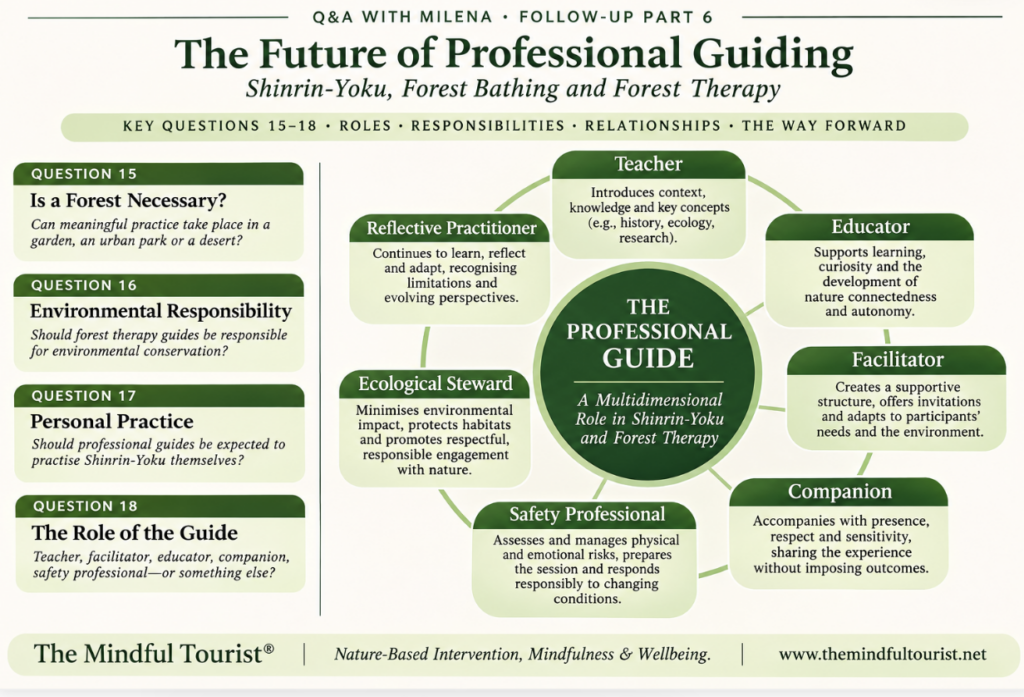
Teacher, educator, facilitator, companion, safety professional or ecological steward? Perhaps the professional role involves several overlapping responsibilities.

I would first question the assumption that therapeutic agency belongs exclusively to the natural environment.

The experience may involve the forest's environmental conditions, the participant's responses, professional guidance and the wider social context.

The guide cannot control every outcome, but remains responsible for professional preparation, appropriate facilitation and safeguarding.

The Multidimensional Role of a Professional Guide

Different responsibilities may become more or less important throughout a guided session. These roles overlap rather than function as separate professions.

The
Professional
Guide
Supports the encounter without owning or controlling the experience
Teacher

Introduces relevant concepts, history, ecological knowledge and scientific context.

Educator

Encourages curiosity, reflection, autonomy and learning through direct experience.

Facilitator

Structures sessions, offers invitations, supports engagement and adapts as needed.

Reflective Practitioner

Evaluates decisions, learns from experience and recognises professional limitations.

Companion

Accompanies participants with respect, presence and sensitivity, without imposing meaning.

Safety Professional

Assesses physical and emotional risks, prepares for uncertainty and responds appropriately.

Ecological Steward

Protects habitats, minimises disturbance and supports responsible environmental engagement.

Ethical Practitioner

Maintains consent, confidentiality, professional boundaries and an appropriate scope of practice.

TMT® conceptual presentation of overlapping professional responsibilities. This is an educational role framework, not a validated model of therapeutic causation.

18.1 · Teacher and Educator

As a teacher, the guide may introduce relevant knowledge about Shinrin-Yoku, ecological conditions, science and professional context.

As an educator, the guide supports curiosity, reflection and the development of understanding and autonomy.

The distinction matters because providing information is not identical to facilitating learning.

Sometimes a guide may possess extensive knowledge but choose not to explain something immediately.

Direct observation may be more appropriate at that moment.

This reflects the participant-centred orientation of the TMT® Scaffolded Model of Engagement.

18.2 · Facilitator and Companion

As a facilitator, the guide holds the structure of the experience.

They provide invitations, manage transitions, observe participants and adapt the session.

But they cannot determine what participants will feel.

As a companion, the guide accompanies rather than claims ownership of the encounter.

This may involve silence, sensitivity, listening and respectful presence.

However, professional companionship is not the same as personal friendship.

Appropriate boundaries remain essential.

18.3 · Safety Professional and Ecological Steward

As a safety professional, the guide prepares for foreseeable physical and emotional risks.

They assess the site, understand participant needs, communicate boundaries and respond to changing circumstances.

As an ecological steward, the guide considers the consequences of professional activities for the natural environment.

This includes appropriate site use, group management, protection of habitats and careful invitation design.

These responsibilities are not optional simply because a session is described as gentle or mindful.

18.4 · Reflective Practice and Ethical Boundaries

Professional competence develops through continued experience and reflection.

A guide should remain willing to examine the effectiveness and appropriateness of their decisions.

They should also recognise the limits of their qualifications.

Shinrin-Yoku Guide certification does not automatically qualify a person to provide psychotherapy or regulated healthcare.

Ethical practice involves informed consent, respect for autonomy, appropriate communication, safeguarding and referral when necessary.

Acknowledging uncertainty is a professional strength, not a weakness.

18.5 · Co-Creation, Co-Responsibility and Co-Being

My research examines these three principles as conceptual ways of understanding guided nature-based experiences.

Co-creation recognises the interaction among environment, participant, guide and social context.

Co-responsibility recognises participant agency while preserving the guide's professional accountability.

Co-being concerns sharing the natural environment without continually directing or interpreting another person's experience.

These principles are ethical and philosophical orientations.

They should not be confused with experimentally established therapeutic mechanisms.

A guide may contribute structure, knowledge, safety and companionship. But meaningful experience cannot be guaranteed, owned or imposed.

What Future Do We Want for Professional Guiding?

As we reach the end of these eighteen questions, I return to the purpose of professional guiding.

Is it to support wellbeing, encourage nature connectedness, provide professional education, develop ecological responsibility, or offer meaningful work?

Perhaps it can involve all these things.

Yet not every guide needs to enter the profession through the same motivation or develop the same personal relationship with nature.

Professional education requires standards, but personal development remains individual.

Guiding requires preparation, but experiences remain partly unpredictable.

Ecological responsibility can be expected, but emotional connection cannot be forced.

And meaningful nature experiences can occur independently of professional guiding services.

Perhaps the most important contribution of a guide is not to become permanently indispensable.

It is to recognise when guidance is valuable, when silence is appropriate, and when participants are ready to continue independently.

The future of professional guiding may depend less upon how many people receive certificates, and more upon how responsibly we support them in developing knowledge, judgment, awareness and the independence to practise with care.

With gratitude,

Milena A. Guziak, MChem, PhDEng, MScPsy
Founder, The Mindful Tourist®
Founder, Shinrin-Yoku Association

Research & Further Reading

Explore the publications and educational frameworks supporting the final four questions of our Q&A series.

SHINRIN-YOKU JOURNAL · 2026

Modalities of Engagement, Connection and Care

Frequency, intention, personal meaning and different relationships with forest environments.

Explore Publication
SHINRIN-YOKU JOURNAL · 2026

When Does Nature Become Therapy?

Therapeutic agency, professional guidance, co-creation, co-responsibility and commercialisation.

Explore Publication
SHINRIN-YOKU JOURNAL · 2023

Scaffolded Model of Engagement

Participant-centred education, gradual release of guidance, autonomy and Degrees of Freedom.

Explore Publication
SHINRIN-YOKU JOURNAL · 2025

Ethical Standards and Best Practices

Ecological responsibility, professional competence, risk assessment and guiding boundaries.

Explore Publication
SHINRIN-YOKU JOURNAL · 2023

Physiological Markers of Wellbeing

Physiological responses to forest atmosphere and the interpretation of research findings.

Explore Publication
SHINRIN-YOKU ASSOCIATION

Professional Competencies and Code of Conduct

Educational expectations, physical and emotional safety, ecological care, continued learning and ethical practice.

Explore Professional Standards

Explore the Q&A Series

Return to the original Q&A and earlier follow-up discussions.

The Mindful Tourist®

Nature-Based Intervention, Mindfulness & Wellbeing.

Milena A. Guziak, MChem, PhDEng, MScPsy

www.themindfultourist.net

The Mindful Tourist® · Q&A Follow-up Part 5

Research & Further Reading

Nature, Culture and Ethics

Explore the publications, historical sources and scientific studies informing our discussion of Questions 11–14.

Research by Milena A. Guziak is presented separately from external scientific and historical sources.

QUESTION 11 · CULTURAL HISTORY

Japanese Origins of Shinrin-Yoku

Historical origins, the 1982 Japanese Forestry Agency initiative, Shinto, sacred forests and scientific contributions to the field.

Research by Milena A. Guziak

From Shinrin-Yoku (Forest Bathing) to Forest Therapy Guziak, M. A. (2025) · Shinrin-Yoku Journal

Historical development of Shinrin-Yoku and the evolution of Japanese forest therapy terminology.

Honoring Tradition, Science, and the Future Guziak, M. A. (2025) · Shinrin-Yoku Journal

Japanese scientific contributions, cultural plurality and the development of international nature-based education.

External Historical Sources

Forest Bathing (森林浴) Japanese Forestry Agency · Official source

Japanese-language overview, including the Forestry Agency's introduction of Shinrin-Yoku in 1982.

Miyazaki Yoshifumi Explores the Healing Power of the Forest Nippon.com · Interview · 2018

Professor Miyazaki discusses the history of Shinrin-Yoku and the development of physiological forest research.

What Are Shrine Groves? Japan Tourism Agency · 2019

An introduction to chinju no mori, sacred shrine groves and their religious and historical context.

QUESTION 12 · ENVIRONMENTAL ETHICS

Can Forest Therapy Harm Nature?

Ecological consequences of guided activities, short- and long-term impacts, professional responsibility and the TMT® Wellbeing Circle of Influence.

Research by Milena A. Guziak

When Does Nature Become Therapy? Guziak, M. A. (2026) · Shinrin-Yoku Journal

Therapeutic agency, ecological responsibility, professional guidance and commercialisation.

Establishing Ethical Standards and Best Practices Guziak, M. A. (2025) · Shinrin-Yoku Journal

Ethical guiding responsibilities, environmental protection, professional competence and participant wellbeing.

SYA Code of Ethical Conduct Shinrin-Yoku Association · 2026 framework

Professional principles covering ecological responsibility, physical and emotional safety and ethical session design.

External Scientific Research

Impacts of Informal Trails on Vegetation and Soils Barros, Gonnet & Pickering (2013)

Research from Aconcagua Provincial Park, Argentina, examining impacts of recreational trails on vegetation and soil.

DOI: 10.1016/j.jenvman.2013.04.030

Meta-analysis of Human Connection to Nature and Proenvironmental Behavior Whitburn, Linklater & Abrahamse (2020)

Examines the relationship between nature connectedness and pro-environmental behaviour. Association does not establish automatic behavioural change.

DOI: 10.1111/cobi.13381

QUESTION 13 · REALITY OF NATURE

Nature, Safety and Unpredictability

Beyond the idealisation of nature: ecological complexity, forest chemistry, environmental hazards and responsible session preparation.

Research by Milena A. Guziak

Phytoncides and Forest Volatile Organic Compounds Guziak, M. A. (2024) · Shinrin-Yoku Journal

Ecological foundations, chemical diversity, environmental variation and limitations of health claims concerning forest atmospheres.

Comprehensive Assessment and Optimization of Invitations Guziak, M. A. (2025) · Shinrin-Yoku Journal

Methodology for critically examining invitation design, participant needs, safety and facilitation decisions.

Professional Standards and Context

Physical and Emotional Risk Assessment Shinrin-Yoku Association · Code of Conduct

Read the sections addressing site assessment, environmental conditions, participant safety, emotional risks and dynamic professional judgment.

Recreational Impact in Sensitive Mountain Environments Barros, Gonnet & Pickering (2013)

Evidence that environmental vulnerability can vary according to the site, vegetation and characteristics of recreational use.

QUESTION 14 · NATURE CONNECTEDNESS

From Reconnection to Recognition

Nature contact and nature connectedness, the experience of disconnection, different pathways of engagement, and recognition of our ecological belonging.

Research by Milena A. Guziak

Spending Time in the Forest: Modalities of Engagement, Connection and Care Guziak, M. A. (2026) · Shinrin-Yoku Journal

A conceptual examination of different ways of engaging with forests, including continuity, meaning and care.

Nature Connection, Emotion Regulation and Mindful Attention Awareness Guziak, M. A. (2025) · Shinrin-Yoku Journal

Research examining relationships among nature connectedness, emotional regulation and mindful attention.

External Scientific Research

Beyond Knowing Nature: Pathways to Nature Connection Lumber, Richardson & Sheffield (2017)

Explores contact, emotion, compassion, meaning and beauty as pathways associated with nature connectedness.

DOI: 10.1371/journal.pone.0177186

Human Connection to Nature and Proenvironmental Behavior Whitburn, Linklater & Abrahamse (2020)

Examines the relationship between nature connection and environmental behaviour, including the limitations of interpreting associations.

Sources are provided for further reading and critical examination. Some journal publications may require membership access to the complete text.

The Mindful Tourist®

Nature-Based Intervention, Mindfulness & Wellbeing.

Research and reflections by
Milena A. Guziak, MChem, PhDEng, MScPsy

www.themindfultourist.net

Author: Milena A. Guziak, PhD Founder, The Mindful Tourist & Shinrin-Yoku Association

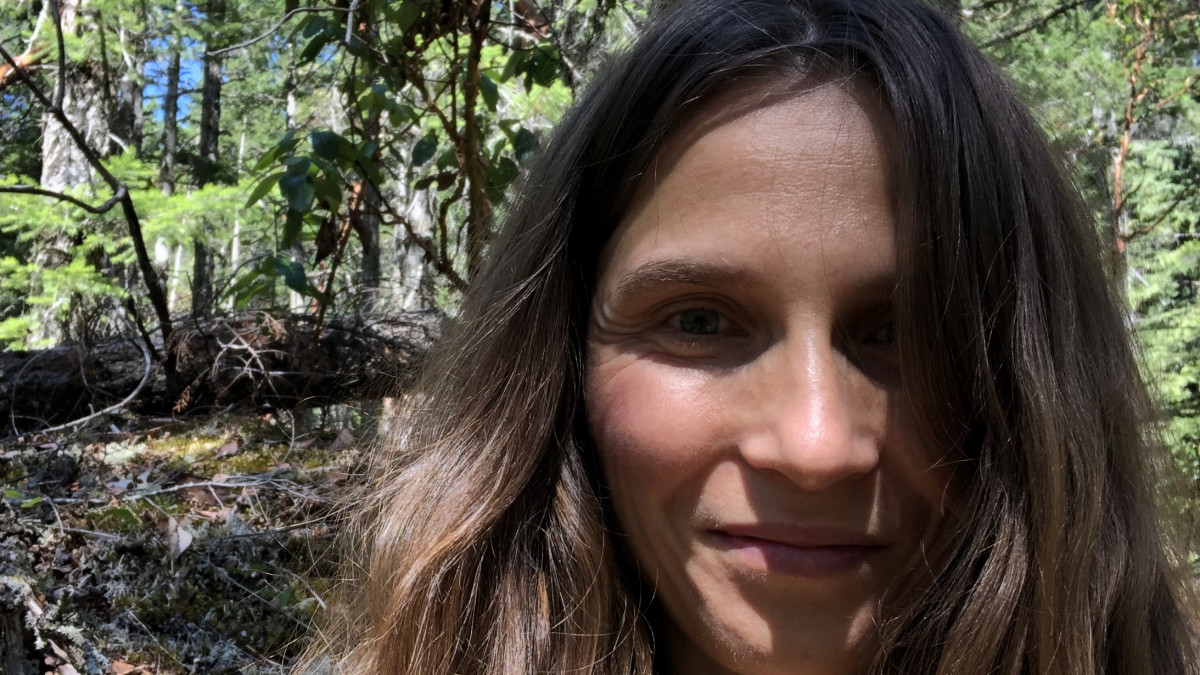
Milena A. Guziak photographed outdoors among trees
Milena A. Guziak · Founder of The Mindful Tourist®

A little about the person behind the work

Meet Milena A. Guziak

MChem · PhD Eng · MSc Psychology

Founder of The Mindful Tourist® and the Shinrin-Yoku Association, Milena brings together a background in chemistry, applied physics and psychology with years of experience in Japan, nature connection, Shinrin-Yoku, mindfulness, meditation and reflective writing.

Her journey has not followed one straight path. What once appeared to be separate interests has gradually revealed connections — between scientific inquiry, direct experience, the natural world and the changing experience of being human.

The Mindful Tourist is not simply about travelling to new places. It is about travelling through life with curiosity, attention and a willingness to keep learning.
error: Content is protected !!
Text size
100%
New Research Publication ✦ When Does Nature Become Therapy? ✦ Shinrin-Yoku · Forest Bathing · Forest Therapy ✦ Read the Scientific Article → ✦
Member Login Login