The Mindful Tourist Nature-Based Intervention, Mindfulness & Wellbeing
The Mindful Tourist

We Are Updating Our Website

We are currently updating The Mindful Tourist website, including pages, articles and resources dating back to 2021.

Bringing everything up to date will take some time. During this process, certain pages and links may not yet work as expected.

We sincerely apologise for any inconvenience. You are warmly invited to continue exploring the website and the content already available.

Thank you for your patience and understanding.

Q&A with Milena: Who Holds the Authority in Shinrin-Yoku, Forest Bathing and Forest Therapy? Follow-up Part 3

The Mindful Tourist® · Follow-up Q&A

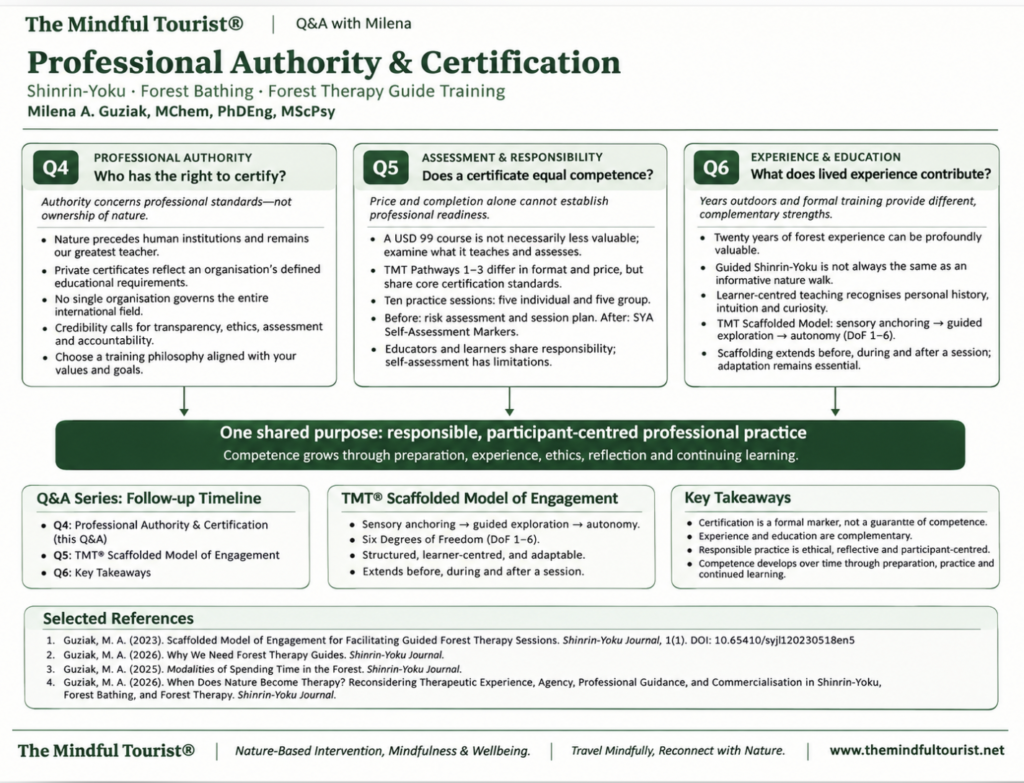
Professional Authority
& Certification

Who has the right to certify a Forest Therapy Guide, and what does competence really mean?

Shinrin-Yoku · Forest Bathing · Forest Therapy

In our continuing Q&A series, we explore three challenging questions about professional authority, certification and the relationship between lived experience and formal education.

These reflections draw upon my professional experience, research, educational philosophy and the development of The Mindful Tourist® training programmes.

The purpose is not to defend one organisation or methodology, but to encourage critical thinking and responsible professional practice.

— Milena A. Guziak, MChem, PhDEng, MScPsy

Select one of the three questions below. Open any chapter to explore its full reflection.

Category 2 · Professional Authority

Who Has the Right to Certify a Forest Therapy Guide?

What gives an organisation legitimacy when there is no single international authority governing the entire field?

4.1 · Nature as Our Greatest Teacher

During our original Q&A, I responded that, for me, nature itself is our greatest teacher.

Long before human beings developed professional associations, certification systems or educational institutions, nature already existed.

Ecosystems evolved, organisms adapted, and relationships formed among living beings and their environments.

Human beings emerged within this evolutionary history. We did not originate separately from nature.

I find it remarkable that we now ask who possesses the authority to certify someone to guide others in an environment of which we are already a part.

Nature existed before our systems of professional authority. Certification became a question only when humans began organising professional activities around their relationship with nature.

Yet describing nature as our teacher does not mean that it can replace professional education or ethical and legal responsibilities.

4.2 · Different Forms of Authority

I believe we must distinguish authority over professional education from authority over the human experience of nature.

A professional organisation may establish educational requirements, assess competencies and certify students within its own framework.

But this does not necessarily give that organisation universal authority over Shinrin-Yoku, forest bathing or forest therapy.

Nor should private certification automatically be confused with a government licence or legal authorisation to provide regulated healthcare services.

Different countries may have different requirements for particular professional titles or healthcare activities.

For this reason, training organisations must be transparent about what their qualifications represent.

The guide, participant, environment and educational organisation each have different roles.

Recognising these differences can help prevent professional authority from becoming a claim of ownership over nature.

4.3 · What Makes a Training Organisation Legitimate?

Today, numerous organisations offer professional education in Shinrin-Yoku, forest bathing and forest therapy.

Some have been established for decades. Others have developed more recently.

Their approaches may emphasise Japanese cultural traditions, environmental psychology, mindfulness, ecology, scientific research or different guiding models.

I see this diversity as potentially valuable rather than inherently problematic.

However, organisational legitimacy should not depend only on age, marketing, titles or reputation.

We should examine the educational philosophy, curriculum, assessment standards, educator competence, professional ethics and commitment to continuing development.

We should also ask whether an organisation applies its own stated principles consistently.

A code of conduct has limited value if professional decisions do not reflect it in practice.

Professional authority should involve accountability and responsibility, not simply the ability to issue a certificate.
4.4 · Choosing the Right Educational Philosophy

As I mentioned during our Q&A, The Mindful Tourist® is not here to convince everyone that they should train with us.

I encourage prospective students to explore different organisations and educational approaches.

Research the curriculum. Understand the certification requirements. Ask who teaches the programme and how practical competence is assessed.

Consider whether the teaching philosophy aligns with your values and the kind of guide you wish to become.

Two organisations may present similar scientific information while offering very different educational experiences.

One may emphasise memorising a fixed methodology. Another may focus on reflective learning, personal experience and independent professional judgment.

The concept of the training itself can make an enormous difference.

And yes, I believe there is also a place for intuition.

Listen to yourself, but combine intuition with informed judgment.
Choose an educational environment that helps you become the kind of guide you wish to be.
Category 2 · Certification & Assessment

Does Holding a Certificate Make Someone a Competent Guide?

Can professional competence be demonstrated through coursework and certification alone? What role should practical assessment, reflection and mentoring play?

5.1 · Is a USD 99 Certificate Less Valuable?

My first response is: not necessarily.

I have encountered inexpensive courses advertising forest bathing certification for around USD 99.

Does that automatically mean someone completing such a course is less competent than someone paying thousands of dollars?

No. Price alone tells us very little about the individual learner.

Someone entering an inexpensive course may already possess decades of experience in education, outdoor leadership, psychology or ecology.

Another person may pay considerably more for a comprehensive programme but invest little effort in their learning or practical development.

What matters is the curriculum, the claims made by the provider, the competencies assessed, and the work undertaken by the learner.

An inexpensive introductory programme may offer valuable knowledge.

But introductory education should not automatically be treated as equivalent to comprehensive professional preparation.

The price of a certificate does not measure a person's competence. The education and assessment behind the certificate deserve examination.
5.2 · Does Pathway 3 Produce Better Guides Than Pathway 1?

Let us apply the same criticism to The Mindful Tourist®.

Our three pathways differ in learning format, mentoring, structure, direct experience and cost.

Pathway 1 is self-paced. Pathway 2 offers structured, mentored online learning. Pathway 3 combines online education with a practical immersion in Japan.

Does the higher financial investment associated with Pathway 3 guarantee greater professional competence?

Certainly not.

A Pathway 1 student may engage deeply, practise consistently and demonstrate excellent professional judgment.

Someone attending an immersive programme may enjoy a meaningful experience but fail to engage sufficiently with the educational requirements.

Different learning pathways provide different educational opportunities.

They do not automatically establish different levels of competence.

All three TMT® pathways follow the same core certification requirements.

The learning format may differ, but the professional standard expected for certification should remain consistent.
5.3 · Learning Is a Shared Responsibility

Responsibility cannot rest entirely with the instructor.

Neither can it rest entirely with the student.

The educator must create a meaningful learning environment, establish appropriate expectations, provide relevant materials, and offer opportunities for practice and feedback.

The learner must participate actively, practise, reflect, ask questions and take responsibility for professional development.

Simply purchasing access to educational content does not demonstrate competence.

Nor does completing theoretical assignments guarantee that someone can facilitate a safe, meaningful and participant-centred session.

Students bring different strengths and difficulties.

Some are confident with theory. Others are naturally sensitive facilitators but struggle with documentation or planning.

A responsible learning environment should recognise these differences without abandoning professional expectations.

5.4 · How TMT® Assesses Guiding Competence

At The Mindful Tourist®, certification is not based simply on attending a course.

Students must demonstrate learning through documented practice, preparation and reflection.

Our requirements include ten guided practice sessions: five individual and five group sessions, each lasting at least two hours.

The practical learning process connects three essential stages.

Stage Documentation Purpose
Before Site Risk Assessment and Session Plan Preparation, participant needs, environmental conditions, physical and emotional risks
During Guided practice session Communication, facilitation, responsiveness, adaptability, professional judgment
After SYA Self-Assessment Markers Reflection on what happened, decisions made, participant responses and future improvement

The guide must consider not only what was intended, but what actually occurred.

Did the invitations suit the group? Was the pacing appropriate? Were participant choices respected? Did unexpected circumstances arise?

What could be improved before the next session?

This is why reflective assessment follows every practice session.

5.5 · The Limits of Self-Assessment

I also believe we need to be critical about assessment itself.

Self-assessment is valuable, but it cannot by itself establish professional competence.

Every person has blind spots.

A guide may believe their instructions were clear when participants found them confusing.

They may interpret silence as engagement when someone was actually uncomfortable.

They may consider a session successful simply because it followed the plan.

Reflective documentation should therefore be considered alongside educational review, appropriate mentoring, feedback and evidence of actual guiding practice.

Participant satisfaction also needs careful interpretation.

Enjoying a session does not prove that every professional decision was appropriate.

And an uncomfortable experience does not automatically mean the guide was incompetent.

Competence involves knowing when to adapt, when to seek additional support, and when a situation lies beyond one's qualifications.

A certificate is a milestone. Professional competence must continue developing through experience, reflection and responsible practice.
Category 2 · Experience & Education

Can 20 Years of Personal Forest Experience Be Less Valuable Than a Short Course?

How should professional education recognise lived experience while preparing people for the responsibilities of guiding others?

6.1 · Personal Experience Is a Valuable Foundation

I believe we must distinguish between being experienced, being formally qualified and being professionally competent.

A person may have spent 20 years walking through forests, observing seasonal changes, studying plants and developing a profound relationship with natural environments.

This experience is valuable.

A newly certified guide may possess knowledge of professional facilitation and participant-centred session design but have much less direct experience in natural environments.

What exactly are we comparing?

Both individuals may possess competencies the other has not yet developed.

At The Mindful Tourist®, I consider personal experience one of the most valuable foundations for learning.

Education should recognise what the learner already brings, rather than assume everyone begins from the same point.

6.2 · Learner-Centred Education and Individual Differences

My interest in learner-centred pedagogy is also personal.

During parts of my own education, I often felt that my way of thinking did not fit the expected approach.

Sometimes I reached similar conclusions through different pathways.

Yet those pathways were not always recognised as legitimate.

Through later experience in higher education, pedagogical study and curriculum development, one question became increasingly important to me.

How can education recognise individual differences while still supporting the development of specific competencies?

Learner-centred education does not mean abandoning structure.

It means organising educational experiences around participation, existing knowledge, autonomy, reflection and meaningful development.

The learner is not simply a passive recipient of information.

They become an active participant in the educational process.

6.3 · A Nature Walk Is Not Necessarily a Shinrin-Yoku Session

Someone with decades of forest experience may be an excellent nature guide.

They may possess extensive ecological knowledge, navigation skills and an intuitive understanding of natural environments.

These are valuable competencies.

However, a guided Shinrin-Yoku session may have a different educational and experiential intention.

Rather than primarily explaining the environment, the guide may support participants in developing their own sensory awareness, reflection and relationship with nature.

This requires sensitivity to communication, silence, pacing, autonomy and individual responses.

A highly knowledgeable nature guide may need to learn when to speak less and allow more space for experience.

Equally, a Shinrin-Yoku Guide may need further ecological or outdoor leadership education for particular environments and participant groups.

Neither professional role is automatically superior.

They involve overlapping but partly different competencies.

6.4 · The TMT® Scaffolded Model of Engagement

This brings me to the educational approach I developed:

The Scaffolded Model of Engagement TMT® for Facilitating Guided Forest Therapy Sessions.

The model draws upon learner-centred educational principles and adapts them to participant-centred Shinrin-Yoku experiences.

At its centre lies one question:

How can structure support freedom rather than restrict it?

Participants arrive with different histories, expectations, levels of nature connectedness and capacities for openness.

Some benefit from clear guidance and specific sensory invitations.

Others may feel comfortable with more open exploration.

The model recognises these differences through progressive Degrees of Freedom (DoF).

Stage DoF Purpose
Sensory Anchoring 1–2 Orientation, sensory contact, structured engagement
Guided Exploration 3–4 Curiosity, personal interpretation, increasing freedom
Full Autonomy 5–6 Open-ended and self-directed engagement

In practical terms, the progression may begin with a highly structured invitation to observe a particular natural feature.

Later, the participant may choose how and where to explore.

Eventually, there may be opportunities for self-directed immersion with minimal external guidance.

I sometimes describe this movement as one from doing toward being.

Yet greater openness is not always appropriate for every participant.

The model must remain responsive, not become a rigid sequence.

Explore the Scaffolded Model research chapter →

6.5 · Scaffolding Before, During and After Sessions

Scaffolding is not limited to the exploration phase.

It can extend across the entire guided experience.

Time Role of scaffolding
Before Communication, consent, expectations, risk assessment and practical preparation
Opening Orientation, group agreements, safety and settling
Exploration Adaptable invitations, pacing, silence and Degrees of Freedom 1–6
Closing Reflection, gentle transition and integration
After Reflection, journaling, continued nature engagement and growing autonomy

Every session contains uncertainty.

The guide cannot fully control participants' reactions, changing weather, group dynamics or the emotions that may arise.

This is why professional guiding requires the ability to balance structure, uncertainty and adaptation.

Intuition can be valuable, but it must be accompanied by observation, reasoning and awareness of risks.

Freedom without preparation may become uncertainty. Structure without flexibility may become control.
6.6 · What Is the Ultimate Purpose of Education?

Returning to the original question, someone with 20 years of forest experience may already possess an extraordinary foundation.

Such a person should not be treated as though their experience has no educational value.

But they may still benefit from learning about participant-centred session design, informed consent, emotional safety and the responsibilities of guiding others.

Similarly, a skilled psychologist or educator may possess excellent interpersonal competencies while needing to develop greater familiarity with natural environments.

The educational needs of these individuals are different.

Yet both should demonstrate the required professional competencies before certification.

The aim is not to create identical guides.

It is to support thoughtful, curious and responsible practitioners who can bring their own experience and values into professional work.

A good educational programme should help the learner develop independent professional judgment, not permanent dependence upon the educator.

Related Research & Chapters

These publications expand the themes discussed in our Q&A, connecting theory, ethics, education and professional guiding practice.

SHINRIN-YOKU JOURNAL · 2023

Scaffolded Model of Engagement

Learner-centred pedagogy, participant autonomy, gradual release of guidance and Degrees of Freedom.

DOI: 10.65410/syjI120230518en5

Explore Research →
SHINRIN-YOKU JOURNAL · 2026

Why We Need Forest Therapy Guides

Human evolution, urbanisation, nature disconnectedness and the role of professional guidance.

DOI: 10.65410/syjI3202601en

Explore Research →
SHINRIN-YOKU JOURNAL · 2025

Modalities of Spending Time in the Forest

Independent nature experiences, guided practices and nature-based interventions.

Explore Research →
SHINRIN-YOKU JOURNAL · 2026

When Does Nature Become Therapy?

Therapeutic experience, participant agency, professional guidance and commercialisation.

Explore Research →
SHINRIN-YOKU JOURNAL · 2025

Establishing Ethical Standards and Best Practices

The Shinrin-Yoku Association's approach to professional ethics, safety and guiding responsibility.

Explore Research →

Some full-text Shinrin-Yoku Journal publications require membership access.

Your Guide to Becoming a Forest Therapy Guide

By Milena A. Guziak, MChem, PhDEng, MScPsy

What began as a training manual for students attending our Japanese immersions in 2023 gradually developed through eight editions before becoming a book for a wider readership.

It brings together scientific research, professional practice, mindfulness, nature connectedness, session design, guiding ethics and reflective learning.

The revised second edition was announced for late November 2026.

ISBN: 978-83-68042-40-5

The Certificate Is Not the End of Learning

Nature existed long before human beings developed professional qualifications.

Yet when we begin guiding others, responsibilities emerge.

We become responsible for preparation, communication, safety, ethics and the limits of our professional competence.

A certificate may recognise what someone has demonstrated at a particular point in time.

But professional development continues long after certification.

The question is not simply: "Who has the authority to certify me?" Perhaps the more meaningful question is: "What kind of guide am I becoming, and how will I take responsibility for those I accompany?"

With gratitude,

Milena A. Guziak, MChem, PhDEng, MScPsy
Founder, The Mindful Tourist®
Founder, Shinrin-Yoku Association

Author: Milena A. Guziak, PhD Founder, The Mindful Tourist & Shinrin-Yoku Association

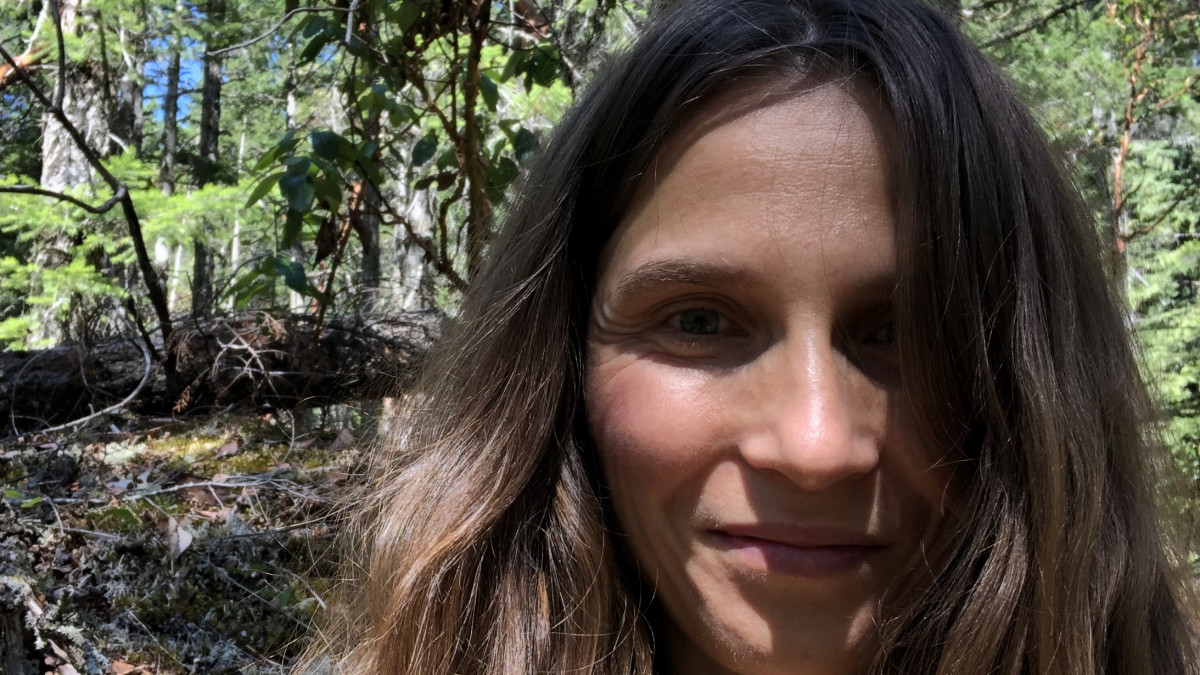
Milena A. Guziak photographed outdoors among trees
Milena A. Guziak · Founder of The Mindful Tourist®

A little about the person behind the work

Meet Milena A. Guziak

MChem · PhD Eng · MSc Psychology

Founder of The Mindful Tourist® and the Shinrin-Yoku Association, Milena brings together a background in chemistry, applied physics and psychology with years of experience in Japan, nature connection, Shinrin-Yoku, mindfulness, meditation and reflective writing.

Her journey has not followed one straight path. What once appeared to be separate interests has gradually revealed connections — between scientific inquiry, direct experience, the natural world and the changing experience of being human.

The Mindful Tourist is not simply about travelling to new places. It is about travelling through life with curiosity, attention and a willingness to keep learning.
error: Content is protected !!
Text size
100%
New Research Publication ✦ When Does Nature Become Therapy? ✦ Shinrin-Yoku · Forest Bathing · Forest Therapy ✦ Read the Scientific Article → ✦
Member Login Login