Does Forest Therapy Actually Work, or Do People Simply Feel Better Because They Expect To?
How can we distinguish the effects of forest exposure from movement, rest, social interaction and psychological expectations?
7.1 · It Does, and It Doesn't — What Does "Work" Mean?
My first response may sound contradictory, but it depends upon what we mean by the word work.
Are we asking whether a forest visit reduces perceived stress, changes cortisol, supports attention, improves mood, influences clinical symptoms, or strengthens nature connectedness?
These are different outcomes. Scientific evidence supporting one does not automatically establish effectiveness for another.
A person may enter a forest to walk, cycle, rest, take photographs or join a structured Shinrin-Yoku session.
In all these situations, the individual encounters an environment with particular biological, chemical, physical and sensory characteristics.
The forest continues functioning regardless of whether the person intends to experience something therapeutic.
But environmental exposure does not guarantee a beneficial physiological or psychological outcome.
7.2 · The Forest, Movement, Rest and Social Interaction
Imagine two people walking for the same length of time.
One walks through a forest, while the other walks through a city.
Both may receive benefits associated with physical movement and temporary relief from daily responsibilities.
However, their environments differ in visual patterns, sounds, temperature, air quality, vegetation and other characteristics.
How can we distinguish which element contributes to a particular outcome?
Researchers may compare forest and urban conditions while attempting to match activity, duration and other variables.
Yet even carefully designed studies may struggle to isolate every environmental influence.
Social interaction adds another layer. A supportive friend may contribute to a meaningful experience.
But an uncomfortable social encounter may instead increase stress.
The forest, physical activity, social circumstances and personal expectations can interact.
This is why I prefer to examine the experience as a complex interaction rather than attribute every change to one therapeutic agent.
7.3 · What If Two Friends Have an Argument in the Forest?
Consider two friends visiting a forest together.
During their walk, they disagree, and the conversation becomes emotionally intense.
Their stress responses may become activated. Heart rate may increase, attention may narrow, and their emotional states may change.
Yet the forest remains present.
Does the surrounding environment prevent the stress response? Not necessarily.
Could it influence the magnitude or duration of that response? Possibly.
But to investigate this, we would need to consider their physiological condition before entering the forest, what happened during the disagreement, and how they recovered afterwards.
Cortisol is particularly interesting because its concentration changes naturally throughout the day.
It is also influenced by sleep, activity, illness, medication and numerous other factors.
A lower cortisol value after a forest visit does not automatically prove that the forest caused the reduction.
7.4 · Expectations, Placebo and Subjective Experience
We should distinguish expectations from placebo effects and from broader placebo responses.
Expectations concern what people anticipate before an experience.
Someone attending forest therapy may expect to feel peaceful because of previous experiences, advertising or information from the guide.
These expectations may influence perception, attention and reporting.
Placebo effects involve psychological mechanisms associated with the treatment context, including expectation and learning.
Broader placebo responses may also include natural fluctuations, regression toward the mean and other influences.
Therefore, we cannot conclude that a participant's improvement is simply a placebo effect because they expected to feel better.
Nor should expectations be dismissed as imaginary. Psychological processes are part of human biological experience.
The challenge is to understand their contribution without assuming they explain every outcome.
7.5 · Guided versus Independent Forest Experiences
A guided Shinrin-Yoku session introduces elements that may not be present in an independent visit.
These include structured invitations, professional preparation, group facilitation, communication, pacing and participant expectations.
But professional guidance does not automatically establish a more therapeutic experience.
Someone exploring independently may experience restoration, emotional connection or meaningful personal reflection.
Conversely, a guided group may include social dynamics that some participants find uncomfortable.
The research question is not simply whether guided forest therapy works.
It is whether guidance contributes additional benefits, under what conditions, and for which people.
This distinction is important when assessing professional claims and the value of guided services.
7.6 · What Can We Conclude from the Evidence?
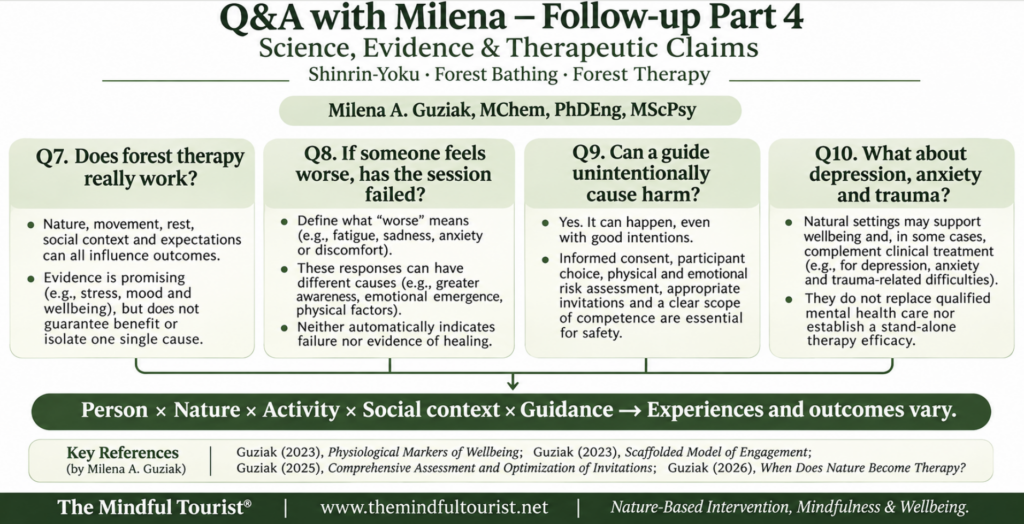
Scientific reviews report promising psychological and physiological outcomes associated with forest exposure and certain structured forest-based interventions.
Yet study quality, heterogeneity, participant expectations, incomplete blinding and limited long-term follow-up remain important concerns.
We should therefore be careful about promising particular outcomes.
A forest experience may support stress reduction, attention, restoration or nature connectedness.
But it may also be neutral or uncomfortable for a particular person under particular circumstances.
The appropriate conclusion is not that forest therapy never works, nor that it always works.
Rather, it has potential benefits that must be interpreted in relation to the individual, environment, activity and evidence available.