Is a Forest Necessary for Shinrin-Yoku?
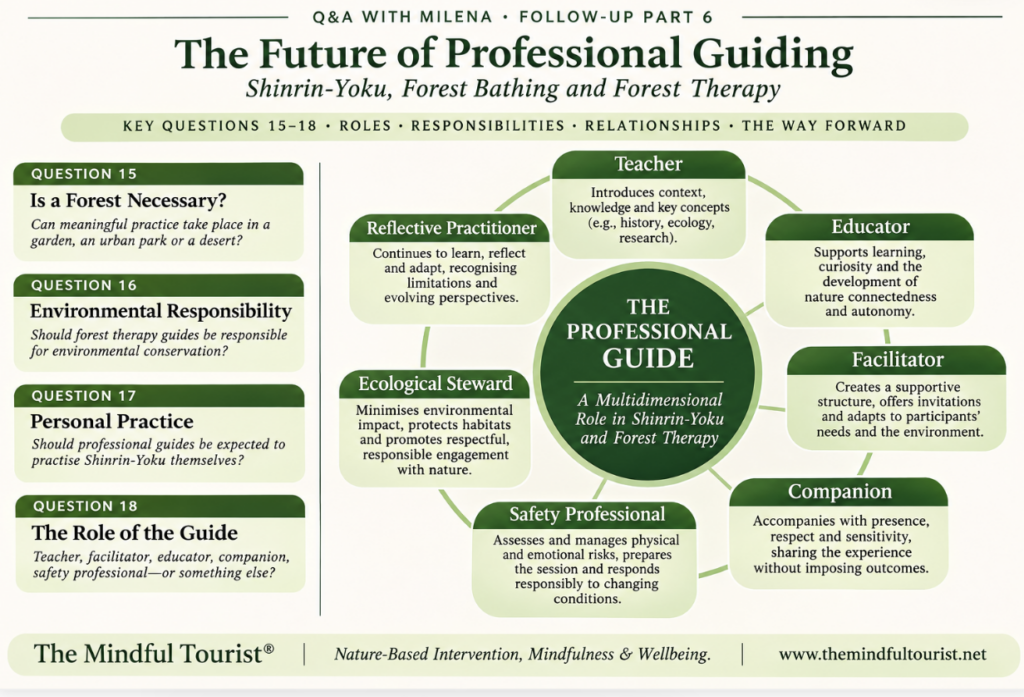
Can meaningful practice take place in a garden, urban park or desert? And how do we distinguish forest-specific practice from broader nature connectedness?
15.1 · What Do We Mean by Practice?
Before discussing the environment, I think we should examine the meaning of the word practice.
Someone may participate in one professionally guided session. Another person may visit a forest independently every week.
Both may experience meaningful encounters, but they are not necessarily engaging in identical activities.
Practice may involve frequency, repetition, continuity, intention and integration into everyday life.
Yet repeated exposure does not automatically establish a particular quality of attention or emotional connection.
A person may walk through a forest daily without consciously reflecting upon it.
Another may experience a meaningful encounter during one short visit.
These distinctions are explored in my research on modalities of spending time in forests.
15.2 · Guided and Independent Shinrin-Yoku
Professional guidance is not a necessary condition for meaningful forest engagement.
A person may spend time in a forest independently, with attention, curiosity and personal meaning.
A guided session introduces additional elements, including preparation, invitations, facilitation, professional support and group interaction.
These elements may influence the experience, but they do not guarantee superior outcomes.
We should therefore distinguish the forest encounter from the professional methodology used to facilitate it.
15.3 · Why the Forest Environment Matters
The Japanese term Shinrin-Yoku includes the word shinrin, meaning forest.
In this sense, the forest is not simply an interchangeable background.
A forest environment has physical, chemical, biological and sensory characteristics that may differ from those of gardens, urban parks or deserts.
Important characteristics can include vegetation density, canopy structure, temperature, humidity, air composition, sunlight, sound and ecological interactions.
My research on physiological markers and forest volatile organic compounds examines why such factors matter.
Yet the presence of trees does not guarantee therapeutic effectiveness.
We need to distinguish environmental exposure from a claim about a specific health outcome.
15.4 · Urban Forest Bathing in Japan
The Japanese concept of urban forest bathing, toshi shinrin-yoku (都市森林浴), introduces another dimension.
Research associated with Chiba University's Nature Therapy Laboratory considers a broad range of nature-related experiences in urban contexts.
These may involve parks, gardens, balconies and nature-derived stimuli.
However, this does not mean every urban environment provides the same exposure as a forest ecosystem.
We should consider what the actual environment contains and what research question is being investigated.
Is the study examining forest atmosphere, general green-space exposure or a particular sensory methodology?
These distinctions are scientifically important.
15.5 · Gardens, Parks, Deserts and Nature Connectedness
I strongly believe that meaningful nature engagement can occur beyond forests.
Gardens, urban green spaces, grasslands, mountains and deserts can all offer opportunities for sensory attention, curiosity and personal relationships.
Living in Mendoza has made this distinction particularly meaningful to me.
The arid environment contains its own ecological complexity, including drought-adapted vegetation, seasonal changes, soils and geological features.
A meaningful experience in a desert is not inferior to an experience in a forest.
But I would describe it more accurately as nature connectedness practice rather than automatically calling it Shinrin-Yoku.
This is one reason I am developing broader Nature Connectedness Guide Training TMT®.