The Paradox of Formlessness and Form
Reflections on Unity, Separation and Consciousness
Today is Day 487 of my meditation journey. Having recently completed a research article examining aspects of my meditation journal through phenomenological self-inquiry, I feel that something has begun to shift within me. I find myself returning to questions I have asked repeatedly throughout this journey, but now I approach them from a slightly different perspective. The questions themselves have not changed significantly. What seems to be changing is my relationship with them, and perhaps my understanding of what I have been experiencing all along.
Throughout these 487 days, as I recorded my daily meditation experiences, I often felt that I was not entirely the one producing the words. There were moments when writing seemed to happen through me rather than being consciously constructed by me. I have often described this sensation as channeling, because that is the closest word I can find for the experience. It felt as though I was temporarily connected to something beyond my ordinary sense of self, something I perceived as an omnipresent and ultimate consciousness. During those moments, I experienced a certain distance from the process of writing, as though the words were emerging without the usual effort of deliberate thinking. Whether this was an altered relationship with my own cognitive processes or something that I do not yet understand remains an open question. What I can say is that the experience was real to me, even if its underlying nature remains uncertain.
The experience of unity and separation has been one of the most persistent themes throughout my meditation journey. There have been moments when the experience of formlessness felt extraordinarily familiar, almost as though I were returning home. In contrast, the experience of existing in a physical body, with its limitations, boundaries and individual identity, has sometimes felt profoundly strange and unnatural. I have often found myself wondering why the experience of unity should feel so familiar, while the very human experience of separation can feel so foreign. At times, the contrast between these two modes of experience has been so pronounced that I have struggled to reconcile them.
There have also been periods when the longing for unity became particularly persistent, to the point that I questioned my desire to continue existing as a being with a physical form. This is perhaps one of the most difficult aspects of my experience to understand and articulate. The longing was not merely for silence, peace or temporary relief from the demands of everyday life. It felt like a longing for something fundamental, something I could recognize experientially but could not fully explain. Yet I must also ask whether the sense of returning home is itself an interpretation created by my mind, informed by memories, emotions and previous experiences. The intensity of a feeling does not necessarily establish the truth of the explanation I give to it.
What makes this inquiry particularly challenging is that the feeling of not entirely belonging to this world did not begin with meditation. As far back as I can remember, even during childhood, there was a persistent sense that something about the reality in which we exist was strange. I often felt that I did not quite belong, although I could never explain what that meant. It was not simply a question of belonging to a particular society, culture or place. It was something more fundamental, concerning the experience of existing as a human being at all. Meditation has brought this longstanding feeling into clearer awareness, but I cannot say that meditation created it.
Over the past three days, I recorded three questions that seem to capture the essence of this inquiry.
Day 484 — November 19, 2026
Why would consciousness manifest as a human being, experience itself as separate, and then long to return to unity?
Day 485 — November 20, 2026
If consciousness is already complete, infinite and undivided, why should it appear as countless separate beings, each experiencing life through a limited body and mind?
Day 486 — November 21, 2026
And if unity is our original nature, why should we experience separation so convincingly that we spend much of our lives searching for something we seem to have lost?
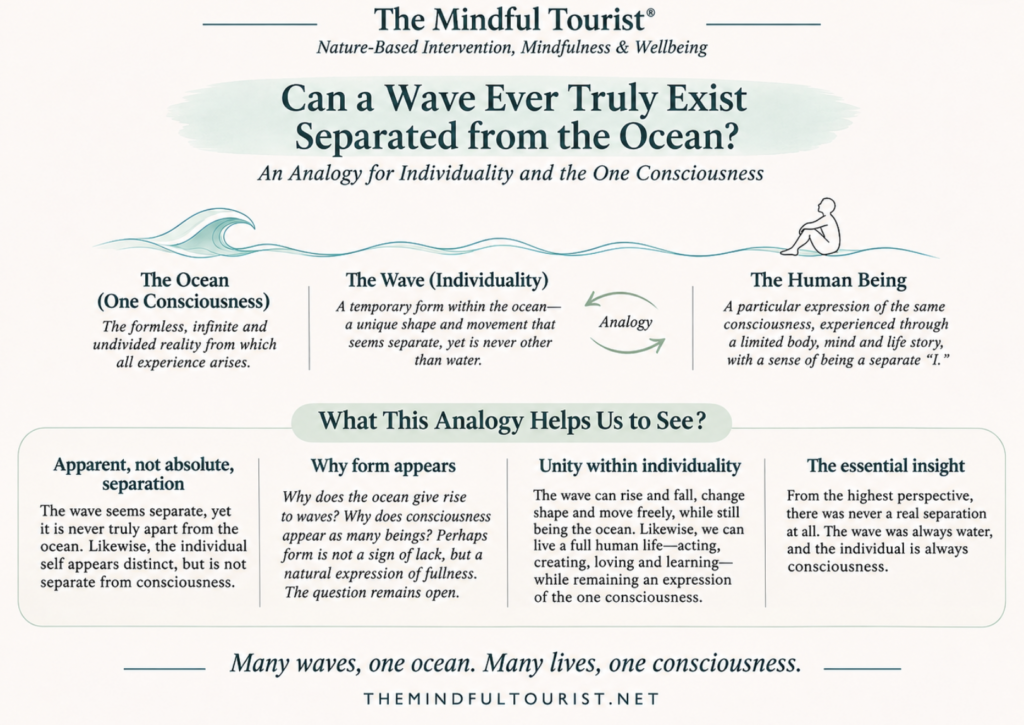
Today, these questions lead me toward another possibility. What if separation never truly occurred? What if the experience of being an individual does not necessarily establish that we are fundamentally separate from the whole? I find myself returning to the proposition that the appearance of individuality does not necessarily imply the reality of existential separation.
We ordinarily experience ourselves as particular individuals. We have names, histories, relationships, memories, fears, preferences and responsibilities. We occupy a particular place in the world and perceive everything else from the standpoint of that location. Our bodies establish boundaries, our senses provide limited perspectives, and our minds construct narratives through which we recognize ourselves as distinct persons. Yet does the existence of these distinctions necessarily mean that we are separate at the most fundamental level of reality? Or could individuality be one particular expression of a reality that remains undivided?
This distinction changes the meaning of spiritual liberation. If separation were real, liberation would require reconnecting two things that had become divided. But if separation exists only as an appearance, liberation would not involve creating unity. It would involve recognizing a unity that was never absent. I find this possibility both compelling and difficult to comprehend. It challenges the very foundation of how I ordinarily understand myself and the world.
Perhaps the greatest challenge is that separation is not simply an intellectual belief that can be abandoned through philosophical reasoning. It is something we experience continuously. The body has limits. The mind distinguishes between self and other. We experience distance, time, longing, uncertainty and loss. Even when I intellectually consider the possibility that separation is only apparent, the experience of being a limited individual continues. How, then, can these two seemingly contradictory dimensions coexist? Can I recognize the possibility of an undivided reality while fully accepting the particular human life I am living?
Perhaps I have been approaching the question from an assumption that itself requires examination. I have often thought of unity and separation as two different states, one of which feels like home and the other like an unfamiliar place. But what if they are not two realities between which I move? What if what I call unity and separation are different ways of experiencing or interpreting the same existence? Could the experience of formlessness arise without requiring the rejection of form? Could I learn to understand the limitations of being human without regarding those limitations as evidence that something has gone wrong?
And another question emerges here… If consciousness is already complete, why would it manifest as form in the first place? Why should something unlimited appear as something limited? Why should an undivided reality be experienced through countless individual perspectives? Is there a purpose to this apparent multiplicity, or does the question of purpose arise only because the human mind seeks reasons for everything it encounters?
I cannot answer these questions today. I am also becoming increasingly aware of the distinction between experiencing something, interpreting that experience and claiming to know the ultimate nature of reality. My meditation experiences have provided material for inquiry, but they do not necessarily provide definitive answers to metaphysical questions.
After 487 days, I find myself returning to the same fundamental mystery that has accompanied me for much of my life.
Why would consciousness manifest as form if it is already complete?
I must ponder this a little longer.